



A Sanskrit subashita dictates that some things must be kept secret and shouldn’t be spoken about in public. They include age, wealth, mantra, problems in one’s home, sex, medicine, insults, austerity, and charity:
आयुर्वित्तं गृहच्छिद्रं मन्त्रमैथुनभेषजम्।
अपमानं तपो दानं नव गोप्यानि यत्नतः॥
Our erstwhile “youth icon” Rahul Gandhi, despite his newfound love for his “Hindu roots”, would do well to spend some time reading the ancient texts that form the basis of this philosophical way of life. Perhaps he would then not indulge in what those in the West call “airing dirty laundry”.
I am not referring to his infamously embarrassing gaffe at the book launch of his mother’s memoir, which is now a meme on Instagram and X. Nor am I referring to his immaturity.
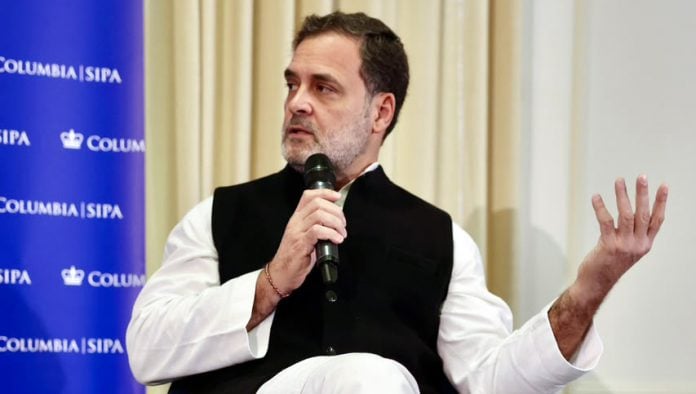
Rather, I am referring to Gandhi’s constant need to paint Bharat in a bad light, seeking validation from I don’t know who, especially in spaces that are supposedly “intellectual”.
In my column last week, I countered his missive from Columbia University that India is facing an economic disaster. On 19 November, during an interaction with students at the University of Chicago, Gandhi yet again made a factually incorrect statement describing India as a “side player” in global affairs. He based the argument on the immediate example of Pakistan’s involvement in discussions between the US and Iran, with India “watching” on the sidelines.
“You really think geopolitics is going to work because the guy is your friend,” Gandhi said.
I would like to remind Gandhi that it was Prime Minister Narendra Modi who pitched for a truce and the reopening of the Strait of Hormuz in June 2026 during his meeting with Trump. The Iranian president has also called upon Modi to seek India’s help in ending the war.
On 20 November, Gandhi shared a photo of Trump, Xi, and Putin on the sidelines of the Shenzhen APEC Summit on X, writing: “If Congress were in Power, India’s PM would be sitting at this table. A compromised PM could never sit at this table.”
I would be happy to separate the facts from Gandhi’s creative interpretation of them.
This was a meeting of the APEC (Asia Pacific Economic Cooperation), a cooperative, multilateral trade forum established in November 1989, with its 12 founding members deeply integrated with the Pacific Rim. In 1989, India was a closed economy and under the leadership of former prime minister Rajiv Gandhi. Rahul’s ‘daddy ji’ was reluctant to join any free trade forum, where there would be pressure on India to open up its global economy. The Gandhi scion can check these facts; they are in the public domain. Since Rajiv was India’s prime minister until December 1989, is he the “compromised PM” referred to in his son’s tweet?
No new members have been added to APEC since 1998, despite India’s push for inclusion. The IK Gujral-led United Front government, which was given external support by the Congress, remained in power until 1998, and by the time BJP’s Atal Bihari Vajpayee came to power, India had missed the proverbial boat on APEC. I reiterate, is Gandhi Jr referring to Gandhi Sr as the “compromised PM”?
US proposes, Nehru disposes
Based on the prevailing geopolitical position in 1945, India was a founding member of the United Nations and signed the UN Charter on 26 June 1945. The original five seats were allocated through power politics and military calculations after the Second World War. The UK, the US, Germany, the Soviet Union, and the Republic of China were given permanent seats. India’s non-sovereign status as a colony of Great Britain did not allow for a leading role. The five permanent members were selected as the principal powers whose participation was considered essential to maintaining the post-war international security system.
However, in August 1950, the US explored the possibility of India replacing the Republic of China as a permanent member on the Security Council.
The Cold War and the communist victory in China in 1949 had changed Asian geopolitics. The US was concerned about Communist influence in Asia, and India, with its democratic government and strategic position, was seen as a potentially useful counterweight. Professor Anton Harder’s working paper, ‘Not at the Cost of China: New Evidence Regarding US Proposals for Nehru for Joining the United Nations Security Council’, sheds some light on Jawaharlal Nehru’s actions.
India’s ambassador to the US and Nehru’s sister, Vijaya Lakshmi Pandit, informed Nehru that American officials John Foster Dulles and Philip Jessup had raised the possibility of removing China from its permanent position and replacing it with India. Nehru rejected the idea outright. On 19 July 1950, he wrote to the US Secretary of State Dean Acheson stating that India’s policy was to support the UN and that seating the new Chinese government was essential to that objective. His argument was that China, irrespective of a communist government, was a major country and had to be represented in the international security system.
Nehru’s actions were akin to shooting oneself in the foot. Who can ever forget his “Hindi Chini Bhai Bhai (Indian-Chinese brotherhood)” slogan? What happened after that is found in every CBSE history book in the country. Compromised much?
Also read: BJP’s youth brigade falls by the wayside as defectors take centre stage
India and the UN, again
On 22 June 1955, Nehru met Soviet leaders Nikolai Bulganin and Nikita Khrushchev in Moscow. The meeting minutes are available in the Nehru Archive and are particularly revealing. Bulganin told Nehru that the Soviet Union was considering proposing India’s inclusion as the sixth permanent member of the Security Council at a later stage. India would have its own seat, independent of China.
Nehru did not want India to replace China. He was opposed to India pushing itself forward for a position that might create diplomatic difficulties. He believed that China’s representation needed to be settled first and did not consider it the right time to revise the UN Charter. Bulganin agreed.
Rahul Gandhi should read his great-grandfather’s thoughts before making irresponsible comments from a Western stage.
India as a side player?
India’s campaign for permanent membership of the UNSC has been actively pursued under the Modi government since it came to power in 2014. While the demand predates it, the government has elevated the effort through sustained diplomacy. In 2015, Modi convened G4 leaders Brazil, Germany, and Japan to push for reform. The US explicitly endorsed India’s candidature in 2015, and reaffirmed its support in 2023. Russia reiterated its support the same year. India has continued working through the G4, L69, and UN reform negotiations. In 2023, the G4 proposed six additional permanent seats.
The seat remains elusive, but claiming India has a “compromised PM” who has made no effort is a total and outright lie.
The chronology of events in November 2026 offers a particularly telling counterpoint to the allegation that India has become a “side player” in global affairs. On 16 November, India was actively engaging at the UN, participating in discussions on multilateral cooperation and the evolving international order. On 17 November, PM Modi was in Manila for a series of consequential diplomatic engagements, including the ASEAN India Summit, the East Asia Summit, and the Quad Leaders’ Summit. This brought India into strategic conversations on Indo-Pacific Security, maritime cooperation, technology, and regional stability, alongside some of the world’s most influential powers.
On 19 November, Gandhi described India as a “side player” in international affairs. Yet, practically, India was demonstrating the very opposite through its sustained diplomatic engagement across multiple platforms.
On 20 November, New Delhi hosted the SCO Civilisational Dialogue Forum, bringing India’s civilisational heritage and intellectual traditions into a contemporary, multilateral conversation. This sequence is difficult to reconcile with the narrative of diplomatic marginalisation. Global influence cannot be measured by whether India participates in one particular international negotiation. It must be assessed through the breadth of the country’s partnerships, its ability to convene nations, its contribution to multilateral institutions, and its capacity to shape conversations across competing geopolitical blocs, from G20 to BRICS to the Global South Summit to BIMSTEC.
Also read:Hasina’s return and rising unrest leave Tarique Rahman with little choice but the July Charter
Compromised PM-in-waiting
Pakistan has often used Gandhi’s statements to promulgate its own agenda. In August 2019, Pakistan’s then-human rights minister cited Gandhi’s remarks on Jammu and Kashmir in a letter to the UN, which were then included in Pakistan’s dossier. In February 2022, Pakistan’s foreign office referred to Gandhi’s parliamentary criticism of the Modi government’s Pakistan and China policy. In May 2024, Pakistani minister Fawad Hussain publicly amplified Gandhi’s election speeches and endorsed his political messaging. In June 2025, Pakistan’s defence minister Khawaja Asif publicly invoked Gandhi’s criticism of Modi, using the LoP’s remarks about Operation Sindoor to reinforce the Pakistani narrative that India had been forced into a ceasefire. And after the recent “side player” remark, The Express Tribune in Pakistan prominently amplified Gandhi’s comments, reporting them as evidence of India’s diminishing geopolitical influence.
One question remains unanswered: Who or what is behind Gandhi’s narrative? As a former minister of state for external affairs, I know a little about geopolitics, and my assessment is that Gandhi is not making random statements, but is probably covering up some other picture of his family members. I wonder how he is considered an expert on the subjects where his work needs to be tested. Nepo baby or compromised LoP, the jury is still out.
Returning to my opening argument, ghar ka bhedi Lanka dhaye. A person who has no qualms about sharing the intimate secrets of his family can hardly be expected to maintain the sanctity of his own country.
(Edited by Prasanna Bachchhav)