



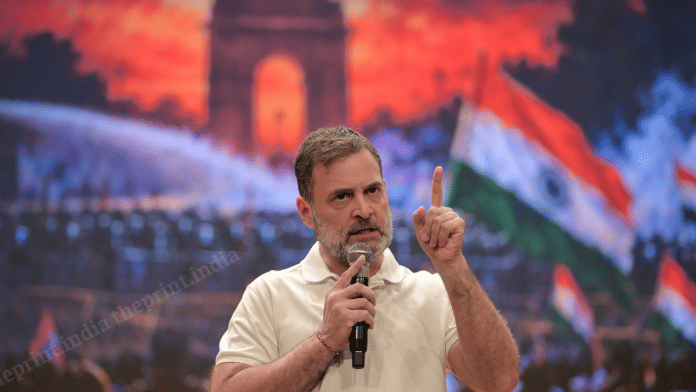
On the day that Rahul Gandhi held his “summit” in Hyderabad, the Press Information Bureau released a report containing the latest data on India’s export growth for 2026-27. The numbers appear robust, and there is cause for cheer that PM Modi’s push for Make in India, Make for the World seems to be paying off.
The idea behind PM Modi’s Make in India, Make for the World vision was that India should become a global manufacturing hub, much like in ancient and medieval times, when India traded with the world and manufactured goods for international markets. A reliable supplier of goods and services to international markets is what the world needs, and India can very well take on that mantle.
The report states that India’s “Exports record seven consecutive months of Year-On-Year Growth”, with exports rising by 16.6 per cent to USD 568.84 billion during the period April to October of the financial year 2026-27. The report further mentions that “this complements India’s broader economic progress, marked by 7.8 per cent GDP growth in April-June and unemployment declining to 5.1 per cent.”
India is actually going through a period of economic stability. Kristalina Georgieva, Managing Director of the IMF, has been referring to India as a “bright spot” and an “efficient growth engine” in the global economy. Effective reforms in taxation, roads, and digital infrastructure have contributed to achieving this success.
Julie Kozack, Communications Director at the IMF, said in November that “India does remain a key growth engine for the world”. In October, the World Bank stated that India “remains one of the fastest-growing major economies in the world and a key contributor to global growth”.
Swedish economist Daniel Waldenström, speaking at October’s Kautilya Summit, remarked, “India is on a good path to increasing its economy at a fast pace”. American economist Jeffrey Sachs commented that India is already the third-largest economy in terms of purchasing power and remarked that “it will overtake the United States in my opinion”, with the disclaimer, “if it does the right things”.
Economic historian Niall Ferguson noted that “it is striking how India has performed”. Just yesterday, Joseph E. Stiglitz expressed optimism about India’s long-term economic potential at the Hindustan Times Summit, claiming that India has enough domestic demand and room to sustain economic growth of 7 per cent.
And yet, the Rajkumar of rhetoric, Rahul, continues to spread vicious lies, for reasons I fail to understand. He has often accused India of being “chewed” by the deep state, and this month itself has accused PM Modi of relying on foreign support and claimed that his financial and political interests are backed by foreign considerations.
I sometimes wonder to myself: is it possible that Rahul Gandhi himself is a member of the Deep State? Otherwise, why would he make statements that could push even the biggest detractor to actually vote for Modi?
I would like to address some of the lies that are being bandied about by Rhetoric Rajkumar and refute his allegations point by point.
Economic state of India: Collapse or continued growth?
At the Bharat Summit in Hyderabad, Gandhi made a sweeping argument about the state of the Indian economy. He linked what he described as the collapse of “India’s economic model” to the concentration of wealth, the alleged nexus between political and corporate power, and the weakening of democracy.
Rahul said, “The economic model that worked for us has failed. It no longer works and will never work”.
Of course, Rahul is much smarter and more well-versed in economics than all the so-called “experts” quoted above, having secured admission to St Stephen’s College on a sports quota for a history major, then dropping out to attend Harvard, and again dropping out from Harvard to join a liberal arts college in Florida, Rollins College, ranked 377th in Forbes’ 2027 rankings, to complete a degree in an undisclosed major (possibly International Relations and Economics).
India’s economic “collapse” linked to excessive liquidity
Gandhi then said, “When it (the economy) collapsed, a massive amount of money was printed, huge liquidity was created, and that liquidity devastated our political system”.
This is an important part of his argument, and he was suggesting that the creation of massive liquidity, following the failure of the economic model, had fundamentally altered political financing and power structures.
However, he did not explain: a) which specific economic model he was referring to; b) when this model supposedly collapsed; c) which institutions or authorities printed the money; d) what monetary or fiscal data supported his assertion; and e) how the creation of liquidity translated into the alleged distortion of political finance.
I would like to know the timeline of these claims and the names of the Finance Minister and Prime Minister in office at the time.
The data and evidence show that India went from the Fragile Five (a term coined by Morgan Stanley to label five emerging economies) in 2013 to the Fab Five. In 2026, India has emerged as the world’s fastest-growing major economy.
Our Prime Minister was called a chaiwala in a derogatory manner by Congress leaders, and I remember retorting to it as a Party Spokesperson in 2013 by saying, “Hum chai bechte hain, imaan nahi” (We sell tea, not our integrity).
He embraced this insult as a badge of honour and proved that common sense and traditional wisdom can go a long way towards making India a more prosperous nation.
In addition, today he is surrounded by economists of the calibre of Prof. S. Mahendra Dev, Dr Shamika Ravi, Dr Rakesh Mohan, Dr Sajjid S. Chenoy, Dr V. Anantha Nageshwaran and other eminent financial experts. And the economic trajectory that India has seen in the 13-odd years of BJP rule is beyond commendable.
The extreme poverty rate in India went from 27.1 per cent in 2011 to 2.6 per cent in 2023-2024, according to the World Bank’s revised poverty estimates. An estimated 496 million people have been lifted out of poverty, as per a World Bank report.
Even an uneducated person can read the numbers, and after all, Rahul Gandhi has an MPhil from Cambridge.
Shifting sands
Gandhi’s argument then shifted from macroeconomic theory to the alleged nexus between Modi and Adani. For the uninitiated, opposition leaders, critics and anti-establishment news agencies have drawn a connection between the Prime Minister and industrialist Gautam Adani through allegations of ‘crony capitalism’, claiming that Adani’s rise in the billionaire rankings is a result of the PM favouring the Adani Group.
Whilst there is no direct evidence linking the two, and arguably the other richest Gujarati in the world has also been awarded several infrastructure projects and a private zoo, I would say that when businessmen take risks to invest in projects for the benefit of the country, they are also entitled to reap the benefits of those risky investments.
Rather than begging foreign governments to expand our much-needed airport, port and railway capacity, it is far more sensible to depend upon the local businessman who, at the end of the day, has his own country’s interest at heart.
Apart from the fact that we aren’t China, where the government runs businesses, businesses in India have to be run by businessmen. The government can only facilitate, create an enabling environment, and make policies in the interest of the country.
Also read: Rahul Gandhi & his besties should verify electoral rolls instead of wasting time protesting
Friends with benefits
Meanwhile, Gandhi’s own father, Rajiv Gandhi, rewarded his Doon School cronies with lucrative business benefits. It is common knowledge that the Doon School Cabinet, or the Doon Goon Squad, was the inner coterie who advised Gandhi senior on everything from politics to Sonia.
Mani Shankar Aiyar, a prominent diplomat and Congress politician; Arun Singh, who served as a key adviser and Defence Minister; Suman Dubey, press adviser; Kamal Nath, whose nephew founded Moser Baer and who is associated with several lucrative businesses, were among the figures associated with this circle.
Rajiv Gandhi’s close associate and friend Lalit Suri was awarded prime land near Modern School to set up what is now known as the Lalit. His brother Sagar Suri was a builder who “somehow” managed to get his 10-storey building, Sagar Apartments, approved.
The Suri brothers were awarded one of the first agencies for the much-coveted Maruti Suzuki, along with Raj Chopra of Competent Motors. I remember the first Maruti rolling out of the Competent Motors showroom, and the key was handed over personally by Smt Indira Gandhi.
In fact, the Suri family’s meteoric rise from Fiat car dealers to major real estate, automobile and hotel magnates was believed to have been fuelled by political patronage, relaxed land laws and preferential government contracts. These allegations were also widely discussed and investigated by the media. And this is something I have been an eyewitness to.
Tatas, Birlas, Ambanis and Adanis have all contributed to India’s economic growth and have worked with governments, as in any other country. What the princeling has forgotten is that when the Congress was in power, we didn’t even have a few hundred start-ups.
Today, that number exceeds 1.5 lakh, along with more than 25 unicorns, which are all future Tatas, Ambanis, Adanis, and Birlas of the future.
So, evidently, corporate cronyism was invented in the Congress era under the Gandhis.
Fact or fiction?
The assertion that India’s economic model has collapsed is difficult to reconcile with the country’s economic trajectory and the structural transformation underway. If the model has indeed failed, how does one explain India’s continued economic growth, as highlighted by the World Bank and IMF, international agencies not owned by my Prime Minister?
Not to mention expanding digital infrastructure, rising exports, and the emergence of new manufacturing capabilities in electronics, pharmaceuticals, automobiles, and defence.
India’s ambition to move from Make in India to Make for the World reflects an effort to strengthen domestic manufacturing, attract investment, integrate into global supply chains and reduce strategic import dependence.
This is not to suggest that challenges don’t exist. Employment generation, manufacturing’s share of GDP, income inequality, and the need for greater domestic value addition remain legitimate concerns. But acknowledging these challenges is vastly different from declaring the entire economic model dead.
Similarly, concerns about corporate concentration and political finance deserve scrutiny through transparent procurement records, regulatory findings, and audited disclosures, not sweeping assertions of political-business collusion.
Economic criticism must be grounded in measurable outcomes, causal reasoning and a credible alternative. Declaring an economy dead without the economic evidence to support it is not an economic argument, just as showing how to build a more productive, competitive, and inclusive economy requires more than political rhetoric.
Another 10 years of Modi and the BJP in power will likely address these shortcomings. Not the “loot and plunder” economy.
Meenakshi Lekhi is a BJP leader and lawyer. Her X handle is @M_Lekhi. Views are personal.
(Edited by Maryam Hassan)