





I have returned to India after a brief trip abroad to promote India’s rich cultural and historical heritage. Headlines are ablaze with political unrest; Europe is burning. Illegal migrants and dissatisfied settlers are demanding rights that they have no entitlement to.
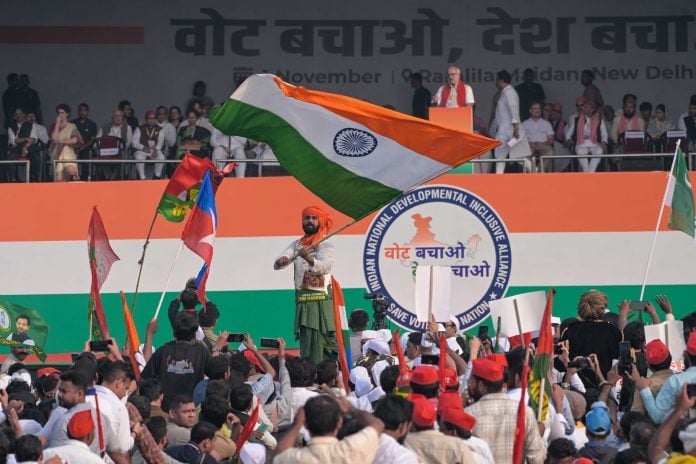
In India, the opposition has been carrying out processions against the SIR. I will attempt to clear up some of the confusion around the SIR process, the Election Commission of India (ECI), which is being targeted by a serial anarchist and his besties, and a country being manipulated and distracted from its goal of becoming a Viksit Bharat by 2047.
In a democracy, the right to question institutions, scrutinise electoral processes and protest peacefully is fundamental. Equally important, however, is the responsibility to distinguish between allegations and facts. Concerns over electoral rolls, complaints of irregularities and questions about constitutional authorities must be examined through the legal and constitutional mechanisms assigned to address them.
I say every allegation deserves due consideration, every credible irregularity warrants investigation and any wrongdoing must invite appropriate action. Ultimately, the integrity of an electoral process must be judged not by political rhetoric or competing claims, but by evidence, the rule of law and the fairness of the procedures followed.
India’s rock-solid democratic processes enshrined in the Constitution
Universal Adult Franchise is guaranteed under Article 326 of the Indian Constitution for Lok Sabha and State Legislative Assembly Elections. Every adult citizen in India has the right to vote in elections irrespective of gender, caste, creed, colour, religion or social status. It is the strongest pillar of Indian Democracy.
In fact, we can proudly say that India, the largest democracy in the world, granted every one of its citizens the right to vote from the very inception of the Republic of India; unlike its Western counterparts such as the US, where women and people of colour weren’t fully allowed to vote until 1965. Universal Adult suffrage was revolutionary in the history of Independent India, right from the beginning when India became an independent nation, and its first elections were held in 1951. It ensured social parity by providing for every Indian citizen to have a vote.
As per Article 326 of the Indian Constitution, “The elections to the House of the People and to the Legislative Assembly of every State shall be on the basis of adult suffrage; that is to say, every person who is a citizen of India and who is not less than eighteen years of age on such date as may be fixed in that behalf by or under any law made by the appropriate Legislature and is not otherwise disqualified under this Constitution or any law made by the appropriate Legislature on the ground of non-residence, unsoundness of mind, crime or corrupt or illegal practice, shall be entitled to be registered as a voter at any such election.”
Adopting the concept of ‘one citizen, one vote’, is what enriches Indian democracy, and the vote is the great equaliser. But One Citizen is entitled to only one vote, not more and not less. Hence the need for SIR.
Special Intensive Revision
Section 21 of the Representation of the People’s Act 1950 clearly lays out that the ECI has the task of maintaining up-to-date electoral rolls in “each constituency” of the nation. As per Section 21(2)(a), the electoral rolls are to be revised “in the prescribed manner” before each round of elections to the Lok Sabha (lower house of Parliament) or the State Legislative Assembly Election, and also before each by-election.
The rolls are to be revised specifically in accordance with statutory rules which are clearly laid out in the Registration of Electors Rules 1960, “in the prescribed manner”. In both 1950 and 1960, the Indian National Congress was in power. And these rules were set in stone long before the BJP ever came to power.
Section 21(2)(b) states that the electoral roll:
“shall be revised in any year in the prescribed manner by reference to the qualifying date if such revision has been directed by the Election Commission”
21(3) states:
“Notwithstanding anything contained in sub-section (2), the Election Commission may at any time, for reasons to be recorded, direct a special revision of the electoral roll for any constituency or any part of a constituency in such manner as it may think fit:”
Why is an accurate electoral roll important?
“Free and fair elections are a basic structure of the Constitution,” said the Supreme Court in its October 2026 judgment. In order to conduct free and fair elections, the foundation stone, the list of voters eligible to vote, needs to be solid. No person is eligible to have more than one vote. And a person’s name is not to be registered in more than one place. This is not lawful or legal.
I have noticed this during elections in my constituency, New Delhi. So many voters who had been transferred, moved out, or relocated (New Delhi has a strong base of transferable government officers) had not bothered to get their names removed from the voter list, and of course they would not return just to exercise their right to vote in a constituency where they were no longer living.
In many cases, deceased people remained on the electoral rolls. Remember, a living citizen has the right to vote, not a dead one.
My team once overheard a neighbourhood driver boasting that he had registered to vote in Delhi but also retained his vote in his village in Bihar and would return home to cast his vote during various local elections, thus availing any freebies that were offered by different parties to “persuade” him to vote.
In an age of digital Aadhaar, UPI payments and instant calling, it would be criminal to allow such malpractices to continue; therefore, the onus is on the government in power to ensure that the electoral rolls are clean and updated. This is the first step to ensuring free and fair elections.
History of SIR and other such stories
Intensive revisions of the electoral rolls have been conducted in the period 1952-1956, 1957, 1961, 1965, 1966, 1983-1984 and 2002-2004. Fun Fact: the first electoral rolls that were created for the first General Elections were themselves flawed and left many eligible voters disenfranchised for a multitude of reasons, including remoteness and inaccessibility of some regions, female voters who didn’t give their own identity independent of their husbands, limitations of enumerators, etc.
Earlier versions of SIR involved door-to-door field enumeration where election officials visited homes and verified and identified entries, accounting for people who had died or moved away. Updated lists were then prepared by the officials and compared with previous rolls. In 2004, the ECI explicitly included comparison with previous versions of the rolls, updating of records and preparation of final draft lists.
Once the draft rolls were published, the voters and political parties could check their names, and claims and objections could be submitted. Only then were the lists finalised.
In the current scenario, at the threshold of 80 years of Independence, there is a requirement to conduct an especially intensive SIR. In Delhi, for example, a baseline year (2002) was used. If you, your parents, or your grandparents were present on those lists, there is no issue at all. If you have moved to the city after the baseline year, then you need to provide documents to show where you or your family/ had previously voted.
There’s no rocket science in this. With the kind of technology available today, this should not be an issue at all.
I remember my oldest voter ID card from my youth, when my name was spelled Meenakashi. The Electronic Photo Identity card (EPIC) was first introduced around 1993. I looked different then, and getting a voter ID made and having my photograph taken was a great experience. The BJP was not in power at the time.
The introduction of these cards was the need of the hour. Until then, without a voter ID, many people could misrepresent themselves and vote on behalf of friends or relatives. I do not recall any citizens claiming “vote chori” or creating any such drama.
The voter ID card was a revolutionary, historic moment in India’s electoral history, and credit for it goes to the then Prime Minister, PV Narasimha Rao.
How to add/relocate/remove names from an electoral list
I will again repeat my favourite line: “Ask not what your country can do for you—ask what you can do for your country.” Is it not the duty of every eligible voter and honest citizen of this country to register to vote at a voting centre near them? If you’re a first-time voter, register on https://voters.eci.gov.in/ and use Form 6 to fill in your details. Submit the respective proof and voila, you are registered. Filling out Form 6 is easier than learning how to use Instagram.
If you’re moving your residence, then you log onto the same portal and enter your existing EPIC number, fill Form 8, submit 2 address proofs from your new residence and upload the documents, and submit. The Booth Level Officer (BLO) is likely to visit you to verify the details. The Election Commission has even provided a helpline—1950.
Now, if someone has died, of course they can’t remove themselves from the electoral list. But then their legal heirs, family representative or someone else needs to fill Form 7 and remove their name from the voting list. The death certificate is required to be uploaded, and even in this case the verification will be conducted by the BLO.
Opposition objections
The prime minister-in-waiting, Rahul Gandhi, has grown tired of playing the waiting game after his party was routed in three general elections. So, every time he loses, he has a new target.
Sometimes he targets the EVMs and wants to revert to the good old days of the paper ballots, which, of course, could be manipulated through physical vote chori or booth capturing, as was common in the past.
However, Congress’ performance in the recent MLC elections, where it won 1/28 seats in elections using paper ballots, puts to rest the theory that EVMs are responsible for its electoral defeats.
Electoral outcomes in India have varied widely across parties, states and voting systems. In the 2026 Tamil Nadu Assembly election, TVK emerged as the single largest party with 108 of 234 seats and defeated the incumbent DMK-led alliance; Congress won five seats and subsequently extended support to TVK. In the 2026 Kerala Assembly election, the Congress-led UDF defeated the incumbent Left Democratic Front, winning 102 of 140 seats, with Congress alone winning 63.
The Aam Aadmi Party defeated Congress in the 2022 Punjab Assembly election; the National Conference-led alliance defeated the PDP in the 2024 Jammu and Kashmir Assembly election; and the JMM-led alliance defeated the BJP-led NDA in the 2024 Jharkhand Assembly election. Congress defeated the BRS in the 2023 Telangana Assembly election, while the TDP-led NDA defeated YSRCP in the 2024 Andhra Pradesh Assembly election. Congress also defeated the BJP in the 2023 Karnataka and 2022 Himachal Pradesh Assembly elections.
The Trinamool Congress defeated the Left Front in West Bengal in 2011, 2016 and 2021, winning three consecutive Assembly terms. Congress defeated the BJP in the 2018 Chhattisgarh and Rajasthan Assembly elections. In Odisha, the Biju Janata Dal defeated both Congress and the BJP in the 2009, 2014 and 2019 Assembly elections, before the BJP defeated the BJD in the 2024 Assembly election. These results show that parties have both won and lost under EVM-based elections, making EVMs an insufficient standalone explanation for any party’s electoral performance.
There is an old proverb: “A bad workman blames his tools.” Food for thought.
In the interest of our country and its democracy, I wish to give a guru mantra: “Booth jita toh chunav jita.” If you win the booth, you win the election.
Instead of wasting time and energy making reels at rallies, dharnas and processions, Rahul Gandhi and other Opposition parties should have spent their time verifying the electoral rolls, helping people fill out Form 6,7,8 and following other procedures to help voters and their parties. But I guess entitled politicians have different priorities!
First, the process under Section 21(3) is referred to as a “special” revision, indicating the power is an exceptional one. Second, while Section 21(2), by reference to Section 21(1), refers to revision of electoral rolls in “each constituency”, Section 21(3) refers to revisions in “any constituency or any part of a constituency,” implying a geographic limitation, i.e., the power is not for every constituency. Third, Section 21(3) requires the ECI to record its reasons for invoking the provision.
Moreover, it is to be noted that Section 21(3) refers to a “special revision”, but the current exercise is titled a “special intensive revision.” The difference between a summary revision of rolls and an intensive revision is set out in the Registration of Electors Rules. Rule 25(1) states that a revision of electoral rolls under Section 21(2) may be summary, intensive revision, or partly summary.
Rule 25(2) states that where a roll or any part of it is revised intensively, it shall be prepared afresh, and Rules 4 to 23 shall apply as they apply to the first preparation of a roll. Rules 4 to 23 set out the various procedures and safeguards the ECI and its agents must abide by when revising rolls. Rule 25 expressly governs revisions under Section 21(2) and the rules will be read in totality and be applied to special revision ordered under Section 21(3). Election Commission is an independent agency and is vested with powers under the law to establish procedures for a fair election.
Also read: Neha Bora must file a peace bond. Gen Z should demand it as an act of good faith
Opposition’s issues with SIR
The opposition has multiple arguments against the SIR exercise. Some objections concern constitutional powers, others concern practical risks of disenfranchisement, still others allege political intent. I will attempt to address them all.
The most consequential legal development is that on 27 May 2026 the Supreme Court upheld Bihar’s SIR, rejecting the broad challenge to its legality. It held that the ECI had the authority to conduct the exercise, that its measures were proportionate overall and that it could undertake a limited enquiry into citizenship for electoral eligibility. That ruling does substantially weaken the argument that SIR is inherently unlawful. It does not establish that every deletion was correct or that every implementation decision was beyond criticism.
We must remember that no system is ever perfect. The SIR exercise rests on the able shoulders of its foot soldiers who are, at the end of the day, human. And human error is most definitely a thing. So far, the Election Commission’s stated position is that AI is not used to prepare the electoral roll; however, as dependency on AI increases in the world at large, it could be pressed into use to manage the 1.4 billion citizens of this country and their ability to vote. Case in point: the 97 voters in Goa, where steps have been taken to correct this through prescribed procedures.
Some numbers of Rohingyas and Bangladeshis have historically been added to the electoral rolls in states like Delhi and Jammu, and it has been electorally raised for at least 30 years.
Even in Telangana, it is alleged that there are over 30,000 foreigners wrongly registered in the voter lists, and the SIR exercise is exposing this; therefore, some parties in the opposition are objecting to the SIR and spreading misinformation.
A misleading narrative has circulated that 13 crore names have been removed from the electoral lists. In fact, approximately 13.39 crore electors were flagged or omitted from draft electoral rolls during the Special Intensive Revision under the Election Commission’s Absent, Shifted, Dead and Duplicate (ASDD) classification. The principal categories were permanently shifted electors, absent or untraceable electors, deceased electors, and duplicate entries; a smaller additional group was classified as “others.” These draft-stage classifications are not final deletions. The draft rolls and ASDD lists were published and made available for scrutiny, and affected eligible voters could seek restoration or inclusion through the claims-and-objections process. The final electoral roll is prepared only after those claims and objections are decided.
Another false narrative that is floating around is that the SIR exercise is specially designed to remove the opposition’s votes. If the opposition is using illegal ghuspetiyas to win elections or sway voter outcomes in India, only then does this statement stand true. And every responsible citizen of India should have an objection to this.
Meenakshi Lekhi is a BJP leader and lawyer. Her X handle is @M_Lekhi. Views are personal.
(Edited by Ratan Priya)