




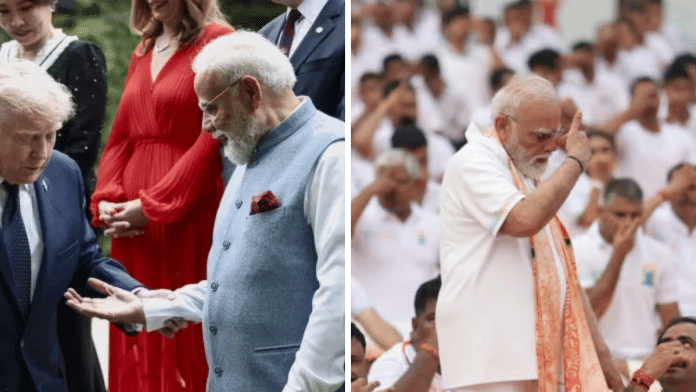

Diplomacy has many forms. From economic, cultural, and e-diplomacy to others, such as data, export, and even gastronomic diplomacy. Many of these were on display during the recent G7 meet. Last week, several world leaders gathered in France to discuss one of the most debilitating stalemates of our time, one that is making the world spin out of control.
Simultaneously, the world bore witness to one of the biggest and most visible festivals of cultural diplomacy. Prime Minister Narendra Modi, throughout his 12 years in office, has ensured that India receives its much overdue global recognition for indigenous, holistic and healthcare practices and that the summer solstice is observed as the International Yoga Day.
The juxtaposition of the two diplomatic events is striking. One reflected the quiet power of culture, whilst the other reflected the enduring relevance of dialogue. Together they underscored a fundamental truth—whether through soft power or statecraft, lasting influence is built by engagement, not confrontation.
As I write this, US Vice-President JD Vance would have arrived in Switzerland to further ratify the tenuous ceasefire pact signed by US President Trump in Versailles on 17 June.
India at G7
India has had a very public participation at the G7 Summit in Evian, with PM Modi taking centre stage at many of the events. India’s growing diplomatic importance was further reinforced as Modi attended the Outreach Session as a special invitee.
Even though India is not a formal member of the G7(formerly G6), we are regularly invited as a key partner nation. Because of India’s immense economic scale, population and leadership across the global south, the other members often actively advocate for New Delhi’s presence at the table.
India is uniquely positioned to bridge the divide between advanced, industrialised economies and emerging market economies. The country is also a champion for reform of international financial and developmental institutions, all while pushing for equitable representation for developing nations. India is also central to supply chain diversification, clean energy transitions and AI governance discussions. So it made sense why both India and G7 nations were happy to accept French President Emmanuel Macron’s invitation, because we are increasingly being viewed as an essential stakeholder in global governance.
India even brought up several relevant issues related to energy, security, freedom of navigation in the Strait of Hormuz, supply chains and regional stability in the Middle East at the 52nd summit. In fact, it was Modi who highlighted the urgency of reopening the Strait of Hormuz during his meeting with Trump last week. Modi emphasised the absolute importance of finding a reasonable solution to end the US-Iran war.
India’s reiteration for peace and diplomatic solutions has also contributed to the current truce.
Also Read: Reset, rapprochement or relief? What Modi and Trump bonhomie in France achieved
14 points of peace
The interim agreement between the US and Iran to pause hostilities and open the strait of Hormuz contains 14 points that will tentatively peace for 60 days, at least until Vance and his Iranian counterparts have time to work around the nitty-gritty for a permanent solution. The current Memorandum of Understanding (MoU) states the “Immediate and permanent termination of military operations on all fronts, including in Lebanon, and undertake from now on not to initiate any war or any military operation against each other, and to refrain from the threat or use of force against each other, and ensuring the territorial integrity and sovereignty of Lebanon.”
Immediate concessions include a complete cessation of armed hostilities, instantaneous removal of the US blockade of the Strait of Hormuz (to be completed within 30 days), mutual undertaking to respect each other’s sovereignty and territorial integrity and to abstain from interfering in the internal affairs of the other country. The MoU further states that Iran must arrange safe passage of commercial vehicles from the Persian Gulf to the Sea of Oman, without any charges or levies, and a $300 billion deal to be worked out for the reconstruction and economic development of Iran. All sanctions against Iran imposed by the West, including UN bodies, will be removed. In return, Iran has committed that it shall not procure or develop nuclear weapons.
“Until the termination of sanctions, the US Department of the Treasury will issue waivers for the export of Iranian crude oil, petroleum products, and derivatives, and all associated services, including banking transactions, insurances, transportation, etc,” the agreement read.
International consequences of the US-Iran peace pact
The tentative peace pact between the US and Iran is definitely significant. It not only brings an end to months of conflict, but its implications extend far beyond the two countries involved.
Trade routes to Europe and even North America have been under disruption for months. The reopening of the Strait of Hormuz is a crucial factor in this agreement, since one-fifth of the world’s oil container traffic passes via this body of water. The restoration of maritime traffic through this critical chokepoint has the potential to stabilise global energy markets, reduce volatility in oil prices and ease inflationary pressures across all those economies dependent upon imported oil. A phased easing of sanctions, which is what Iran has been demanding vociferously and the release of the Iranian frozen assets, will also go a long way in bringing peace to the region and the world at large.
Iran is alleged to have a Nuclear Weapons Program, which it has denied throughout. It remains to be seen if an agreement can be reached for a structured and diplomatic process to address this. Both sides so far appear to be on the same page that issues need to be sorted through negotiations across the table rather than military conflict. And this is the message that Vance seeks to send out at the Lake Lucerne summit.
“Can we change relations in the Middle East permanently, or do we go back to doing things the old way, which is not our preference, but is certainly very much something that can happen,” Vance said ahead of his visit to Switzerland.
Issues that could still derail the talks are: Israel going head-to-head with Hezbollah in Lebanon, and the elephant in the room—Iran’s “yes-you-have-it-no-we-don’t” nuclear weapons program.
Also Read: Why the G7 needs India
Benefits for India
During the conflict, India had energy anxiety as 85 per cent of our crude oil is imported. A pact to end the war ensures that India’s energy crisis ends when oil tankers can safely transit the Strait of Hormuz. Further, nearly one in five seafarers is Indian, which ensures a safe passage for merchant ships ensures the maritime safety of our seamen.
Lower freight and insurance costs and greater stability for India’s exports to the Gulf are other benefits.
One of the most significant long-term ramifications of the ceasefire is the oil trade that India has with Iran. It is not our war, and India has historically maintained cordial relations with the Middle East. The energy needs of 1.5 billion people cannot be dependent on a war that benefits only a few.
Another long-term implication is the resumption of Iran’s Chabahar port construction. India can continue investing in this strategic maritime port, which would open doors to trade with Afghanistan and the rest of the Middle East, bypass routes via Pakistan, and counterbalance growing Chinese influence through the Gwadar Port in Balochistan. This could be a strategic long-term gain from any sustained Iran-US rapprochement .
India’s geopolitical strategy of maitrata or friendship has led to widespread cordiality. Through PM Modi’s diplomatic outreach, India is friends with the Middle East, Israel, the US, Iran, and Russia. India is not conflicted to take sides if the ceasefire fails and can engage all sides without facing constant strategic pressure. This aligns well with India’s doctrine of strategic autonomy.
The Lake Lucerne Summit will determine the permanence of the process of peace. There are mainly two aspects to this process, one of course is the language of the MoU, but the second is the interpretation of that language, not only for communication, but more importantly, the implementation of the same principles on the ground for bringing permanence to the peace beyond engaging in the process of peace and discarding war.
Meenakshi Lekhi is a BJP leader, lawyer and social activist. Her X handle is @M_Lekhi. Views are personal.
(Edited by Insha Jalil Waziri)
Could Indian diplomacy have played a role in bringing about peace between USA and Iran. Ukraine, it was said, is Europe’s war. However, that does not hold true in the case of the Iran conflict. The Indian economy has paid a very high price since 28th February.