




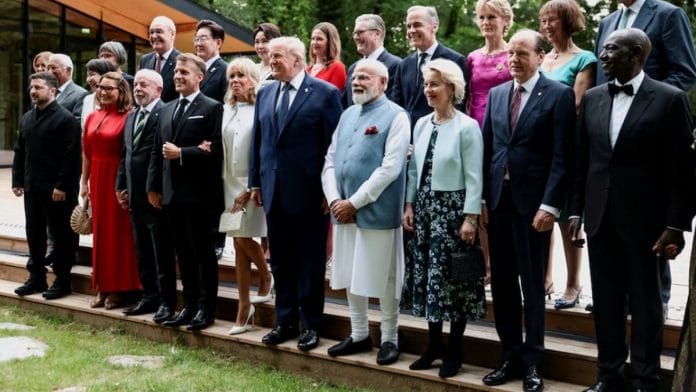

Not long ago, the G7 was widely viewed as a relic of a fading era and an increasingly irrelevant gathering of established Western powers that failed to reflect the rise of non-Western states and the shifting balance of global influence. Yet recent geopolitical crises have breathed new life into the grouping. The Russia-Ukraine war, and, more recently, the conflict in West Asia, have thrust the G7 back to the centre of international diplomacy. A platform once perceived to be in terminal decline has re-emerged as a key forum for coordinating responses to some of the most consequential security and political challenges of the 21st century.
As leaders of the G7 gathered in Évian-les-Bains, France, alongside invited partners including India, attention was firmly fixed on the outcomes relating to two unfinished regional wars in which member states have significant stakes. Since the outbreak of the Russia-Ukraine war in 2022, the G7 has been forced to confront a crisis that has fundamentally altered Europe’s assumptions about war and peace. The return of Donald Trump to the White House has further unsettled the fundamentals of the Western alliance. Yet the imperative of coordinating sanctions on Russia, financing Ukraine’s war effort, and expanding military assistance to Kyiv has injected the G7 with a renewed sense of purpose. The ongoing crisis in West Asia has only reinforced this trend, bringing issues of maritime security, nuclear non-proliferation, and energy resilience squarely to the forefront of the grouping’s agenda.
And India now matters more to the G7 than ever.
Also Read: Trump throws weight behind Modi, says both will work together on issue of seafarers
G7 cannot be a lone ranger
The G7 emerged from the 1973 energy crisis, holding its first leaders’ summit at the Château de Rambouillet in France in 1975 with six members: France, the United States, the United Kingdom, Germany, Japan, and Italy. Canada joined in 1976, while the European Community (now the EU) has participated since 1977. Russia’s inclusion transformed the grouping into the G8 from 1997 until its suspension following the Crimea crisis in 2014.
More recently, one overriding message has emerged that the G7 cannot operate alone. It continues to face a legitimacy deficit stemming from the exclusion of non-Western powers that increasingly shape twenty-first-century geopolitics. The G7’s like-mindedness and collective influence give it considerable weight on questions of war and peace, but these same attributes also invite criticism of Western overreach and a narrow lens through which contemporary international challenges are viewed. While the G7 offers speed, cohesion, and geopolitical alignment, these advantages cannot substitute for the broader legitimacy and buy-in required to address global challenges that demand the participation of major non-Western powers beyond the traditional circle of decision-makers.
India is not a fence-sitter
That is where India’s regular participation as a non-member assumes significance for both New Delhi and a G7 that has struggled to retain relevance in a rapidly changing global order.
India is no fence-sitter, but a pivotal actor that lends both legitimacy and capability while preserving its strategic autonomy and policy of multi-alignment. It brings diplomatic heft as a leading voice of the Global South, proven convening power from its G20 presidency, the ability to engage competing powers from Western capitals to Moscow, expanding energy and trade linkages, and a growing role in shaping the future technological and defence landscape. India’s development partnerships have also helped challenge the traditional donor-recipient model in the Global South.
Engagement with the G7 is equally consequential for New Delhi, providing access to agenda-setting on security, technology, supply chains, energy, and global governance reform-all critical to its developmental ambitions. As Prime Minister Narendra Modi underlined at the 2026 summit: “India’s belief not in fragmentation, but in integration, not in protectionism, but in partnership, and not in uncertainty, but in shared prosperity.”
For New Delhi, the G7 has evolved into a diplomatic hub where major, middle, and regional powers can be engaged simultaneously amid geopolitical uncertainty. The 2026 summit unfolded against the backdrop of the Ukraine war, the evolving US-Iran understanding, concerns over the Strait of Hormuz, energy security, AI governance, and debates over the future global economic order.
Moreover, at a time of continuing concerns over China’s growing influence across the Indo-Pacific, economic coercion, critical technologies and supply chains, the G7 offers India an important platform to shape conversations among advanced economies that share convergent, if not identical, concerns related to the strategic ramifications of China’s rise. It also provides opportunities to coordinate on issues such as counter-terror financing, and the strengthening of institutions like the Financial Action Task Force (FATF), which remain relevant to India’s broader security interests.
Ahead of his bilateral meeting with President Trump, PM Modi met his counterparts from Canada, the United Kingdom, the United Arab Emirates, Japan, South Korea, Kenya, and Egypt, underscoring that India’s foreign policy remains diversified rather than contingent on the trajectory of India-US relations. Yet the much-anticipated Modi-Trump interaction remained one of the most closely watched engagements at the summit, reflecting the continued importance of India-US ties for trade, technology, defence cooperation, supply-chain resilience and the management of wider geopolitical challenges. India’s ability to engage Washington while maintaining relationships across competing geopolitical camps enhances its value to the G7.
India is valuable to the G7 precisely because it is not Western. It combines democratic credentials with strategic autonomy, major-power aspirations with Global South legitimacy and pragmatic ties with both Western partners and Russia.
Also Read: 3 things the US-Iran peace deal will likely yield
Ahead of the summit, President Emmanuel Macron convened a call on global economic governance with China, India, Brazil, South Korea and Kenya-an implicit acknowledgement that the G7 alone cannot steer the next generation of global crises.
A renovated G7 is therefore not a return to an old Western order, but a reflection of a world in which formal crisis-management mechanisms are often too slow, divided, or constrained to respond with urgency. That helps explain why the G7 has regained relevance over the past four years, particularly in regional conflicts where its members face significant risks and vulnerabilities.
But to remain relevant, the G7 must institutionalise structured consultation with pivotal non-Western powers. A G7 that seeks only alignment will grow narrower with every crisis. However, a G7 that seeks partnership can remain relevant as part of a broader network of governing coalitions. For India, engagement should be sober and pragmatic. New Delhi gains more by shaping Western agendas early than by reacting to them post facto. It should use its G7 access to advance priorities, including a stronger development agenda for the Global South, more equitable technology partnerships, and a credible link between global crisis management and reform of global governance institutions.
A G7 redux is neither the future of global order nor a relic of the past. It is a necessary but insufficient instrument of crisis management. Its real test is not internal cohesion, but its ability to convert crisis coordination into broader coalition-building. By that measure, India’s participation is not peripheral to the G7’s future, but central to bringing legitimacy, strategic weight, and access to constituencies that the G7 cannot effectively reach on its own.
Shishir Priyadarshi is president at Chintan Research Foundation (CRF), and a former director at the WTO. Monish Tourangbam is a Fellow at the Chintan Research Foundation (CRF), New Delhi. Views are personal.
(Edited by Asavari Singh)
I have a simple, possibly naive, view that in a globalised world and economy, everybody needs everybody else. Not a fan of clubs and cliques. As far as India’s economic salience is concerned, it would be a fair assessment that we could have consistently grown at two percentage points higher over the last decade. That comes from wise, pragmatic, market friendly policies and a deeper embrace of structural reforms.