




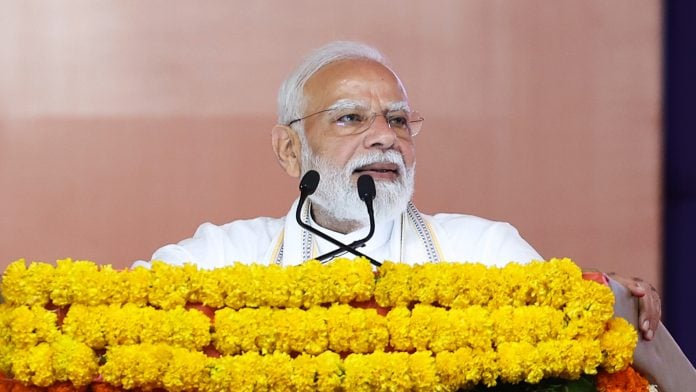

It’s time for Prime Minister Narendra Modi to ponder over how he, as a three-term Prime Minister of India, will be remembered in history. I can almost hear many angry voices: ‘Why talk about his legacy now?’
He has turned just 76. US President Donald Trump is 80. Morarji Desai became PM at 81. Mahathir Mohamad started his last stint as Malaysia’s PM at 92. Incidentally, Mohamad resigned two years later following a political crisis caused by his reluctance to declare a timeline to hand over power to his designated successor.
Let me, therefore, start with some disclaimers. I am not talking about his legacy because he has crossed the 75-year age ceiling. No, that unofficial ceiling was a one-time contingency measure to take care of Lal Krishna Advani, Murli Manohar Joshi and a few others.
Union Home Minister Amit Shah and Maharashtra Chief Minister Devendra Fadnavis, who are among PM Modi’s putative successors, made it a point to declare that Modi will continue to lead the government even after the 2029 Lok Sabha elections. That settles the age issue.
It’s not about Bhagwat’s dig
The second disclaimer is that I don’t subscribe to the Opposition’s conspiracy theories about Rashtriya Swayamsevak Sangh chief Mohan Bhagwat’s recent remarks.
“When we think of a leader today, a picture… looms in front of us, delivering speeches, winning elections, giving sermons to people. Iss se nahin hotaa hai (this doesn’t cut)…. Leadership is to create leaders…it is not to lead by myself only,” Bhagwat said.
The Opposition latched on to it, asking which leader he was talking about, but the RSS chief was making a general remark. The Opposition also had their own interpretation of the RSS patron’s remark about the inevitability of the sunset after the sunrise– —“Surya ka uday-asta nishchit hai”.
The fact is that Bhagwat is not given to public admonitions or digs even at ideological rivals, not to speak of a former pracharak whose ascension to the PM’s chair turned out to be the golden decade of the century-old organisation.
If any RSS chief did really give a hard time to a BJP Prime Minister, it was Bhagwat’s predecessor, KS Sudarshan (2000-09), who sought to keep PM Vajpayee on a tight leash, albeit unsuccessfully.
But even when Sudarshan wanted to get rid of the then-PM by elevating him to political irrelevance in the Rashtrapati Bhavan, he did it very discreetly. As Vinay Sitapati writes in “Jugalbandi: The BJP Before Modi”, the then RSS chief came to Vajpayee’s house in April 2002 with a proposal: “Why does not Vajpayee become the next president of India and make Advani (home minister then) prime minister?”
The RSS head met Advani over breakfast the next morning. When Advani asked how Vajpayee responded to the proposal, the Sangh chief said, “He (Vajpayee) said neither yes nor no. I therefore think that he has not rejected my suggestion.”
Vinay Sitapati writes that a few weeks before these meetings, industrialist Dhirubhai Ambani met Vajpayee and informed him about what some journalists close to Advani had told him about Vajpayee becoming president. So, Vajpayee knew about the RSS plan even before the sarsanghchalak (RSS chief) proposed it to him.
After their meeting, Vajpayee got the NDA’s coalition partners to agree to let him decide India’s next president. And that’s the backstory of APJ Abdul Kalam becoming the President of India in July 2002. A few weeks before that, by the end of June that year, Vajpayee had appointed Advani the Deputy Prime Minister.
Come April-May 2027, ahead of the presidential election, be ready for similar speculation and conjecture about the RSS’s plan for PM Modi. Frankly, I am not buying this theory yet.
It’s not about unpopularity, either
That brings me to the third disclaimer. I am not talking about PM Modi’s legacy because I think he is getting unpopular, as the Opposition believes, especially after the nationwide protests by students and youth. As India Today’s biennial Mood of the Nation surveys show, Modi remains the most popular PM by choice of the people—far, far ahead of his putative challengers inside and outside the party.
Many believe that if and when the BJP wins the next Assembly elections in Uttar Pradesh, all scepticism about PM Modi’s popularity will go away.
I have a different opinion, though. Win or lose, the UP election results may make things complicated for PM Modi. If the BJP loses in UP, despite CM Yogi Adityanath’s popularity, Modi baiters in the BJP and the larger Sangh ecosystem would clamour for a change at the top. The BJP just can’t afford to lose UP, which would give a crucial lifeline to the Opposition a couple of years ahead of the next parliamentary elections.
And if Yogi wins UP a third term for the BJP, the clamour for his ascension to the top would only get stronger and louder. After Modi, he is the only BJP leader with pan-India appeal, the only one who can get votes for the BJP candidates beyond his own state. Anyway, never use hypotheticals to make political predictions. PM Modi’s popularity is indisputable as of today.
So, why should I be talking about PM Modi’s legacy now? Because building a legacy takes a long time, and PM Modi wouldn’t want to leave it to posterity to decide on his legacy. Dr. Manmohan Singh, his predecessor, left it to history to be kinder to him.
PM Modi believes in making history now. From the construction of the Ayodhya Ram temple to the invalidation of Article 370, Balakot air strike, Op Sindoor, GST, Jan Dhan scheme, Ayushman Bharat, PM-KISAN, piped drinking water and many more, he can produce a long list of achievements as his legacy.
But all these might sound meaningless if there is a perception that his tenure left Indian democracy weaker, with a vitiated electoral system and processes.
The 2069 prediction
In December 2023, I wrote that the BJP was increasingly convinced that it would be in power for another 46 years, as per then party president Amit Shah’s 50-year-rule prediction in 2018.
The trigger for my conclusion was the Chief Election Commissioner and other Election Commissioners (Appointment, Conditions of Service and Term of Office) Bill, 2023, which became a law soon after. Only a political party that’s super confident of never losing power could make such a law.
It enabled the PM to handpick the CEC and the ECs, as in the past. The Modi government went beyond the Congress-era appointment practice to give immunity to serving and former ECs and CECs from any civil or criminal proceedings.
“Think of a scenario where the PM appoints the ECs and the CEC—presumably with a proven record of loyalty and obedience. They would be expected to repay their debts of gratitude in every way possible. They don’t have to fear any consequences in the future once the law is in place,” I wrote in December 2023. It’s playing out exactly like that three years later.
Also Read: Modi govt’s push for EC Bill shows BJP is convinced it will rule India till 2069
Faith in the EC is collapsing
Let’s go beyond the Opposition allegations and the BJP’s whataboutery. An increasing number of Indians are losing trust in the Election Commission and the electoral processes. A pre-poll survey conducted by the CSDS-Lokniti in March-April 2024 showed that 28 per cent of voters trusted the ECI to a great extent, down from 51 per cent in 2019. The sceptics who did not trust the ECI much doubled to 14 per cent over those five years.
According to India Today–C Voter Mood of the Nation survey, while 43 per cent of respondents said that their trust in the ECI increased, 38 per cent said it decreased. Look at the responses in the last three MOTN surveys to this question: Do you believe elections are free and fair in India? 64 per cent of respondents said ‘yes’ in August 2025, 57 per cent in January 2026 and 52 per cent in August 2026—a consistent decline.
‘No’ was the response of 32 per cent of respondents in August 2025, 37 per cent in January 2026 and 41 per cent in August 2026—a consistent increase. It would be fallacious to argue that a majority of Indians—52 per cent—still believe that elections in India are free and fair. If two out of five Indians believe that they aren’t fair, it’s very alarming for our democracy.
Restoring the faith of 100 per cent of people in the fairness of our electoral system, processes and institutions must be the utmost priority for PM Modi.
What the Opposition says
He can blame the Opposition, as usual. But if 41 per cent Indians are buying their conspiracy theories, PM Modi must do everything possible to convince them otherwise. So, what is the Opposition’s broader narrative? That India’s poll watchdog is partisan and compromised. That it disenfranchises non-NDA voters. That it helps the ruling party in every way possible by tampering with electoral rolls, disqualifying opposition candidates, targeting the Opposition, and letting the ruling party get away with the worst violations, etc. That it uses saam, daam, dand, bhed—especially central investigation agencies such as the CBI and the ED—to break the opposition parties and bring down opposition-led governments.
Five things Modi can do
I am not getting into the merits of these allegations. But if only one out of two Indians finds the elections fair and the number of such believers is declining with every survey, it’s a crisis situation for our democracy.
How PM Modi resolves this crisis will determine his true legacy. There are five things he can do immediately to address their concerns. First, scrap the 2023 law to end the PM’s and, through him, the ruling party’s power to handpick ECs and the CEC. Make the selection exercise truly independent, objective, and non-partisan.
Second, ensure parliamentary oversight over central investigative and intelligence agencies, as happens in many countries, including the United States. It will make them more accountable and prevent their weaponisation for political purposes. If nothing else, at least ‘washing machines’ won’t get a bad name.
Third, either scrap the anti-defection law entirely or make disqualification automatic or mandatory for defectors, no matter their numbers. Expecting the Speakers of the state Assemblies and the Lok Sabha—or the Rajya Sabha chairperson, for that matter—to act objectively beyond their own party loyalty is naïve.
Fourth, given government officials’ involvement in conducting elections, impose a five-year cooling period post-retirement before they enter politics or contest elections.
Fifth, put a ceiling on corporate donations and on how much a party can accept as donations from them. Do we really think that a businessman or industrialist donates hundreds of crores to a political party without expecting anything in return?
And why is it that the ruling party at the Centre or in a state invariably gets much more corporate donations than the Opposition? By the way, why should political parties have thousands of crores at their disposal? Institute a commission or committee to come up with an amount that a political party needs for its day-to-day functioning and for contesting elections.
If PM Modi were to implement just these five things, it would go a long way in restoring every voter’s faith—not just 52 per cent – in our electoral system. That’s the kind of legacy that such a popular Prime Minister would usually want to leave behind. PM Modi believes in doing things that his predecessors couldn’t do for “70 years”. In the above-mentioned matters, though, he has chosen to follow in their footsteps.
DK Singh is Political Editor at ThePrint. He tweets @dksingh73. Views are personal.
(Edited by Maryam Hassan)
What’s DK smoking ?😄
Asking the most power hungry PM to give up power over EC🤷🏻♂️… itne bhi dream world mei nhi jaana
Needless article when PM has already stated previously once he would be there for 2032.
But yes what’s True is that Election Commission & Gyanesh Kumar has lot all the credibility.
When BJP is so strong & opposition is so weak; ideally EC should have been totally non-partisan as anyways BJP would have won. But maybe Gyanesh Kumar somewhere has put a big hole into that claim now.
In this undeveloped, corrupt, socialist country, even the great socialist moron’s poo is mistaken for gold. When the country has already gone to the dogs because of moron number two, the man himself doesn’t give two hoots about his legacy.”
This author has been suffering from Modi derangement syndrome. Take a break bro!
D.K. at his best. Disguising a liberal and giving sermons Modi, this is a perfect example of a left looney who preach when they are in opposition but concentrate all the power when they get chance. This guy has never said even a single word to Mamta Banerjee when she was at her dictatorship best. Also, this guy never criticise Rahul Gandhi for all his buffoonery.
Legacy. Can only be evaluated after the lapse of a considerable period of time. Prime Minister Jawaharlal Nehru’s glitters like gold.