






The recently concluded IMF-WBG meetings featured several interesting presentations. While much of the discussion around the meetings focused on AI and related topics, one paper caught our attention. This new IMF paper argues that fiscal discipline rewards investment in low-income countries. We argue that this not only applies to India but also reveals that the Indian growth story could be its fiscal prudence after the Covid episode.
The IMF paper argues that fiscal credibility plays an important role in driving capital into countries, and that key policy initiatives such as the development of special economic zones (SEZs) and tax holidays work well only when fiscal credibility is present. For instance, low-income countries (LICs) with stronger fiscal ratings saw a larger, more persistent rise in foreign direct investment (FDI) after SEZ approval, while those with weaker fiscal ratings showed little durable response. Therefore, the paper argues that fiscal credibility is key to greater investment. In our view, these lessons are not restricted to LICs but apply to most, if not all, economies, including emerging markets such as India. How has macro-fiscal management shaped the Bharat story?
There is unequivocal evidence to suggest that stronger macro-fiscal management reduces policy uncertainty and improves investors’ risk-adjusted returns. This emphasis has deeper institutional roots in the Fiscal Responsibility and Budget Management Act era, which marked a greater post-2000s focus on fiscal issues, as reflected in Montek Singh Ahluwalia’s profile in Finance & Development. This applies clearly to India after the Covid-19 pandemic. Finance minister Nirmala Sitharaman had promised in Parliament a credible fiscal glide path after Covid-19, and current Cabinet Secretary TV Somanathan later reinforced the commitment. He added that from 2026-27, the deficit would be set so that the Centre’s debt-to-GDP ratio remains on a declining path.
The numbers vindicate this commitment. India’s fiscal deficit came down from 9.2 per cent of GDP in 2020-21 to 4.4 per cent in 2025-26 (revised), with a targeted 4.3 per cent for 2026-27. There was also an emphasis on the Centre shifting to debt-to-GDP as a primary fiscal anchor, which added further credibility. At the same time, as fiscal consolidation was being pursued, capex was expanding, rising from Rs 2 lakh crore in 2014-15 to Rs 12.22 lakh crore in 2026-27. How did capital respond during this period? More importantly, how does this compare with previous large shocks such as the global financial crisis?
Also read: Sharjeel Imam and the danger of inventing an enemy India cannot defeat
Why fiscal credibility matters
Consider two shocks and two exits, as shown in the figure below. After the 2008 global financial crisis, India’s fiscal deficit averaged 5.6 per cent of GDP over the next five years, but with no linear and calibrated path downward. Gross FDI stalled at around $35-47 billion a year, and the period ended in the 2013 taper tantrum. After the pandemic, the deficit was higher at its peak, at 9.2 per cent in 2020-21, but it came down on schedule every year to 4.4 per cent by 2025-26. Gross FDI climbed to a record $94.5 billion. The lesson is not that India now runs small deficits; on average, it does not. It is that investors can now credibly believe that the deficit will keep falling, adding legitimacy and a premium to the government’s commitment. Hot money still moves with global risk as portfolio investors pulled out $16.4 billion last year as conflict erupted in the Middle East. But long-horizon capital, the kind that builds factories, follows credibility.
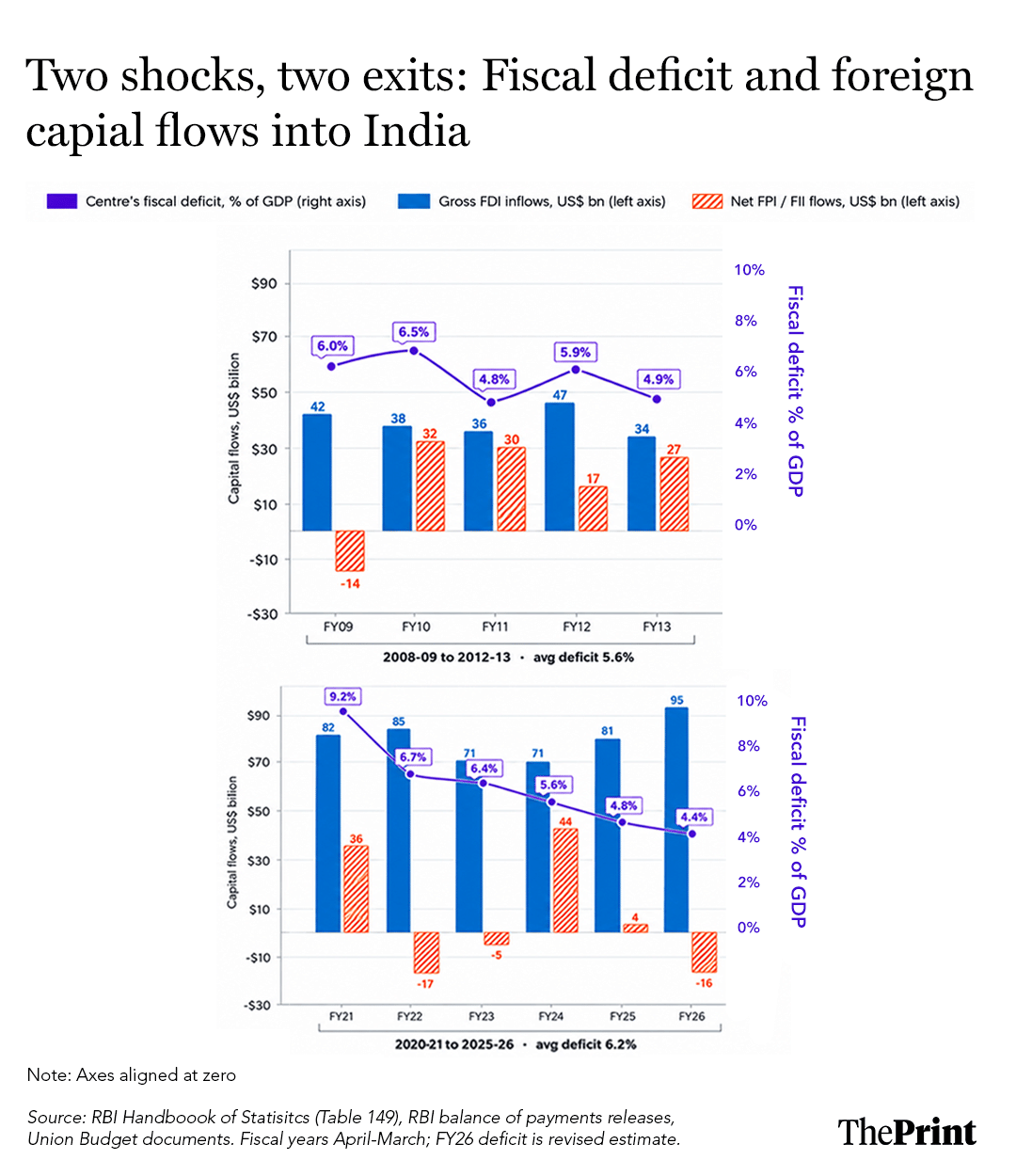
This leads to the important story of why fiscal credibility matters and why it has anchored high growth after Covid-19. Several factors reinforce this trend.
First, rating agencies have taken notice. The Japan Credit Rating Agency upgraded India to A- for the first time in decades. S&P raised India to BBB in August 2025—its first upgrade in 18 years—citing sustained fiscal consolidation and improved quality of public spending. Notably, India’s weak fiscal settings had long been the most vulnerable part of its ratings profile, as even past IMF reviews have concurred.
Second, record gross FDI numbers have also come in, with many investors arguing that fiscal consolidation matters. The World Bank’s latest report argues that improving institutional quality, promoting macroeconomic stability, and easing trade and investment restrictions can help reinvigorate FDI inflows in emerging economies.
Third, the criticism of net FDI numbers is something we have addressed in an earlier article, but repatriation could be seen as a sign of a maturing economy. In the previous piece, we had emphasised the need for more legal reforms to retain more capital. Gross flows determine the level of investor interest in the country, especially through the FDI lens. Concerns remain about debt levels, especially at the state level, and about regulatory constraints on businesses, among other issues.
In retrospect, this year, both the World Bank’s flagship report and the IMF’s new research find that stronger fiscal and institutional credibility is associated with higher FDI. The calibrated fiscal consolidation during the years following Covid-19 has been one of the most important anchors of the growth we are seeing today, a rarity in post-Independence India. On fiscal consolidation after Covid-19, the government and civil servants have been spot on.
Sriram Balasubramanian is a former IMF economist and author of ‘Dharmanomics’. Prakash Loungani is director of the MS in Applied Economics programme at Johns Hopkins University. They are on X at @Sriramb1000 and @LounganiPrakash, respectively. Views are personal.
(Edited by Prasanna Bachchhav)