





“For many years,” the man who proclaimed himself caliph had written the night before he was killed in a battle, and his decapitated body tossed into the Kunhar river, “I have dedicated myself to this godly task of jihad, and no stone have I left unturned. I sent my deputies to Hindustan, Khurasan and Turkistan, who did all in their power to attract people towards the path of God. Yet, none but some strangers joined hands with me, and the bulk invented calumnies towards me. This was perhaps the will of God. Our scribe has now got tired of writing letters, and we have got tired of despatching them. Nothing has developed out of it.”
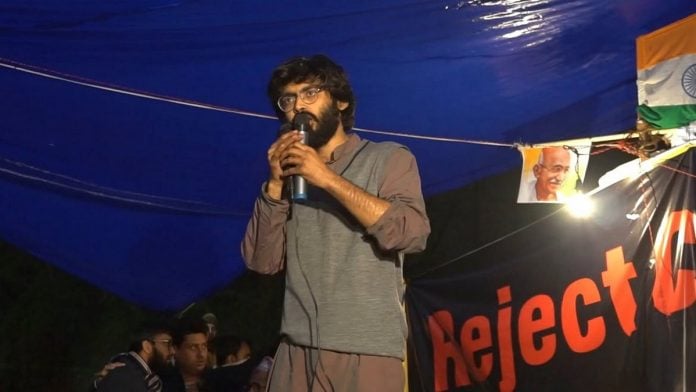
Nearly two centuries after the killing of the charismatic mystic and warlord Syed Ahmad Barelvi in 1831, his disembodied spirit still hangs over us. Sharjeel Imam’s calls for an Islam walled off from its Hindu milieu; his rejection of secularism and liberal cosmopolitanism; even the state’s relentless campaign to criminalise his words and keep him in prison: each of these can trace its patrimony to Syed Ahmad’s war to evict Maharaja Ranjit Singh from what he imagined to be lands usurped from Islam.
For decades after his death in 1831 at the North-West Frontier’s Balakot, the East India Company and the British crown remained at war with the ghost of Syed Ahmad Barelvi. From the North-West Frontier to Bengal and the Deccan, spies and soldiers worked desperately to interpret Syed Ahmad’s ideas in the grave his maimed body had been denied.
Like the Raj, the Indian Government is in real danger of inventing an enemy it cannot defeat.
The rise of the Indian Taliban
Less than a week after 9/11, some 25,000 delegates of the Students Islamic Movement of India, or SIMI, met in Mumbai. The commentator Javed Anand recalled seeing stickers pasted “in large numbers in Muslim shops and homes, a thick red ‘NO’ splashed across the words DEMOCRACY, NATIONALISM, POLYTHEISM.” Two years earlier, a SIMI convention had been addressed, over the telephone, by the founder of Hamas, Sheikh Ahmed Yassin, and the head of Pakistan’s Jama’at-e-Islami, Qazi Hussain Ahmad. The highlights of that convention had included a small child reading this poem:
Islam ka ghazi, butshikan (Warrior of Islam, destroyer of idols)
Mera sher, Osama bin Laden (My lion, Osama bin Laden)
Led by the Delhi-born Abdul Karim ‘Tunda’, a jihadist current had begun to resurface from 1985, as communal violence escalated across India. Although pogroms were no strangers to Indian Muslims, the ill-concealed entanglement between Prime Minister Rajiv Gandhi’s government and the Hindu nationalist Ram Janmabhoomi movement empowered those who argued Indian secularism had been a hoax. Following the demolition of the Babri Masjid in 1992, Tunda’s group planted multiple bombs.
For the most part, these jihadist networks had little impact. The most lethal terrorist attack in India, the 1993 serial bombings in Mumbai, was carried out by the crimelord Dawood Ibrahim Kaskar and invoked vengeance against communal violence, not ideological jihadism.
The rise of SIMI — using much the same language Sharjeel Imam now draws on — was different. Blocked by endemic social exclusion and communal discrimination, a new cohort of educated young Muslims had been drawn to the organisation. Scholar Yoginder Sikand perceptively noted that SIMI’s jihadist polemic gave its members “a sense of agency that was absent in their everyday lives.”
Leaders of SIMI invoked the Islamist ideologue Abul A’la Maududi to argue that Islam was in a position of irreducible opposition to Hinduism and the secular state. Former SIMI president Qasim Omar argued, in an interview with the scholar Irfan Ahmad, that the post-Independence Islamist drift away from jihad had reduced Muslims to subjugation. These arguments were given weight by the Gujarat pogrom of 2002 — a warning, many imagined, of what a Hindu nationalist India would look like.
The loss of Muslim power had driven the rise of the Tehreek-e-Muhammadi, which drew thousands of supporters from the plains of Bihar and Bengal. Another kind of political loss ignited the new Islamist movement.
The making of enemies
From the Masjid-e-Nawab nestled inside the granite walls of Vellore Fort — or so a witness would claim — the cleric Sayyed Shah Modin Qadiri reminded his congregation of God’s injunction of jihad: “Although necessity now obliges them to eat the salt of kafirs, the intention is to be kept in the heart and when the day and favourable opportunity offers them, united in heart and mind, they must slay them whether these kafirs are rulers or not.” Another witness claimed Modin was the author of a book which shamed Muslims for letting themselves be ruled by “men with women’s faces.”
The fall of Mysore in 1799 had marked the sunrise of the Raj over the Deccan — but also the birth of an age of imperial anxiety. In 1806, sepoys stationed at Vellore rebelled against the East India Company, angered by demands that they remove caste marks, remove their turbans, and shave off their beards. Fifteen British officers, and 83 civilians, were killed.
Efforts to prosecute the Vellore mullah collapsed, historian Chandra Mallampalli has shown, but paranoia played an important role in shaping the policies of a power that, in 1838, was on the cusp of the first of its wars in Afghanistan. The last Nawab of Kurnool, Ghulam Rasool Khan, the Hyderabad prince Mubariz ud-Daula, and Shah Abbas Ali Khan, a jagirdar of Udayagiri, would all spend their lives in prison without trial.
The East India Company also confronted Wahhabis — as it described Syed Ahmad’s followers — in Bengal, where it was compelled to commit soldiers to crush the messianic egalitarianism of Titu Mir and Dudu Mian. The Malabar coast saw a succession of battles between Mappila communities and their Hindu landlords. These would culminate in the savage violence of 1921–22.
Less than a quarter-century after the Hindustani Mujahideen of Syed Ahmad were crushed at Balakot, the British Empire was at war with them again — in 1852, in 1854, and in 1863. Each battle ended in victory; each, equally, led on to the next. The ethnic Pashtuns of the borderlands, enraged by the slaughter of their communities and the burning of their villages, fought on. The soldier and author John Masters wrote: “While he flitted and sniped, rushed and ran away, we felt as if we were using a crowbar to swat wasps.”
Also read: Sharjeel Imam’s Islamist manifesto will be forgotten. The silence of liberals will not
The black water
Empires are built on the exercise of power — but also on imagination, through myth and self-deceit. Late in 1857, the commissioner of Patna, William Tayler, was sacked for his overenthusiastic hanging of men suspected of organising the Great Rebellion. He responded: “The present outbreak is no military revolt alone, no soldier mutiny, no mere rising of an army. It is the issue of a long-meditated and deeply-laid scheme, the deliberate purpose of which was the extermination of the whole Christian race, the overthrow of the British government, and the reestablishment of Moslem rule.”
To his superiors, struggling to extinguish rebellion, Tayler’s actions had seemed unhinged; in an Empire eager to assert its moral superiority, his claims proved profoundly attractive. The rebellion was recast as a plot by a decayed old order against the superior virtue of England, evidence not of mass grievance but barbarism.
Following the 1863 battle at Ambela, on the North-West Frontier, between the British and the last remnants of the Hindustani Mujahideen — which ended in an embarrassing military stalemate — imperial authorities turned to the law. Five sets of trials of purported Wahhabis — at Ambala in 1864, Patna in 1865, Malda and Rajmahal in 1870, and again Patna in 1871 — were initiated, centred on letters purporting to show the elderly Tehreek-e-Muhammadi leaders had routed funds to the Hindustani Mujahideen, paying for the uprising of 1857.
The empire emerged battered from the trials, even though several men were to serve long sentences in the Andamans. Act III of 1858 had given the Government of India extensive powers to detain individuals without charge merely to secure public tranquillity. Fourteen months into arrest without charge, the elderly brothers Amir Khan and Hashmadad Khan invoked the ancient writ of habeas corpus. The courts, though, held that the Government of India — citing the supposedly primitive nature of its subjects — enjoyed the right of indefinite detention.
This was followed by Section 124A of the Indian Penal Code, which expanded the power to restrict speech. The consequence, historian Julie Stephens has argued, was to unite liberal Indians against the Raj — leading, less than a century later, to its downfall.
Letters or no letters, though, there had been no uprising of significance by the Hindustani Mujahideen — not in 1857, and not after. Local residents had rebelled against Syed Ahmad’s harsh religion and contempt for local practice. Following his death, the Hindustani Mujahideen survived as a body of mercenaries, not an ideological organisation. Forty sepoys of the 55th Native Infantry, who had deserted before the mutiny, briefly held the village of Naranji. British troops levelled the village using elephants as a demonstration of retribution; the Mujahideen fled without resistance.
Praveen Swami is a Contributing Editor at ThePrint. His X handle is @praveenswami. Views are personal.
(Edited by Aamaan Alam Khan)