




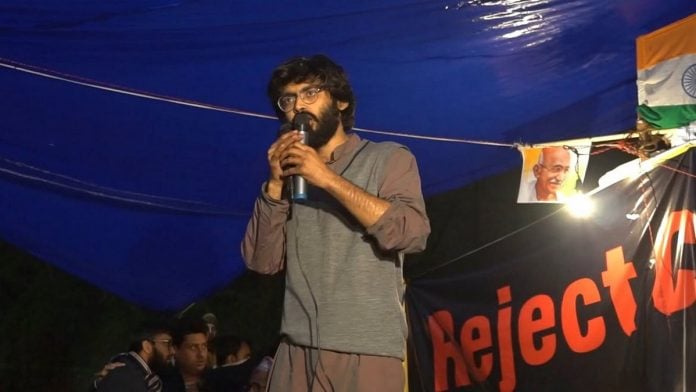

Sharjeel Imam, the main architect of the anti-CAA agitation, has given an interview to The Quint detailing his Islamist manifesto.
Surprisingly, no storm has been kicked up over pronouncements that are so unapologetically anti-liberal, anti-secular, anti-democracy, anti-Constitution—in a word, anti-national.
He openly calls the Constitution fascist, labels secularism a trap, and denounces democracy as a contrivance to deny Muslims their political rights. He dismisses liberalism as a ploy for majoritarianism, and accuses the presiding deity of the liberal pantheon, Jawaharlal Nehru, of falsehood and myth-making for projecting an ancient, unbroken, unified Indian nation in his book, The Discovery of India. He has long disparaged Mahatma Gandhi as the biggest fascist of the 20th century for deploying the term Ram Rajya, and views the “Nation of India” as a fascist project.
This piece—not the first in his brazen oeuvre—is a litany of indictments against the liberal class: its philosophy, ethos, and politics. He contemptuously rejects any suggestion of a difference between liberals and Hindutvadis. For him, both are simply Hindus. In his essentialist worldview, all Hindus are the same, for they are unanimous in denying Muslims the political power they claim as a divine right to enforce Allah’s will on the land.
In his worldview, the liberal “secular framework” is “actually a branch of the overarching nationalist framework, which the Hindutva framework is also a part of”. But what causes him the utmost indignation is the liberal presumption that Muslims are Indians first and foremost. He expostulates, “the secular framework considers us all ‘Indians’ by default; the end product of all education and political development is to feel that we are only ‘Indian’ and everything else is secondary”.
Inadvertently, Sharjeel has recognised something that liberals have been fighting shy of acknowledging: that Hindutva’s idea of India is anchored in the same “overarching nationalist framework”, and that in its conception, Muslims are Indians above all else.
Considering how liberals have been excoriated, and how the author refuses to see any difference between them and the right wing—there being no greater ignominy for a self-respecting member of the tribe than being bracketed with Hindutva—one would have expected a burning fury at such an imputation. And so, one scans the internet for a searing rebuttal from the leading lights of liberalism, only to discover a deafening silence that exposes their abject inability to confront the Islamist agenda.
Also Read: From Shah Bano to Waqf—how Muslim politics has produced just intermediaries, not intellectuals
Left-liberals’ unrequited love
In Western academia, the left-liberal is more interested in “Dismantling Global Hindutva” than confronting Global Islam. The reason is obvious. Global Hindutva is a phantom that poses no challenge to Western civilisation, whereas Global Islam has demographically embedded itself in the West and is open about its intentions to destroy that civilisation. The left-liberals hope to draw upon its raw energy to finish off the capitalist system and neoliberal ideology. Add to it the esoterica of postmodernism—a non-philosophy that argues for the return-to-the-cave sort of primitivism—and combine it with the Islamisation-of-knowledge project funded by the Wahhabi regime of Saudi Arabia since the 1970s, and the ideological toolkit for the Red-Green alliance is ready.
Already debilitated by such pseudo-philosophy, the Indian left-liberals—dependent as they are on the Muslim vote bank for survival—would rather risk Islamist domination than tolerate nationalist politics.
The left-liberal’s love for Islamists has always been unrequited. Islamists hate them from their ideological core. Wherever Islamists come to power, they make mincemeat of them. One needs only a cursory look at Muslim social media to gauge how much they loathe the left-liberal. In his now-famous speech in 2020, Sharjeel Imam said, “This is the time to tell non-Muslims, ‘If you are our sympathisers, stand with us on our terms.’ If they can’t stand with us on our terms, they are not our sympathisers.”
Sharjeel Imam has not said anything new; he has merely articulated the Islamist common sense that permeates a substantial swathe of educated Muslims. In fact, he is simply the latest in a long line of Muslim thought-leaders—spanning from long before Iqbal and Jinnah to Syed Shahabuddin and Asaduddin Owaisi.
Before I deal with his ideas in detail, it is pertinent to locate his recent outbursts in the context of internal rivalry between Islamists and left-liberals. Both strands vie with each other in denying India’s nationhood, its civilisational antiquity and its overarching, supra-political unity. So much so that in their discourse, the name “India” has been replaced by “South Asia”. This goes a step further than the colonial geography in which India, instead of its proper name, is referred to as a mere landmass without a name and identity—a subcontinent. To deny our nationhood, the British maintained, “India is a mere geographical expression”.
Sharjeel Imam, owing to his unabashed outspokenness, has gradually become an embarrassment for the left-liberals—someone whom they can neither openly denounce nor fully endorse. “Why? Because I do not conform to their image of a good Muslim, because I am too much of a Muslim for them,” grumbles he.
Seeing himself as a successor to Iqbal and Jinnah, he is aggrieved at being “written out of history” by the “secular” media. Sherali Tareen, a US-based Pakistani scholar, considers him a political thinker and not a mere activist. He has dedicated his book, with the tell-tale title Perilous Intimacies: Debating Hindu Muslim Friendship After Empire, to Imam and devoted its epilogue to him. Therefore, Imam’s recent postulations should be seen as a counter-manoeuvre against the left-liberal erasure of him.
Islam or the highway?
Imam opens his manifesto with the theoretical premise of his Islamist agenda. Unlike other Muslim intellectuals, he does not even care to give it a secular garnish for academic respectability.
Though unacknowledged, his framework is Islamo-Marxian, borrowed from Ali Shariati, the Iranian intellectual who is regarded as the Voltaire of the Islamic Revolution. The revolution erased his memory—a fate that haunts every Muslim with the slightest hint of liberalism in his ideas.
In his book, On the Sociology of Islam, Shariati extrapolated the Marxian paradigm—its teleology, dialectics, historical materialism, class struggle, revolution, dictatorship of the proletariat and utopian vision of a classless society—onto the sacred history of Islam. He constructed a neat teleology from the primordial dialectical conflict between the sons of Adam, the agriculturist Cain and the pastoralist Abel, to its divinely ordained denouement in “The Ideal Society: The Umma”, the Islamic equivalent of a classless society.
In Imam’s worldview, the class struggle of Marxism has been Islamised into “a struggle for liberation and emancipation from ‘shirk’” (polytheism), which he identifies as “the primary source of oppression in human history”, while regarding nationalism as one of the branches of polytheism.
Just as Marxism purports to be a theory of human liberation, Imam sees tawhid (Islamic monotheism) as the sole “source of liberty, justice, equality and a just political order”. And to that end, in the same vein as “Workers of the world, unite!”, he advocates “allying with ‘people of the book’ and monotheistic communities, as mandated by the Qur’an”.
There is a fatal flaw in this logic, however. In orthodox Islamic theology, every religion other than Islam is shirk, even Christianity and Judaism—the religions of the People of the Book (Ahl al-Kitab). Islam regards the concept of the Trinity as polytheism and similarly condemns Jews, accusing them of regarding Ezra as the son of God (Surah 9, Ayat 30).
Hindus, in any case, are regarded as the most inveterate polytheists. Under Imam’s doctrine, Hinduism—being shirk—becomes “the primary source of oppression in human history”.
The dream of a Pakistan within India
Having set out what might be called Dialectical Islamism between shirk and tawhid, Sharjeel Imam moves on to the concept of Muslim nationalism. After denying India’s nationhood and criticising liberals, including Nehru, for “the myth of the existence of an ancient Indian nation”, he posits a Muslim nation in South Asia (deliberately avoiding the name India).
He claims that “South Asian Muslims who, although a minority here, comprised almost one-third of the Muslims of the world, and as such were the largest Muslim nation, and hence required specific constitutional arrangements to ensure their autonomy…” He invokes Iqbal, in whose opinion Indian Muslims were the only group that could be called “a nation in the modern sense”.
While Iqbal attacked territorial nationalism in his poem Wataniyat—likening it to a new idol in the pantheon of polytheism—his prose essays and exchanges with Nehru reveal that he wasn’t against nationalism per se, but only against the idea of Indian nationalism, as it opened the way for Hindus to rule their own country. If Muslims could be the rulers, he had no quarrel with nationalism and could still sing Saare jahan se achha Hindustan hamara.
Ever since Muhammad bin Qasim’s invasion of Sindh in 712 CE, Muslims were rulers in various parts of India for centuries. This has instilled in their psyche an entitlement to the rulership of India, which has kept their thought-leaders confused about whether they are a nation or a minority.
A nation needs a state, whereas a minority needs constitutional guarantees. Neither in theory nor in practice can one be both at the same time. But such has been the ingenuity of Muslim leaders that they have managed to be both simultaneously. They carved a country for themselves and also secured special privileges as a minority—a classic example of having one’s cake and eating it too.
Alluding to the historiography of Partition, Imam argues with rare gumption: “Two nations never meant two geographical nations…, but two religious nations dispersed across South Asia for which a delicate constitutional arrangement was needed.”
Such a formulation implies that India continues to house two nations (though the logic is never applied to Pakistan and Bangladesh). And since there are two nations in the mutilated India, there should be two states as well.
Though he doesn’t acknowledge it, the idea of imperium in imperio (a state within a state) for India had been floated by Maulana Maududi, the world’s chief Islamist ideologue and founder of Jamaat-e-Islami, in his book Musalman Aur Maujuda Siyasi Kashmakash (1938). The model goes even beyond the fanciful “two nations under one state”, as it asks for two states in one country. Pakistan only whetted, not sated, the appetite.
It is obvious that Imam’s talk of “specific constitutional arrangements to ensure their autonomy so that they could freely develop cultural, educational, religious and political institutions without interference” is utter balderdash. It is obviously not about minority rights, nor about equality for the Muslim citizen, but rather about parity for the Muslim community, which demands the status of a nation—a Pakistan within the borders of India.
In Emergency Chronicles, Gyan Prakash points out the inability of the Muslim community to develop a minority rights discourse. Historian Mohammad Sajjad perceptively asks whether the Muslim leadership’s demands were ever about minority rights at all. He contends that they were always about their claim to be recognised as a separate nation—and wryly remarks that if it were about minority rights, wouldn’t Pakistan have granted its minorities the same rights as were secured for Muslims in India?
The unfinished business of Partition
The Partition of India continues to haunt anyone interested in the country’s past and present. Unsurprisingly, Imam revisits it compulsively—not to draw lessons from it, but to complete its unfinished agenda.
The conventional wisdom about the Partition has been that the representative party of Muslims, the Muslim League, demanded it, and the Congress conceded.
In the 1980s, the zeitgeist of renewed Muslim assertion was reflected in the revisionist historiography of Partition, best represented by Ayesha Jalal’s The Sole Spokesman and HM Seervai’s Partition of India: Legend and Reality. Jalal accused the Congress of thrusting Partition on an unsuspecting Muslim League, which was using the demand for Pakistan merely as a bargaining counter to secure better terms for Muslims in a united India.
The lineage of this historiography can be traced back to Maulana Azad’s India Wins Freedom and Ram Manohar Lohia’s Guilty Men of India’s Partition, which had absolved Muslims of any real guilt in the politics of Partition.
The vivisection of a living civilisation and the violence that accompanied it had been pricking at the Muslim conscience. Revisionism of the kind pioneered by Jalal and Seervai freed them from that guilt, enabling them to pursue their old politics with renewed conviction.
Sharjeel Imam pronounces the Muslim League innocent in the matter of Partition and instead blames the “Brahmanical forces in Congress”. According to him, if the Muslim League’s proposal for decentralisation had been accepted, there would have been no Partition.
However, he fails to reproduce any such proposal that aimed at decentralised governance. All that the Muslim League ever wanted was disproportionate weightage for Muslims in provinces where they were in a minority, particularly in UP, and a guarantee of a Muslim majority in the legislature of provinces where their population was just slightly above that of Hindus. The debate was always about a disproportionate share for Muslims at the centres of power, and never about decentralisation. Had it been about decentralisation, Pakistan would have become the epitome of federal structure and decentralised governance.
He presents the Cabinet Mission Plan as a loyalty test for a unified India, which the League passed but the Congress failed. This is a historiographical fetish created by Maulana Azad, who in India Wins Freedom blamed Partition on Congress’s rejection of the Cabinet Mission Plan. One may ask: if it was such a great scheme, why didn’t Pakistan put it into practice, given that the proposed Groups B and C became its west and east wings?
While absolving the Muslim League or, more accurately, the people it represented, the author makes an argument that is true but ironic. He notes that the League “under the leadership of Jinnah received 80% of the (Muslim) votes in 1946—i.e., almost all of the middle classes…”
The League had contested these elections on the agenda of Pakistan, and 80 per cent of the enfranchised Muslims—the educated, the middle class and the elite—voted for it. The author calls it a consensus, using the Islamic fiqhi term “ijma” to argue that almost all Muslims were behind the League. Therefore, the obfuscation introduced in recent revisionist historiography—that only the elite wanted Pakistan, and that if the Muslim masses could have voted, they would have voted differently—needs to be rejected. The Muslim elite and masses have always shared the same political ideology, because their politics is based on religion, and all of them follow the same religion.
Finding the right foot soldiers
The author accuses so-called Brahminical forces, including “Congress, RSS and Hindu Mahasabha”, of being “not just anti-Muslim, but anti-Tribal, anti-Dalit” as well. It has long been a fervent hope of Islamists to forge an alliance with Dalits and tribals—or rather, recruit them as foot soldiers—to launch a frontal attack on Hinduism. In their sociology, Dalits and tribals are not Hindus; and in their history, they converted to Islam to escape caste discrimination in Hindu society—as if they became Sayyids or Pathans as soon as they converted.
It may be asked whether, across fourteen centuries of Islam in India, there was ever any genuine concern for Dalits and tribals. In fact, they suffered even more under foreign conquerors than under caste Hindus.
Islamic texts produced in India reviled Hindus for idol worship, yet never questioned caste oppression. Instead of mitigating caste discrimination, Muslim conquerors exacerbated it by layering it with racial and religious prejudice. When an upper-caste Muslim looks down upon a lower-caste one, the disdain is fundamentally racial—that of a conqueror despising the vanquished.
Also Read: Muslims aren’t panicking over BJP’s 2026 assembly polls results—Liberals are
A silence that will be remembered
If Brahmanism is a valid category of analysis, Islamic Brahmanism is worse than the Hindu one insofar as it is not yet acknowledged, problematised or critiqued.
In Muslim literature, the word Brahmin is often juxtaposed with Shaikh to denote the clergy of the two religions. The Islamists, however, use the term Brahmanism as a slur. They have borrowed it from Dalit discourse, which, in turn, took it from orientalist scholarship. Since they can no longer traduce Hinduism openly, they use Brahmanism instead.
Another term they use indiscriminately for those who question Islamism is “fascist”—because they can’t call them “Kafir” anymore.
This doctrine by Imam—a provocative reiteration of the Muslim League’s politics and Jamaat-e-Islami’s ideology—will soon be forgotten. However, the left-liberals’ conniving silence will long be remembered.
Ibn Khaldun Bharati is a student of Islam, and looks at Islamic history from an Indian perspective. He tweets @IbnKhaldunIndic. He can be reached by email at ibn.khaldun.bharati@gmail.com. Views are personal.
Editor’s note: We know the writer well and only allow pseudonyms when we do so.
(Edited by Asavari Singh)