




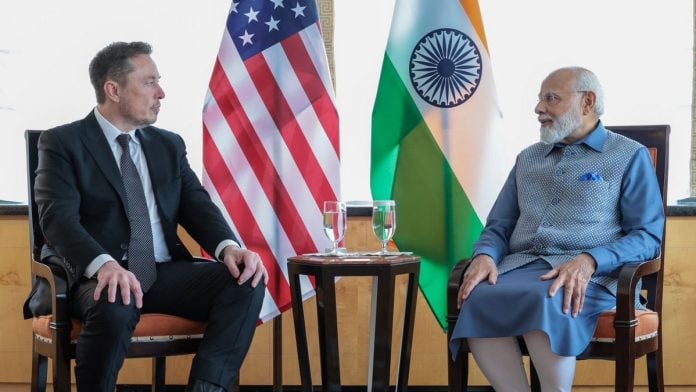

India and Elon Musk have had a testy relationship ever since the world’s first trillionaire railed against the government and Indian “oligarchs” for “preventing” the entry of Starlink, his satellite internet service, into India.
Even before this latest fracas, which played out mostly on Musk’s own X, he has not been a fan of the Indian business environment, choosing not to build Tesla in this country. He does claim an admiration for Indians — a former domestic partner whom he brought to meet PM Modi is half-Indian, and one of his children has the middle name Sekhar after the Nobel Prize-winning physicist of Indian origin, S. Chandrasekhar. Fundamentally, India as a place to do business is incompatible with Musk, even as Indians with talent, drive and ability to work hard are likely to win his favour.
Like all successful entrepreneurs, Musk is impatient. And as the most successful entrepreneur in the world, his impatience is likely many degrees higher than that of some of his peers. He is a man who constantly pushes barriers, breaching his way into new frontiers.
By definition, entrepreneurs are pioneers, at least the first-generation ones. But few have covered the spectrum Musk has. Among his many innovations in technology are electric cars (Tesla), internet through satellite (Starlink) and a self-landing rocket (SpaceX). He has pushed the frontiers in several domains. Where he has not pioneered, he has found an audacious way in. Buying Twitter and then running it despite the naysayers is one example. Another is xAI, a latecomer to artificial intelligence. Combined with SpaceX and Tesla (with its foray into autonomous vehicles and robots), it could yet leapfrog Anthropic and OpenAI by becoming the first to combine the large language models of AI with physical capabilities (autonomous machines/robots).
Even in philanthropy, Musk has dared to be different. Soon after Anthropic announced that it would set aside 5 per cent of its shares for a “public benefit fund”, Musk announced that he would give one share of SpaceX to every American child. For 70 million Americans under the age of 18, at the current value of $140 per share, this would be a $10 billion giveaway. And he says this is just the beginning. Even his political dalliances are unconventional, to say the least.
Also Read: Mark Carney is showing the centre still has a place in an age of extremes
Musk’s speed vs India’s glacial system
In contrast to Musk’s disruptive and quick-action style, the Indian system is one that demands tremendous patience at the least and often conformism. Those who tried to rationally defend India’s position on Starlink based their argument on the principle that “all approvals require a process and take time”. This sounds very reasonable to those used to the Indian system, but for a cutting-edge entrepreneur, this is an unnecessary delay. Perhaps Musk cannot fathom that a system can run so slowly unless it is being influenced. But that is India’s reality. Due process is very lengthy.
On Starlink, in particular, both the benefits (connecting underserved areas) and risks (foreign control over connectivity may have security implications, like in Ukraine) are well known. They don’t need fresh analysis. It operates in around 170 countries. A decision, either for or against, or for with conditions, could possibly be speedier.
Also, in India, there is an expectation that entrepreneurs will align with the priorities of the State. Again, those used to the Indian system will find nothing exceptional in this. But for entrepreneurs like Musk, the State and its priorities are likely to be limiting. In the lead, the State can never be as dynamic as the private sector. But it can facilitate private sector dynamism by supporting from behind. The US government has indeed supported many of Musk’s ventures, even when he has had a tumultuous relationship with the administration.
Also Read: Look beyond ease of doing business. Economic freedom is India’s real path to Viksit Bharat
The perils of patience
India still has an ambivalent outlook towards entrepreneurs — not just the government but also society. A man or woman with the audacity of Elon Musk, and indeed the extremity of his views (on subjects beyond his business), may not find much favour.
Most would not only disagree with Musk but find him disagreeable — someone to be reined in rather than given free rein. Indian entrepreneurs, while inherently no less able, learn to operate with more caution and take greater care to carry the expectations of government and society along. They incorporate some patience in their inherent impatience.
Outside India, Indian entrepreneurs and managers are able to operate at a different level, with more risk-taking audacity. They have the talent and drive. They have the ability to work. And they are unleashed from government and society. It is no surprise that Indians run many top American companies. Musk and other big US companies hire Indians and elevate them all the way to the top because they know that few others possess the sterling qualities that Indians do.
There will be an Indian Elon Musk (as audacious, but perhaps more temperate) sometime soon. The only question is whether that person will live and work in America or in India. Do we have the impatience?
Dhiraj Nayyar is Chief Economist, Vedanta. His X handle is @nayyardhiraj. Views are personal.
(Edited by Asavari Singh)