






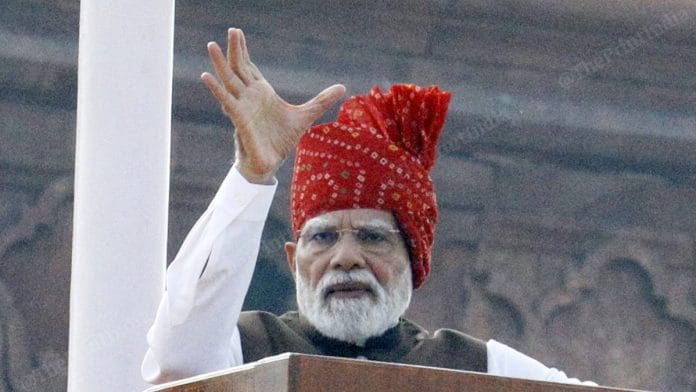


Narendra Modi may have just given us another word through which history will remember him. On India’s 80th Independence Day, the PM stood on the ramparts of the Red Fort and added a curious new label to India’s political vocabulary: Dimagi Naxal.
I confess the phrase has a certain ring to it for people like me. And Indians have wasted little time discovering it. Within a day, there were proud Dimagi Naxals on social media, demands for Reddit flairs, jokes about forming a Dimagi Janta Party, and P Chidambaram simply declaring that he was proud to be one. Political insults have an entertaining habit of escaping their author. Dimagi, after all, is not the worst thing one can be accused of possessing.
But leave the joke aside, and think first of the stage from which this was said. Independence Day is the one morning when the Prime Minister speaks not merely as the head of a party or a government, but as the voice of the Republic. The Red Fort is where India takes stock of itself — its journey, its ambitions, its hopes — and tells its people and the world what it believes itself to be. It is the place from where prime ministers have left behind words that became larger than the speeches containing them.
Nehru gave a young India the vocabulary of scientific temper and modern nationhood. Lal Bahadur Shastri gave it Jai Jawan, Jai Kisan — the soldier and farmer placed together at the heart of the Republic. Atal Bihari Vajpayee added Jai Vigyan: science belonged there too. Manmohan Singh stood on those ramparts and spoke of India entering a “knowledge economy”, arguing that its place in the world would depend upon “new research and new thinking”.
None of these were perfect prime ministers governing perfect Indias; the country has known censorship, intolerance and suppression of dissent under governments of every colour. The argument is about vocabulary, about what leaders choose to place in the national imagination when they stand on that particular podium.
Jawan, kisan, vigyan, knowledge, new thinking—each enlarged the national imagination in some way. Each word offered another figure to honour, another capacity to cultivate, another idea of what India might become. Dimagi Naxal does the opposite. It is not an addition to that vocabulary. It is a subtraction. For the first time in this lineage, the interesting figure is not the Indian we are being asked to become, but the Indian we are being asked to identify. Not someone to bring into the national imagination, but someone to isolate from it. And it comes from the one podium in India meant, at least for one morning, to speak for everyone.
Second, look at the phrase as a patriot rather than a partisan, and something about it will feel profoundly unpatriotic. I use the word in all seriousness. In the past 12 years, “anti-national” has been among the easiest accusations in Indian politics thrown at protesters, students, journalists, academics, activists, and political opponents. But what could be less national in spirit than the Prime Minister saying on the occasion of Independence that the country is suspicious of its own thinking people? What could diminish India more than taking the Indian dimag, the very thing we advertise to the world as our strength, and converting it into a category of political suspicion?
Also read: Nehru built parliamentary democracy. Modi has spent a decade dismantling it
Dimagi Naxal carries two meanings
India is a country that is and continues to be known and respected as a knowledge power. We celebrate Indian-origin CEOs in Silicon Valley as national achievements. We take pride when an Indian scientist succeeds abroad, when an Indian mathematician is honoured, when our engineers build for the world’s largest companies. We invoke zero and Aryabhata, Nalanda and Takshashila. We want artificial intelligence, semiconductor factories, research universities, patents, Nobel Prizes, startups. Prime Minister Modi himself repeatedly asks India’s young people to innovate, disrupt, dream, think big. But then comes Dimagi Naxal. The contradiction would be amusing if it were not so revealing. India wants the Indian mind celebrated when it invents. Apparently, it becomes complicated the moment that mind questions.
Which is why I keep returning to the dimag rather than the Naxal.
Political language eventually becomes historical evidence. It tells future generations not only what a government accomplished, but what it admired, what it imagined and, sometimes, what it feared. And that makes the absence of a definition rather important.
Who, exactly, is a Dimagi Naxal? Modi did not tell us. He spoke of people who carry Naxalite ideology, who seek opportunities to mislead the country and its youth, and who, he said, must be “identified and isolated”. But where that category begins and ends was left unstated. This is not a small problem when the language used belongs to national security rather than ordinary political abuse. The ambiguity is also not incidental. It is what gives the phrase its political usefulness. PM Modi has given many such words. But there is a difference here. Urban Naxal at least offered geography. Andolanjeevi required a protest. Tukde-tukde gang implied, however imaginatively, the existence of a gang. Dimagi Naxal requires no membership card; here the territory is the mind itself.
Within hours, we could already see how far that territory might stretch. At one end, a BJP spokesperson said Rahul Gandhi and Mallikarjun Kharge had displayed the “mindset of a Dimagi Naxal ecosystem” — the evidence being their absence from the ceremony. At the other, a BJP minister gave a considerably graver description circulating in commentary: the Dimagi Naxal as Maoist sympathiser, constitutional subversive, separatist, someone who wants Article 370 restored or the Northeast severed from India through its narrow chicken’s-neck corridor. Treason, in other words, dressed as a mindset.
But both cannot mean the same thing. If skipping a ceremony qualifies a man for the same label as someone plotting to cut the country in two, then the label has stopped meaning anything at all and a government that claims to take national security seriously should be the last to spend that vocabulary so carelessly. If the second, darker definition is what Dimagi Naxal really means, then say so. Tell the country who is advocating Maoist violence, who rejects the Constitution, who wants to sever the Northeast. Say it with evidence.
This confusion should worry the Modi government more than its critics. Because the people now asking some of the most inconvenient questions do not fit comfortably into either meaning of a Dimagi Naxal, as the wave of protests this summer over leaked examination papers and stalled recruitments made clear.
Also read: Modi’s welfare strategy has reached a dead end. India’s youth want jobs, not food handouts
A generation Modi can’t label
To understand why, it is worth remembering Modi’s own relationship with India’s intellectual establishment. The Modi who arrived in Delhi in 2014 was a challenging one, and he had a point. India’s old intellectual elite could be suffocatingly small and extraordinarily pleased with itself. Delhi had its drawing rooms, universities, cultural institutions, journalists, bureaucrats and gatekeepers. English fluency could masquerade as intelligence; proximity to power as knowledge of India. The provincial was patronised, the vernacular often required translation before it could be considered sophisticated. Modi understood the resentment against that world brilliantly. He was not invited into the club, so he built another one. And then he won, again and again.
But 12 years in power is a long time to remain an outsider. Narendra Modi is no longer standing at the gates of India’s establishment demanding entry. He is the establishment. His party has remade the country’s politics, his vocabulary has entered everyday speech and his schemes have shaped the childhood of millions. And those children have grown up. This is a generation raised almost entirely in Modi’s India on Mann Ki Baat, Digital India, Startup India, Beti Bachao Beti Padhao, Atmanirbhar Bharat and now Viksit Bharat. It was promised aspiration, merit and a technology-driven India in which the old networks and connections would matter less. Now it is old enough to examine the promise.
That is what made the recent student protests politically interesting. They did not reveal any neat migration to the Left or Congress. They revealed young Indians who may share Modi’s nationalism, perhaps even admire him, but have run out of patience with leaking papers, stalled recruitments and jobs that remain promises. Their grievance is considerably less revolutionary than the vocabulary being thrown around them. They simply want an education system that works.
Narendra Modi once knew how to fight the old establishment because he could name it. Congress, the Left, Lutyens’ Delhi, tukde-tukde gang, andolanjeevi: each came with an ideology, an address, a familiar face. Now he is discovering that he has run out of enemies he can name. What he faces instead is a generation that is itself the harder question, one he cannot simply label away. They are old enough to compare the promise against the experience, and are asking not whether his idea of India is right, but whether it has been delivered. That question is not coming from Pakistan, or from a forest camp, or from a separatist map of the Northeast. It comes from inside the house he built. It is simply independent. And having no name ready for it, the Modi government appears to have reached for the oldest, gravest name it had left — treason — and pointed it, for now, at an empty chair.
And perhaps that is what makes Dimagi Naxal such a revealing phrase for Modi’s third term. He intended it as a warning to India, but history may remember it rather differently: as the moment India’s most powerful politician told us what kind of Indian had begun to trouble him.
Shruti Vyas is a journalist based in New Delhi. She writes on politics, international relations and current affairs. She tweets @shrutiv_vyas. Views are personal.
(Edited by Prashant Dixit)
I love Lutyens Delhi. Lived on the fringe of it in Moti Bagh for some time. Renewed association with staying at Delhi Gym. It belongs to whoever comes to power in Delhi, starting with its oversized bungalow compounds. The scent of power in an economy where the government is still such a formidable presence. ( Khan Market an attached affection ). So honestly cannot figure out why the animosity has lasted for so long. These are the symbols of power. Accept them gracefully. Then work on the parting blessing the British ( who loved this country very deeply ) engraved at the base of the Jaipur column in Rashtrapati Bhavan : May India be great. A magnificent conception when viewed from the top of Raisina Hill. Nothing small or petty or parochial about it.