





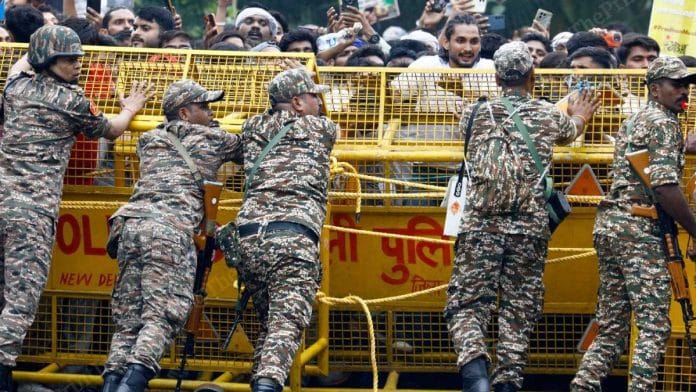


Over five weeks this summer, my travels have taken me to Delhi, Chennai and Sri City, Bangalore, Mumbai and Pune. I arrived roughly two weeks before the Jantar Mantar march to Parliament. The sea change after that march is unmistakable. The public sphere is freer, and the discussions far less constrained by fear. I would normally have predicted that the Hindu nationalist elite would lambast the protests of the young — their mockery, their satire, their choice of words and images for India’s post-2014 establishment — as Bharatiya sanskriti ke virudh (against Indian culture), even an insult to it.
Some have doubtless done that. But the topmost Hindu nationalist echelons have taken a very different approach. Instead of launching an unqualified culture-based critique of the behaviour of the young and hectoring parents and teachers to do a better job, they have used ambivalence as a strategy. They have criticised to some extent but also, more importantly, expressed a desire to understand the concerns of India’s youth better.
That ambivalence seeped into Prime Minister Modi’s Independence Day speech as well. Fresh youth programmes were announced, but a new term, “dimagi Naxal” (ideological Naxals), was also introduced to describe those “trying to lead the country in the wrong direction”.
It is quite understandable why the BJP, as a political party, would go for ambivalence, not downright condemnation. The voting statistics contain the strategic rationale.
According to the Lokniti database, of all age cohorts, the 18-25 group was the largest provider of votes to the BJP in 2019 and 2024. In the last two parliamentary elections, the BJP’s average national vote has hovered around 37 per cent. Though no age cohort has voted below 35 per cent, the 18-25 age cohort has averaged roughly 40 per cent. And the next age cohort, 26-35 years, is the second-highest voter for the BJP.
Since approximately two-thirds of India is below 35 years of age, these proportions constitute a huge bulk of India’s voting population. This holds true even if one takes into account the possibility that younger cohorts are less likely than older ones to be registered to vote. Electorally, the BJP’s victories cannot be explained without the vote choices of those below 35 years of age. And it is these cohorts that have rebelled.
There is one more pertinent way to cut the data. As stated above, the BJP’s average vote in the last two elections was roughly 37 per cent. But at 42-43 per cent, the urban vote was much higher than the rural vote. The Cockroach protesters looked overwhelmingly urban. The BJP cannot remain in power if the urban vote seriously declines.
Also Read: CJP impact — BJP’s narrative hegemony dented, the pall of fear lifted
When coercion becomes costly
Thus, two of the BJP’s organisational proclivities finally clashed as the protests continued. First, as a political party, the BJP naturally seeks votes to win power. And second, it uses force or ideological evangelism (prachaar) to change the minds of the citizenry.
The BJP’s leadership initially seemed to think that the use of coercion, symbolised most vividly in the deployment of pellet guns, would send the young back to their homes, forcing them to realise their follies. But soon, the futility of this strategy dawned. Coercion needed to increase for the movement to be crushed, but that would have increased the odds of vote loss among the cohorts most supportive of the BJP. Robert Dahl, a leading democracy theorist of the post-1945 era, used to describe this as the costs of coercion exceeding the costs of compromise, bringing about a democratic opening.
From the perspective of scholarship on protests, one more thing needs to be said. The Cockroach protests were not a theoretical surprise. They were an empirical surprise.
Mainstream protest theory makes two claims
—If opposition to the rulers cannot be fully or effectively expressed in the formal institutions of politics, it finds utterance on the street.
—If freedom of expression is truncated for long, then resentment keeps simmering until it gets an opening when an accumulated outburst takes place. Instead of low-key routine protests, spectacular rebellions break out.
The empirical surprises occur because the theory does not, and cannot, predict when the outburst will take place. Moreover, while the theory says that the accumulated outburst requires a trigger, it does not and cannot predict which trigger will work. That is the work of actual politics, not theory. The Chief Justice of India, by describing unemployed youth as cockroaches, has contributed a novel trigger to what the scholarship on protest calls the “repertoire of contention”.
Also Read: Who is a citizen in India? The answer will determine who has rights
Subsidies are no substitute for jobs
Another aspect of these protests concerns the political economy, and it has not been discussed enough. It is the idea of state subsidies versus employment. Let me explain through an anecdote.
During the 2024 national elections, I was doing field research in Awadh, the area around the city of Lucknow. My team and I met a middle-aged, lower-income couple. They expressed gratitude for Narendra Modi’s food ration scheme and said they would vote for the BJP. As is well known, 800 million people in India are covered by food rations, accounting for nearly 60 per cent of the nation’s population. The couple also said that the ration shop did not give them their full allocation — only 4 out of 5 kilograms per month — but that was better than before, when the ration shop owner would steal larger amounts.
But they also wanted us to talk to their son, who was to be found sitting in a shop in the nearby bazaar. The young man had an engineering degree from a college in Rae Bareli, an adjacent town. He said his parents were wrong in their approach. Exam papers for government employment had been leaked twice, and the exams were not held. That is why he did not have a job, even though he had worked very hard. He was emphatic that if he had a job, there would be no need for the government’s food rations. He would buy his parents all the food they needed.
This statement has a huge bearing on the recent student protests that were triggered by exam leaks. India’s youth would rather have a job than continue to receive government food handouts. To win power, the Modi government has relied mostly on government subsidies; it has not created enough employment. That strategy has perhaps reached a dead end with these protests.
To conclude, the protests most of all showed two things. Freedom of expression, if repressed for too long, can lead to a rebellion. And the government’s welfare subsidies cannot continue to substitute for jobs.
Ashutosh Varshney is Sol Goldman Professor of International Studies and the Social Sciences and Professor of Political Science at Brown University. Views are personal.
(Edited by Asavari Singh)
How will any govt produce jobs for all? 90% youths have to do some sort of business. or live on welfare. This is especially serious when most of them want office jobs after graduation. Do we need so many graduates? why should majority of youths not do trade courses ?
The article presents a false choice between welfare and employment. Food security and welfare support are not substitutes for jobs; they provide a safety net while India builds opportunities for sustainable livelihoods. Judging a nationwide policy through one family’s experience is insufficient to conclude that Modi’s welfare strategy has “reached a dead end.” The government’s approach combines welfare delivery with infrastructure, manufacturing, digitalisation, skilling, entrepreneurship and employment-linked incentives. At the same time, youth unemployment, graduate employability and quality of jobs remain genuine challenges requiring stronger action. The fair assessment is therefore not “food versus jobs,” but welfare plus skills, investment, productivity, jobs and rising incomes.
INDI state govts are doing far more freebies as a percentage of their budgets, than any BJP-ruled govt – Centre or State.
But, State govt indiscipline can be easily blamed on Centre by cunning opposition.
Maximum unemployment is in Opposition ruled states.
The softest spot on the twelve year Report Card would have to be job creation. In the Indian context, reliance on the services sector alone will not suffice. Make in India is almost as old as the government itself. The percentage of manufacturing in GDP has actually declined during this period. This is also keeping India’s merchandise exports in a trough.
Indian politics revolves around freebies including food handouts. Without it, the political system will collapse, and leftists will die of heart attacks.
Indeed, Prof. Varshney.
Modi’s strategy of handouts to the common man is suffering from the law of diminishing returns.
But what about you, sir? You seem to be on the precipice of good days (achhe din). With a bit of luck, your ‘acche din’ may start in 2029.
You just need to weather the storm till 2029. If things go well for you, the handouts directed at the common man currently by Modi will be redirected to you and other distinguished members of your cabal.