








Tata Motors is on a tear. Well, it’s a passenger vehicle business anyway. The company sold 59,000 vehicles in May, registering a growth of 42 per cent over the same month last year and firmly ensconcing the carmaker in the number two position for domestic sales.
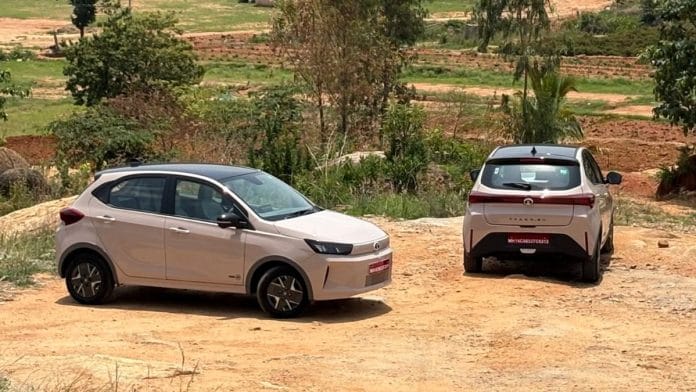
And it is hard not to see why. The firm has completely revamped its range over the past couple of years. I was in Bengaluru, yet again, to drive the latest such product, the refreshed Tiago hatchback. I drove all three powertrain options on the car—petrol, CNG and electric.
Let’s focus on the electric in this column.
Could the Tiago EV be the fabled affordable electric hatchback that the Indian market has apparently been demanding for years? Well, first things first, the Tiago EV is not a new product. It has been around for a few years. The refresh has finally made it look and feel more modern inside and outside.
It all comes down to range
Several specifications, such as the onboard infotainment system, are now identical to those on other Tata vehicles. The light-grey fabric on the seats and dashboard’s inserts gives the cabin a very nice, airy feel. The biggest change on the interior is the new steering wheel with a new ‘Tata.ev’ logo, which comes with a matte finish compared to the glossy steering wheel.
On the outside, too, new sculpted headlights and a redesigned nose add to the overall sense of being contemporary, although I prefer the nose section on the internal-combustion engine variant to the EV, which kind of looks more like a barcode.
However, EVs all come down to the battery and performance. Here is the catch: there are no changes to the size of the battery. You still get the 19.2 and 24-kilowatt-hour battery options. And that is actually a good thing, as I’ll explain a bit later on. The batteries have been updated to charge faster, and Tata Motors is promising 100 kilometres of range in just 18 minutes when using a 30-kilowatt fast charger.
But EVs are all about range, so what is the range on this? Well, the 19.2 kilowatt-hour model has a certified range of 226 kilometres and a real-world (what Tata Motors calls C75) range of approximately 150-160 kilometres.
The larger 24-kilowatt-hour battery pack has a certified range of 285 kilometres and a C75 range of 200-220 kilometres. While I did not test for range as such, driving down the Bengaluru-Hyderabad highway at 70-90 kilometres per hour and then through some rural roads, I averaged 120 watt-hours per kilometre, which works out to a range of 200 kilometres. I’m sure in urban driving, with higher regeneration in traffic, 220 kilometres of range should be easily achievable. The (very good) air-conditioner was constantly on, and I was listening to music or podcasts throughout.
That said, even the top-specification Tiago does not have paddles to switch between regeneration levels, and one has to constantly use buttons on the central console. While many users will keep the vehicle at a single level most of the time, I like moving up and down levels depending on the situation.
But to cut to the chase, I was not driving to optimise range. But the obvious question here would be whether the Tiago has enough range and whether it should have a bigger battery. And my feeling is that it should not. Because this is an urban commuter vehicle, meant to go from home to office or college or to the market and malls.
Also read: Honda has plans for India. The new City signals commitment
One for urban rides
This is not a long-distance cruiser. And because the battery pack is smaller, ergo lighter, the Tiago EV doesn’t feel heavy to drive. It feels nice and dynamic, like a small hatchback should.
Because the battery pack is smaller, the motor can be smaller. The 19.2 kWh battery pack produces just 61 horsepower, the 24kWh battery pack a slightly more impressive 74 horsepower. The top speed, however, is limited to 120 kilometres per hour, and given its raison d’etre of living in the city, that is more than enough. And that is also the legal speed limit on India’s newest and best expressways.
Most commutes, even in a large urban agglomeration like the NCR, are under 50 kilometres daily, so the Tiago has more than enough range for daily usage. Sure, there will be those who will take the Tiago EV on long drives and having driven electric vehicles a fair bit on Indian highways by now, there is more than enough charging support on major highways, so you will be able to charge the vehicle. That said, please check the charger and charging availability before planning any road trip on an EV, which can be done using the manufacturer’s own charging applications or those of charging networks like ChargeZone and Statiq.
A smaller battery also means that Tata Motors can keep the price of the Tiago EV under ten lakh, even for the top-spec 24kWh Creative+ variant I was driving, which costs Rs 9.99 lakh. Prices for the base Smart variant with a 19kWh battery start at Rs 6.99 lakh for full-ownership, and there is a Battery-as-a-Service (BaaS) package for Rs 4.69 lakh. While there is still a two-lakh-rupee ex-showroom price differential between similar petrol automatic versions, this is mitigated for the on-road price in many states where EVs have a lower rate of road tax and free registration charges.
However, it would only be correct for me to point out that while the Tiago EV has a running cost of around a rupee a kilometre with home charging, the petrol and especially the CNG versions are extremely efficient as well. But with rising petrol and gas prices, the difference is increasing, but this just highlights the fact that to take real advantage of an electric vehicle’s lower operating costs, one must have access to home or community charging, and that, as multiple stories have pointed out, is a huge issue.
Would I choose the Tata Tiago EV? If I had a need for a small urban runabout, and since I have a home charger, I definitely would. I think it makes immense sense, and unlike the MG Comet, the only vehicle that can be seen as ‘competition’, it does have four doors, a proper rear passenger seat and space for some small items of luggage. Given that Indian consumers are choosing to buy Tata Motors vehicles, this could be their next hit.
Kushan Mitra is an automotive journalist based in New Delhi. He tweets @kushanmitra. Views are personal.
(Edited by Saptak Datta)