








How quickly things can change in just about seven months. At the Japan Mobility Show in Tokyo in October last year, Honda was extremely bullish about its future, with CEO Toshihiro Mibe outlining the company’s ambitious plans in India, the rest of the world, and in Formula 1.
If you are a fan of F1 like me, you must have seen the ongoing disaster that has marked Honda’s new partnership with Aston Martin. Not all Honda’s fault though. According to F1 insiders, poor team management by their chassis partner Aston Martin has a healthy share of the blame as well. But this is not a good look for the Japanese carmaker by any stretch. And then there were Honda’s plans for the world. In Tokyo, I got up close and personal with the Honda Series 0, a SUV and a Sedan featuring a radical new design language both outside and inside. These were going to be Honda’s flagship products across North America, Europe, and China.
However, in March, Honda announced that they were pulling the plug on the Series 0 electric vehicles. The company declared its first annual loss in 70 years, a huge hit of $2.7 billion. Global tariff wars and shifting consumer preferences, particularly in the lucrative North American market, has taken a toll on the electric vehicle market. To be fair, Honda is not alone in this write-down of electric vehicle investment as other carmakers too struggle declaring massive losses amid competition from China and global tariff wars. Global carmaker Stellantis (owner of Citroen and Jeep, among other brands) declared a truly terrifying loss of $26.3 billion for 2025 and they’ve recently announced that they’ll co-develop the next Jeep for India with Tata, but that is another story.
Honda, on the other hand, doubled down on India. As Mibe told me in Japan, India is one of Honda’s three “key markets”, along with North America and Japan. The Series 0 Alpha, the third electric vehicle that Honda had showcased in Tokyo, is already being tested in India and is set for a 2027 launch, confirmed Takashi Nakajima, President & CEO of Honda Cars India Limited (HCIL), to me recently.
The ‘new’ Honda City
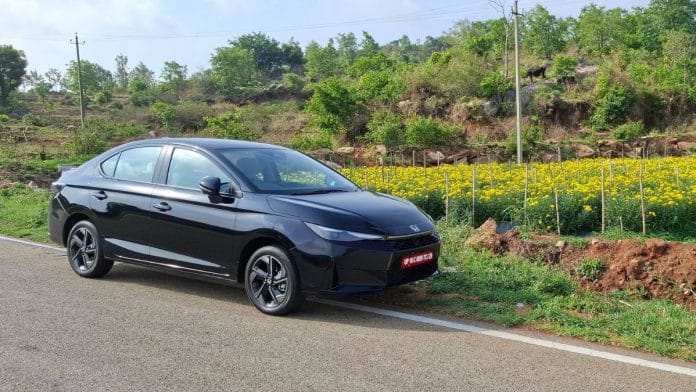
That brings me to the two vehicles that Honda has launched recently. Well, one of them, the City, is just a facelift, the other, the ZR–V, is a full import. The latter, while launched, will only be available from July-August. The City is available right away. These two vehicles mark the beginning of ten vehicle launches by the Japanese carmaker in India by 2030, which will include several new nameplates.
However, the Honda City is not an all-new car. Other than some cosmetic changes on the outside, like a new nose and connected headlights, and some additions inside like a larger screen, it is the same fifth-generation City that has been around since 2020. And while the City has been a reliable nameplate for almost 30 years now, unfortunately, for Honda, the C-segment sedan is a segment that is ‘de-growing’ as some put it, although smaller sedans like the Amaze continue to show some sales resilience.
The Honda City, which once was a sign of prestige for the professional classes, has now been surpassed by the desire for SUVs in the market. So should one consider the City at all these days?
I drove the Hybrid eHEV variant and, given the rapidly increasing fuel prices and the upcoming stricter third iteration of the Corporate Average Fuel Efficiency (CAFE) norms, the vehicle makes sense, until you consider that the hybrid costs Rs 3 lakh more ex-showroom than the automatic naturally-aspirated City with similar specifications. And that is a lot of dough, so until you are driving it a lot — I’m talking of 1,500-2,000 km a month — the technology, while highly advanced, might be expensive. I did write extensively about my experience with the City Hybrid before this facelift a couple of years ago and I averaged close to 24 kmpl. That said, some bureaucrat friends of mine feel that the Honda City Hybrid is the anointed successor to Maruti Suzuki Ciaz as their vehicle of choice, which might be a huge benefit for the carmaker.
Also read: Who should buy a BMW F 450 GS? It is characterful, encourages you to push a little harder
A placeholder?
If petrol prices continue to head north or the government incentivises buying hybrids with road tax and registration benefits, the math could change. If Honda offered the same technology on the Elevate SUV, it could be a different answer, and who knows they just might. The ZR-V, for example, will come with a hybrid engine and I can’t wait to drive, especially when in that heavier and larger SUV segment, the insane fuel efficiency of hybrids could make a major difference even at lower running.
Personally, I think the new City is just a placeholder, a statement from Honda that they are not going away from India. To buttress that point, they also said they will launch a sub-4 metre SUV by 2028 to compete with the Brezza, Venue, and Nexon. I like Honda cars, they’ve been part of my driving experience since I started writing about automobiles. My first-ever media drive was with the Honda Accord back in 2001. So yes, I do hope they hang around, because I like driving their cars.
Kushan Mitra is an automotive journalist based in New Delhi. He tweets @kushanmitra. Views are personal.
(Edited by Aamaan Alam Khan)
After GM, Fiat, and Ford, Honda will be the next to quit India. Vodafone and Honda are the two utter flop companies operating in India with laughable pricing, products, and strategy.