





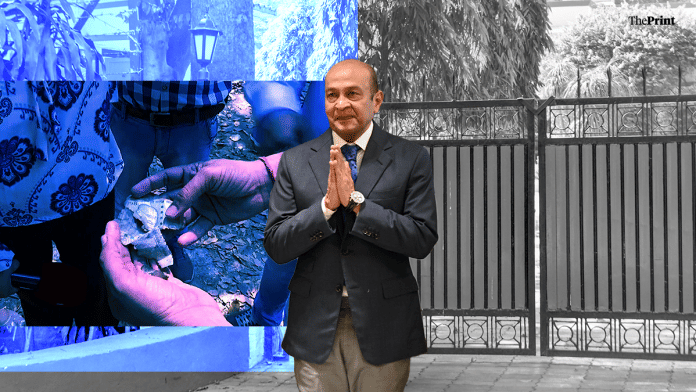

A three-member committee constituted by the Lok Sabha Speaker concluded earlier this month that the charges against Justice Yashwant Varma regarding allegations of corruption stood proved. After months of controversy, Justice Varma resigned this April. The initial public response to such an episode is to call for “transparency”.
Historically, there have been demands for mandatory public accounts disclosure for judges upon appointment. However, this is the wrong call to action. There are many ways to make the judiciary more transparent. Mandating prospective judges to disclose their assets to the public is not one of them.
How rich or poor a judge is on the day they enter office has almost nothing to do with their judicial capabilities, their professional track record or their integrity. In fact, Justice Varma was among the few who did disclose his assets upon assuming office. Rather than such cosmetic demands, it is far more productive to build institutional methods that minimise conflicts of interest when a judge is in office, and that monitor post-appointment income patterns.
The immediate context
After a fire broke out at his official residence on the night of 14 March 2025, stacks of unaccounted cash were discovered in a storeroom at the Tughlak Crescent home of the then Delhi High Court judge. Sensitive to public perception, the apex court acted swiftly by hosting a live webpage on the court’s website that tracked the letter exchanges between Justice Varma and the chief justices of the Delhi High Court and the Supreme Court, the in-house inquiry reports, photographs and more. In parallel, more than 145 Lok Sabha members and over 50 Rajya Sabha members signed motions for his removal under Article 124(4) read with Article 217 and the Judges (Inquiry) Act, 1968. A Parliamentary committee constituted thereafter found him guilty.
Since then, many have reflexively argued that the magic bullet for judicial corruption is judge asset declaration. It isn’t a new idea. In 1997, the Full Court of the Supreme Court adopted the Restatement of Values of Judicial Life — a sixteen-point code of judicial conduct — and, the same day, a companion resolution that every judge should declare their assets. This declaration was, nevertheless, optional. In 2009, though a Bill was placed in Parliament to write disclosure requirements into the law, it did not move ahead. As of 2025, only about 12 per cent of judges had declared their assets publicly. Beneath the careful legalese, every bit of the demand was subjective and open to non-compliance. A judge is to declare assets “within a reasonable time of assuming office (…) and thereafter whenever any acquisition of a substantial nature is made.”
But what counts as “substantial”? What is “reasonable time”? What if the acquisition sits in a relative’s name? And, above all — what does a declaration at the time of appointment actually tell us about a judge?
Also Read: Behind every Supreme Court petition is a waiting game
The wrong kind of transparency
A judge’s asset declaration is only a one-time snapshot of how rich they were at the time of their appointment. It is a stock number. What actually should matter is whether a judge misuses the office to enrich themselves unjustly. For this, we must track the flow.
Take the United Kingdom, for example, whose judges, like ours, are chosen through a non-political, merit-based process by an independent commission. The UK Supreme Court deliberately refuses to maintain a register of its judges’ interests. The institution believes that the public would assume completeness of such a register and that it could therefore be potentially misleading. Instead, a judge is bound to declare interest on a case-by-case basis, when it is actually relevant, and recuse herself if needed. This is governed by the Judiciary’s Guide to Judicial Conduct. The British government has officially taken the same view as well, holding that requiring judges to publish declarations of interest would risk undermining judicial independence.
While such a hands-off, self-monitoring approach is advisable from an independence point of view, it is fair and reasonable if the Indian public is suspicious of misuse of office given the chequered history of Indian State functionaries. Yet, assets at the time of appointment are the least relevant metric. Taking a leaf from how directors of publicly listed companies are asked to disclose their interests and their related-party transactions under the Companies Act, 2013 and SEBI’s listing regulations, the Judiciary must design mechanisms that track the flow of transactions and audit them for discrepancies.
Now, this is easy to game as well. Wealth is not always accumulated in one’s own name. Even for a continuous audit over time, throughout the tenure of a judge, there may arise a need to inspect the financial records of relatives. This will give rise to an accountability versus privacy trade-off. However, transparency to the public does not have to be accounting sheets hosted on the Court’s website for public consumption. It can also be disclosed to a public trust and function independently, thereby reducing privacy concerns while staying steadfast with demands for accountability. A CAG-equivalent, independent ombudsman can be responsible for this record-keeping and reconciliation. The figures they maintain may be put out for public consumption only if discrepancies surface.
Prevention over cure
Money is not the only currency of a corrupt judge, and income-tracing too must be gamed. We must also think of preemptive ways to institutionally prevent such incidents. One way of doing this is to identify and remove conflicts of interest before they can manifest and result in partial outcomes or impermissible transactions.
Today, for instance, even conflicts relating to prior clients, relatives and acquaintances are declared by judges voluntarily. Sometimes they are not declared at all, and it falls to counsel or litigants to stick their necks out and risk contempt by asking a judge to recuse. We saw this play out when Arvind Kejriwal sought the recusal of Justice Swarana Kanta Sharma in the Delhi liquor-policy case, on the ground that her children were empanelled as central-government counsel. She rejected the plea, remarking that a litigant cannot sit in judgment over a judge’s competence. Whatever one makes of that particular application, the design flaw is that the burden of spotting a conflict should not rest on the nerves of the party.
A better preventive method is to collect and collate, for each judge, the litigants they appeared for and against as a private practitioner, their prior offices, and relatives who practise in the courts. This is possible today at an institutional level, to some extent, given the extensive digitisation done by courts. Extraction of judge and lawyer names from digitised case records and orders, and subsequently mapping them for conflicts or proximity to potential conflicts is a useful internal due diligence check that the court can engage in.
Again, these lists need not be public if normatively we feel that publishing them risks picking apart a judge’s pre-judicial life in ways that would impede the job. As suggested above, a neutral ombudsman can hold them; or, better still, a secure database and a good algorithm that flags conflicts can assist in roster allocation with the least possible conflicts. This resonates in spirit with the UK’s case-by-case, conflict-managed model, surfacing the interest that matters, when it matters, rather than demanding a universal ledger of everything a judge owns.
Don’t scare good talent away
The judiciary is enriched, intellectually and morally, when the best of our lawyers are appointed as judges. They take steep pay cuts and surrender much of their privacy when they take up judicial office.
We are given to understand that the collegium already weighs all kinds of such sensitive personal material when it considers a candidate. Forcing them, over and above that, to make a public spectacle of their assets and income at appointment adds little in terms of actual outcomes. If anything, it carries the unintended consequence of pushing talent away, signalling that the onerous burdens of disclosure are simply not worth it. In India’s state of poor judicial infrastructure, we cannot squander away our most potent talent for invasive measures that do not even work.
Justice Varma’s infamy will fade from the front pages soon enough. When it does, we should not lose sight of the larger question — building enduring systems of accountability that are thorough without being onerous, and that catch the corrupt without deterring the capable.
Gokul Sunoj is a Legal Associate at TheProfesseer. He tweets @GokulSunoj.
Srikanth Rajkumar is a Developer and Data Scientist at TheProfesseer. He tweets @SonOfRajkumar.
Views are personal.
(Edited by Insha Jalil Waziri)