





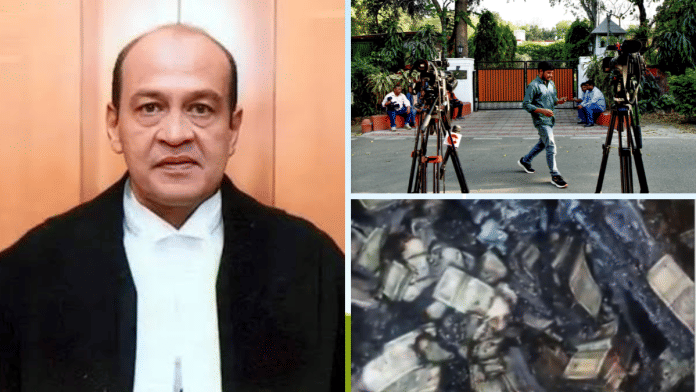


New Delhi: Seventeen months after burnt, unaccounted cash was found at his official residence in Delhi, a Judicial Inquiry Committee (JIC) indicted former judge Yashwant Varma on three charges—the discovery and possession of unexplained Indian currency notes within official premises, failure to preserve and cause interference with material evidence, and furnishing of evasive and misleading explanations.
The three-member JIC’s report tabled Wednesday in Parliament records an intense procedural battle and a meticulously persistent defense by a series of administrative demands, jurisdictional objections, and 11 formal Interlocutory Applications (IAs).
Though the then Chief Justice of India (CJI) had advised him to resign or seek voluntary retirement, Varma submitted his resignation to the President on 9 April amid parliamentary proceedings to remove him. He was originally scheduled to retire in 2031
ThePrint examines every request, application and procedural demand made by Justice Varma to the JIC, tracing how the Committee adjudicated each—from outright rejections of broad disclosure demands to the tailored allowance of specific official logbooks.
Also Read: ‘History will record unfairness’—what Justice Yashwant Varma wrote in letter to judges inquiry panel
Jurisdictional & constitutional challenges
Request: In a communication dated 4 December, 2025, Justice Varma raised a fundamental jurisdictional objection: challenging the JIC’s constitution and the request for stay. He asserted that, “….the constitution of this Committee by the Speaker of the House of the People alone rendered it invalid and contrary to the mandate of the first proviso to Section 3(2) of the [Judges (Inquiry)] Act”.
In tandem with this objection, he filed a writ petition before the Supreme Court in which he sought a stay on all proceedings before the JIC.
Outcome: Denying the same, the JIC noted that under Section 4(1) of the Act, it was fully vested with the authority to regulate its own procedure and continue its mandate.
On 12 January, the Committee perused correspondence revealing that the Supreme Court completely denied Justice Varma’s prayer for a stay of the inquiry. Consequently, the JIC recorded that it “did not deem it necessary to halt the proceedings at any stage during the parallel pending proceedings before the Supreme Court”.
At its sixth meeting on 19 January, the JIC placed on record the Supreme Court’s final judgment dated 16 January, which officially declined the writ petition and confirmed the legality of the JIC’s constitution.
Administrative & procedural discovery requests
Request: On 4 December, 2025, Justice Varma requested clear, legible, and paginated copies of all record materials. He pointed out that certain files listed as “relied-upon documents” by the JIC contained missing enclosures and annexures. He undertook to provide a list of specific discrepancies once the full record was received.
Outcome: Allowing the same, on 6 December, 2025, the Presiding Officer of JIC dispatched a comprehensive reply. The JIC furnished “clear, legible and paginated copies of the documents which were inadvertently missed or were not legible, along with copies of the witness statements as were recorded by the In-House Committee for ensuring fair disclosure of all the relied upon material”. In total, the JIC supplied four volumes of documents running into 1,089 pages, alongside 84 pages of witness statements.
‘Vague’ objections to incomplete documents
Request: In a follow-up letter dated 27 December, 2025, the former Delhi High Court judge again asserted that certain documents he received were “incomplete”.
Outcome: Because this second complaint was entirely general and “without mentioning the particulars thereof”, the committee secretary Ganpati Bhat informed Varma on 12 January that the JIC was “unable to process the request for providing enclosures as alleged to have not been supplied” due to the total absence of specific references.
Demand for JIC’s adopted procedure
Request: Justice Varma sought the supply of a formal, written copy of the specific procedure that was to be adopted by the Committee during the inquiry.
Outcome: The JIC declined to supply an independent “procedural code”, explaining that under Section 4(1) of the Act, the Committee is legally empowered to regulate its own procedure “from stage to stage”. The JIC assured him that the procedure would be guided by the statutory framework and the constitutional duty of providing a “reasonable opportunity” to cross-examine witnesses, adduce defense evidence, and be heard.
Also Read: Cash-at-home row: The 3 charges against Justice Yashwant Varma & what Inquiry Committee found
Extension of time to submit defense statement
Request: Justice Varma’s written defense was originally due on 21 December, 2025. Citing the voluminous nature of the record, he requested a six-week extension of time from the date he received the complete, legible record and procedural details.
Outcome: Balancing the need for a thorough defense with the time-bound mandate of the inquiry, the JIC granted a three-week extension, permitting Justice Varma to submit his written statement up to 12 January, 2026. To accommodate this shift, the JIC also rescheduled his formal personal appearance from 5 January to 24 January.
Oral hearing on sufficiency of charges
Request: Upon filing his written statement of defense on 12 January, Justice Varma raised several preliminary objections and requested a separate, intermediate oral hearing to argue the “validity and sufficiency” of the charges, demanding that the charges be dropped or modified before the JIC proceeded to record any evidence.
Outcome: At its sixth meeting on 19 January, the JIC rejected this request. The Committee ruled that Varma’s objections were essentially denials of the allegations that required a trial on the merits.
“…the scheme of the Act and the Rules does not contemplate an intermediate stage of oral hearing for adjudication upon the sufficiency of charges, once the Judge has been served with the charges and has submitted his statement of defence,” the JIC held.
Opportunity to file additional or revised statement
Request: At the first formal hearing on 24 January, Justice Varma’s legal team requested an opportunity to file an additional or revised statement of defense. This request was prompted by the JIC’s procedural resolutions of 19 January and Varma’s physical receipt of the CFSL digital pen drives on 23 January, which he wished to analyze and respond to.
Outcome: In compliance with the principles of natural justice and to afford the judge a full opportunity to meet the forensic evidence, the JIC granted this request, allowing Varma until 3 February to file his additional written statement.
Also Read: Clean-up job by Justice Yashwant Varma’s aides: What panel probing judge cash row found
The heavy disclosure applications
As the hearings advanced, Justice Varma’s defense team filed substantial IAs to include internal and uncited materials.
Request: Filed under IA No. 2, he sought copy disclosures of “all minutes, resolutions, decisions, orders and correspondence prepared or issued by the Committee since the date of its constitution”, arguing these were necessary to understand the procedural framework and participate effectively.
Through IA No. 3, Varma sought directions for the supply of the entire electronic dataset collected during the preliminary investigative stages, including a “clone copy” or “mirror image” of the CFSL pen drive.
Through IA No. 4, he sought to recall the JIC’s 19 January resolution to proceed with the inquiry and record evidence. The defense argued that under Section 3(3) of the Act and Rules 6 and 7 of the Judges (Inquiry) Rules, 1969, the JIC was legally required to hold a separate, preliminary hearing to adjudicate the “validity and sufficiency” of the charges prior to entering the evidentiary stage.
Under IA No. 5, the judge sought unrestricted access to the entire body of records and documents available before the Committee, including materials that were not cited as relied-upon documents in support of the charges. The defense argued that restricting access violated natural justice because uncited files might contain exculpatory material.
Through IA No. 6, Varma sought to modify the JIC’s adopted procedure to conduct the examination-in-chief of all witnesses viva voce (orally) rather than receiving them by way of written affidavit.
Under IA No. 7, he sought to defer the cross-examination of certain witnesses until the examination-in-chief of a larger, overlapping group of witnesses was completed. The defense argued that because several witnesses belonged to “common official clusters” (Police, Fire Services, CRPF) and would depose on overlapping aspects of the 14 March, 2025 fire incident and currency identification, immediate cross-examination would prematurely reveal the defense’s strategy, allowing subsequent witnesses to align their testimonies.
Through IA No. 8, the judge requested the JIC to issue summonses to the Delhi Police, Delhi Fire Services, and CRPF to produce original daily registers, visitor books, and fire occurrence logs concerning the blaze at his Tughlak Road bungalow on the night of 14 March 2025.
Assigned as IA No. 9, the defense sought to place on record a list of admission and denial of documents. The judge agreed to admit the “existence and execution” of a major block of documents, but strictly “without prejudice to his rights” and without admitting the “correctness of the contents”.
Outcome: On 5 February, 2026, the JIC rejected the application. The Committee held that administrative and deliberative materials are entirely distinct from the evidentiary basis of an inquiry: “Minutes of meetings, internal correspondence, logistical arrangements, and deliberative processes of the Committee are part of its institutional functioning and do not constitute material upon which the charges are founded or the inquiry proceeds.”
The JIC concluded that the requirements of fairness were fully met by providing the Articles of Charge, the statement of grounds, and the relied-upon documents.
The JIC rejected the application for a “clone copy” of the CFSL pen drive on 5 February, ruling that the broader dataset was extracted from mobile devices belonging to third parties. Disclosing non-relied-upon personal data would result in an “unwarranted invasion of the privacy of individuals”, it held.
A demand for a mirror image of the entire forensic database was “disproportionate to the requirements of the inquiry and was not supported by any statutory provision,” it said.
About the IA No. 5 seeking unrestricted access to the record available before the Committee, the JIC dismissed it on 13 February delivering a major procedural ruling. The Committee defined the constitutional boundaries of the inquiry: “Proceedings under the Judges (Inquiry) Act, 1968 constitute a sui generis constitutional mechanism designed to balance two imperatives: fairness to the Judge concerned and preservation of the integrity and functional efficacy of the institutional process entrusted to the Committee.”
The JIC flatly rejected the defense’s attempt to transplant adversarial criminal law standards (which involve prosecutorial power and potential deprivation of liberty) into a constitutional inquiry, calling it a “category error”. It concluded that, “natural justice was fully satisfied because Varma was provided with the full case he had to meet”. Granting unrestricted access to the JIC’s entire archive would “transform the inquiry into an open-ended discovery process and result in fishing for evidence,” the JIC noted.
It rejected the IA No. 4 reaffirming that the inquiry is sui generis (unique) and contains no intermediate “discharge” stage: “…the inquiry under the Act is sui generis in nature and cannot be equated with a criminal proceeding involving stages such as discharge or framing of charge, nor with a civil trial involving settlement of issues.”
The JIC held that the safeguards of natural justice are embedded directly within the trial itself through cross-examination and defense.
The IA No. 6 was also rejected on 5 February. The Committee pointed to Section 5(c) of the Act (conferring civil court powers) and Order XVIII Rule 4 of the Code of Civil Procedure (CPC), which explicitly permits chief-by-affidavit. The JIC held that receiving affidavits in advance facilitated an orderly, efficient process and gave the judge more time to prepare a focused and effective cross-examination.
For IA No. 7, the JIC declined the request to “stall” or indefinitely defer cross-examinations, finding the defense’s fears of witness alignment to be speculative on 13 February. To ensure clarity and coherence, it adopted a “structured framework for sequencing”. The Committee directed that the first responders—specifically the fire department officials—would be examined and cross-examined first, ensuring an orderly flow of evidence without stalling the trial.
As for IA No. 8, the JIC allowed the application in part on 13 February. Acknowledging that these contemporaneous official records had a direct bearing on the credibility and cross-examination of the witnesses, it ordered the production of specific, targeted documents.
The JIC declined “omnibus” or speculative requests for other uncited public documents, noting the time-bound nature of the inquiry under Rule 9(2)(c) (of ????)1969 Rules. It also clarified that the physical production of these documents would not operate as a ground to stall the ongoing recording of evidence.
For IA no. 9, the Committee accepted it on 14 February, directing that the admitted documents be marked as Exhibits, subject to subsequent proof of contents and relevancy, significantly streamlining the trial’s documentary record.
To isolate & specifically mark hourly daily diary entries
Request: During the proceedings on 16 March following the physical production of the original registers, Varma’s defense counsel requested that specific pages and hourly entries within the massive police and fire registers be isolated and marked to facilitate their effective use in cross-examination.
Outcome: With no opposition from the presenting side, the JIC permitted the precise marking. Specific entries were officially isolated and marked as Exhibits.
Deferral/adequate time to prepare cross-examination
Request: On 15 March, after receiving the final three affidavits of Delhi Police witnesses at 4:40 p.m., senior advocate Siddharth Aggarwal submitted that because these affidavits had just been received, adequate time ought to be granted to enable proper preparation for cross-examination of five witnesses.
Outcome: The JIC balanced the requirement of fairness with the need to avoid unnecessary interruptions. It directed that upon the completion of the examinations-in-chief (i.e., the first time a lawyer questions their own witness in court), cross-examination must proceed without delay. However, because the five witnesses were physically unavailable on that day, the JIC adjourned the trial to 16 March. This natural adjournment effectively provided the defense with the preparation window they had requested, without granting a general deferral on procedural indulgence.
IAs for CDRs, location tracking of head constable
Request: Filed on 16 March, these late-stage applications sought highly specialized electronic tracking. IA No. 10 requested directions to summon the Call Detail Records (CDRs) and location data of mobile number belonging to Head Constable Ajit Singh, Delhi Police, a witness, for the period from 13 March, 2025, to 16 March, 2025.
IA No. 11 requested the physical production of Singh’s mobile device and his corresponding Google Takeout location data to test the veracity of his movement.
Outcome: The JIC initially deferred passing orders. However, on 17 March, the presenting side formally declared that they would not be examining Singh as a witness. As the necessity for his cross-examination dissolved, the defense counsel submitted that both applications would not be pressed. The JIC officially dismissed IA Nos. 10 and 11 saying that they were not pressed, while granting liberty to Varma to revive them if the witness was ever proposed to be examined in the future.
(Edited by Tony Rai)
Also Read: SC’s transparency in Justice Yashwant Varma cash controversy draws praise from legal fraternity