



In the aftermath of the nationwide protests and the police action in Delhi on 20 July, several petitions have been filed in the Supreme Court for enforcing fundamental rights against the State. These range from Junaid Malik’s plea for wrongful detainment to Manoj Kumar Jha’s petition seeking FIRs against police excesses and a Gurugram protester’s plea over her pellet-gun injuries. Filing a petition in the Supreme Court is, however, only half the battle. Whether your petition gets a hearing depends on several moving parts: how quickly the registry processes defects in the case, whether a ‘mentioning’ succeeds, how urgently you push to cure those defects and ultimately, whether the Court’s docket has room for you.
The question that comes next before the litigants who have approached the court is this: when will their case be listed? In a system where cases can take years to get disposed of, the first hearing is arguably the most important event, because it decides if the case will be admitted by the Court, to begin with.
In the days immediately preceding the protests, our report used data to explore how protest-friendly Indian High Courts have been. In this article, using TheProfesseer’s database, we measure the time it takes between filing a case and its first listing. Observing cases filed between 2020 and 2026, we find that, contrary to popular impression, the median case takes just about 32 days to get its first hearing after it is filed—albeit with a few extreme outliers. This pattern has held steady over the past five years and is largely unaffected by the Master of the Roster. We also find that the Court is more expeditious when it is moved by a private party than when it is moved by the government.
When can you hope to get heard?
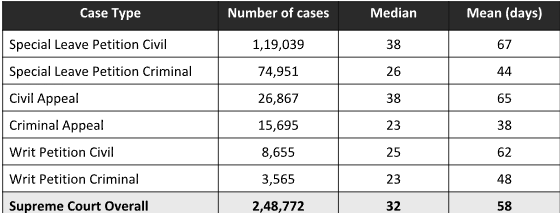
First hearings are crucial milestones in case lifecycles. These are the moments when the Court, if satisfied that there is merit in the case, formally directs notice to be served on the other side. Usually the first hearing is also when urgent interim relief such as protection from demolition or a stay on a High Court order, is granted or refused. Table 1 below shows that, across our dataset, the median age at first hearing is 32 days.
In other words, if you were to file a case today, the odds are that it would be listed in the Supreme Court for its first hearing a little over a month later. This could be due to several reasons, first, the petitioner has 30 days to refile a petition, after curing defects and it possibly takes a few days to process for listing. Second, fresh matters, unless urgent, are usually listed on Mondays and Fridays, with no more than 60-70 fresh matters per court. Third, even beyond the 30 day refiling limit, petitioners can refile with a delay, which is often condoned by the court.
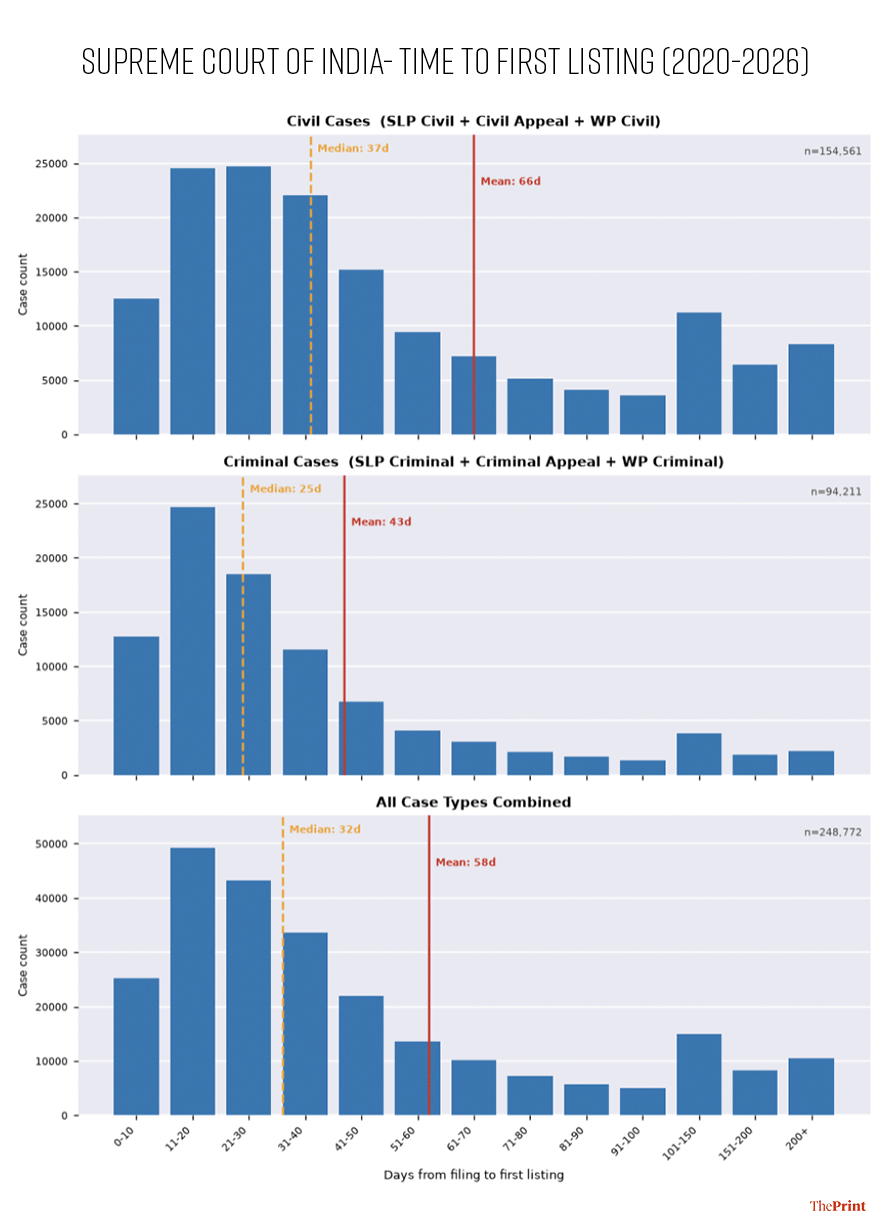
There is, however, considerable variation around the median. Figure 1 below shows the distribution of these cases across time buckets. While half of the cases filed are listed within 32 days, the remaining half stretches into a long tail, with some cases waiting over 200 days for their first hearing.
Since our dataset covers only cases filed from 2020 onwards, it is likely that even older cases — those filed before our window opens — are still waiting for their first listing, which would push this tail out further still. What explains these outliers? It is plausible that this tail reflects petitioner inaction as much as Court delays.
Many cases languish in defects indefinitely because the petitioner has simply moved on, or strategically chosen not to cure them. Second, strategic litigants often file petitions primarily to create the appearance of a pending matter before the Supreme Court, leaving defects unattended as a kind of indefinite holding pattern. While the Supreme Court Rules, 2013, prescribes a procedure for an ‘Office Report on Default’, if defects are not cured in 90 days, it is possible that the court is not dismissing such petitions for non-prosecution.
Across all case types—it stands out from Figure 1 that civil case types take longer to reach a first hearing than criminal ones. Criminal matters carry an urgency, often involving personal liberty, that pushes them up the queue.
Our database also shows that on average, cases end up getting hearings a few days sooner than their designated date of ‘first listing’. While on first glance this may seem like an anomaly – it is, in fact, a feature of the Supreme Court’s “mentioning” system. Under this practice, lawyers mention urgent matters that haven’t yet been listed. The court can, in its own discretion, take them up for hearing. Historically, senior counsel typically drive these mentions and recent reforms have aimed at making the process more streamlined.
Is this pattern consistent?
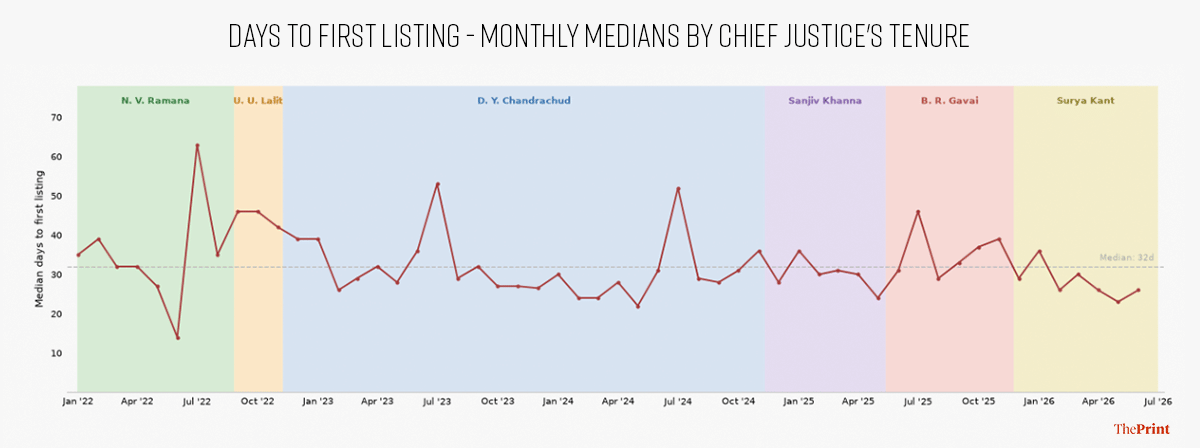
This pattern has held for the better part of the past decade. As Figure 2 shows, the first listings of the court are, predictably, likely to happen around the first month of filing. This consistency also holds across case types through different Chief Justices’ terms. The Court’s sense of which case types deserve priority appears remarkably stable, with no significant shifts visible in the data.
One development worth watching is Chief Justice of India Surya Kant’s recent decision to constitute four additional benches on non-miscellaneous days (Tuesday, Wednesday, Thursday) to dispose of long-pending, legacy cases. While this should help clear the legacy backlog faster, the judges on these benches continue to sit on admission benches on Mondays and Fridays as well — meaning the inflow of fresh cases continues at its usual pace, even as judicial bandwidth for hearings on non-admission days is redirected toward long-pending matters. Whether this trade-off ends up shortening or lengthening the time to disposal for cases already in the system remains to be seen.
Also read: Why India’s court digitisation keeps failing
What if the government were a litigant?
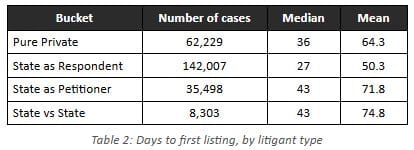
Finally, we look at whether the Court’s docket management changes when the government is a party. Specifically: if the government is the petitioner in a matter, does the Court fast-track it? Likewise, if the government is a respondent, does the Court deliberately delay the hearing? Either pattern would be a signal of a Court that treats government litigation favourably, with government interests in priority over disputes moved by private persons. We use petitioner and respondent names from the case metadata to sort cases into four buckets — purely private disputes, cases with government as petitioner, cases with government as respondent, and government versus government litigation.
The data in Table 2 shows that the Court is, in fact, somewhat quicker to hear cases initiated by private petitioners. If a private person files a case against the state or against another private entity – the court seems to list and hear it with greater haste. Cases where the government is the petitioner, or where two government parties are pitted against each other, tend to take a little longer to reach their first hearing. At the State’s end, this could be due to several reasons, a strategic call by the government department, delay in receiving instructions from the department, or panel counsels inundated with government briefs that result in defects being cured at a slower pace. Irrespective, the average citizen’s matter getting priority in the Court’s docket is a positive signal.
None of this, however, tells us anything about the actual relief a litigant eventually gets. This analysis is confined to the first hearing alone – which is, at best – a gateway and not the destination that litigants hope for. Legal scholarship has, in the past, focused on how Supreme Court outcomes have shifted over the decades, but process predictability is itself a form of justice, independent of who ultimately wins. And that predictability rests not only on when the first hearing arrives, but on the rhythm of everything that follows.
Beneath the numbers that we showed above lies a churn of confusion, speckled with mentioning memos, adjournment letters and computer-generated “tentative dates”; through which every litigant must find their own way, mostly guided by guesswork and estimates. This uncertainty is, by itself, a cost that every litigant pays, long before a case is ever decided.
Rashika Narain is an Advocate on Record, Supreme Court of India. Gokul Sunoj is the Founding Lawyer at TheProfesseer. Views are personal.
(Edited by Ratan Priya)
It remains the sole prerogative of the Hon’ble SC to accord ‘priority’ to various petitions filed before it either by private individuals or the state. However, the manner in which a large number of petitions (concerning the CJP protests) have reportedly been filed before it, the same seems to be unusual. It may also be added here that both erring cops and the violent protestors deserve to be dealt with strictly as per law of the land.