



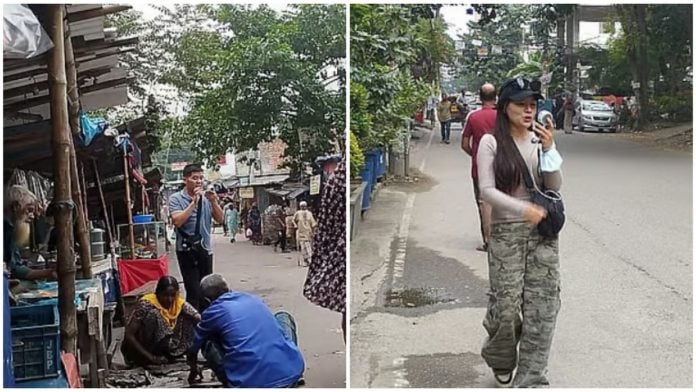
India’s foreign ministry said on Tuesday that the Chinese livestreamers filming Dhaka’s poorest lanes and passing the footage off as from New Delhi undermine the credibility of “the actors involved and those behind them.” Unnamed officials went further, telling PTI that this was a coordinated anti-India campaign.
But is this really state-directed psychological warfare? Indians, not to mention the Bangladeshis whose homes are being filmed, have every right to be offended. But the evidence on the record so far points toward creators exploiting and mocking poverty-stricken South Asians for profit—a business rather than a psyop.
This genre is hardly new. In the 25 years since my first Chinese language class, I’ve spent two years in Taiwan and six at Chinese tech companies in the Bay Area, where the real work happened in Chinese over WeChat. I have seen the full range of Chinese attitudes towards India, from warmth and curiosity to indifference and, sometimes, contempt. On Chinese web forums in the 2000s and on Bilibili today, captions like “印度阿三又在自己喝水的粪池里洗澡了” (“The A-San are bathing again in the cesspool they drink from”, with A-San being a slur for Indians) have farmed engagement for years. Dhaka is simply a cheaper, closer set for an old show.
Follow the money
The answer was in the reporting all along. ThePrint was the first national Indian outlet I found to flag the story’s commercial dimension. Bangladeshi media quoted a Chinese streamer and a Bangladeshi guide who said the streams were product promotion, earning money on WeChat and Douyin, China’s counterpart to TikTok. Local residents told ThePrint that crews filmed in pharmacies stocked with Indian shampoo and Kesh King hair oil, paying shopkeepers Tk 500. One streamer ran a giveaway asking viewers to guess the brand of the Chinese air conditioners on nearby buildings.
That is livestream commerce, or 直播带货, where high-engagement content—often provoking strong emotions such as excitement, disgust or pity—accelerates conversion of viewers into sales. Similar Bangladesh “poverty porn” accounts I reviewed on WeChat sell everything from toothpaste to cosmetics, with listed sales ranging from the hundreds to nearly 10,000. Two of them, 疯狂的小毛闯世界 (Crazy Xiao Mao Takes on the World) and 哈哈环游世界 (HaHa Travels the World), are verified to media companies in Xiamen and Changsha registered for video production, advertising, talent management and online retail. The trail leads to Chinese multichannel networks (MCNs), not the Ministry of State Security.
The numbers deserve scrutiny too. Bangladeshi residents quoted by Prothom Alo estimated more than 150 streamers, and the paper said no accurate count exists. Yet a figure of 5,000 or more, drawn from residents’ estimates and likely counting members of Bangladesh’s sizable Chinese community, now circulates as purported evidence of a state campaign.
Also Read: Jensen Huang affair — The spy, the seductress and the story we keep falling for
Beijing’s own embarrassment
If this is a state operation, Beijing’s own echo chambers are behaving strangely. A Weibo news blogger tagged the story as streamers’ “乱象” (misconduct). The WeChat account 华人在孟加拉 (Chinese in Bangladesh), which claims tens of thousands of followers, posted a notice from 孟华联会, a Chinese community federation, urging members to report “problem” bloggers.
China has seen this business before at home too. Creators had few qualms about exploiting their own countrymen’s poverty until Beijing intervened: authorities shut down five MCN firms and jailed a company head after influencers posed in derelict homes in Liangshan, Sichuan, to sell counterfeit “mountain” produce. In 2025, China’s internet regulator made staged filming a campaign target. Dhaka may simply be where the business went next.
Interestingly, AI models may apply different standards to filming poverty depending on the location.
In a small experiment, I used an automated AI stress-testing tool to simulate 12 conversations in Chinese with two AI models, one Chinese and one American. The tool posed as a creator planning poverty livestreams in rural China and in Dhaka, with each conversation running up to 18 turns.
While both refused to pass Dhaka off as Delhi or to use anti-Indian slurs, they nevertheless treated filming poor South Asians as routine business, providing detailed guidance on filming locations and evading police scrutiny. When it came to such content in rural China, the American model refused to assist, while the Chinese model offered workarounds such as switching phones and SIM cards to evade account bans. Twelve conversations prove nothing statistically, but do provide cause for further investigation.
A global market for contempt
None of this is uniquely Chinese. American YouTuber Tyler Oliveira’s teaser “Inside India’s Poop-Throwing Festival” passed 5 million views. The Network Contagion Research Institute found that anti-Indian posts on X roughly tripled in 2025, drawing more than 300 million views, on a platform that pays creators for engagement.
Nor is Chinese state activity against India negligible. Meta has removed China-based networks that posed as journalists covering Arunachal Pradesh, and another posing as Sikhs. Beijing courts South Asian audiences directly in Hindi, Bengali, Tamil and Urdu. Indians, and Americans, should take China extremely seriously.
But this also means being precise. The reflex to brand crass content a psyop, and its makers agents, is the same reflex that brands Chinese Americans and, increasingly, Indian and Hindu Americans as foreign proxies without evidence. As a managing director at the Hindu American Foundation, I have watched such accusations against organisations like ours migrate into Wikipedia and, from there, into the answers AI models give. Baseless accusations help no one, least of all those serious about countering real adversaries.
Precision also points to better remedies. Since India banned WeChat and more than 200 other Chinese apps in 2020, Indians mostly encounter such content, Chinese or otherwise, on American platforms such as X, YouTube and Instagram. New Delhi can press Chinese platforms to apply the rules on staged content they enforce at home to their creators abroad, and press American platforms on the monetisation that rewards hate. Expelling a few streamers will not close the market for exploitative poverty porn.
Also Read: Indian yogis once crossed China’s borders as Buddhist monks—merchants to spies to diplomats
The elephant in the room
The Chinese idiom 盲人摸象, referring to the parable of the blind men and the elephant, came to China from India through Buddhist scripture. Each man mistakes the part he can touch for the whole. Chasing phantom Chinese spies in Dhaka risks the same error: mistaking a grubby market for a state plot, and missing the larger animal of platform incentives. Indians would do well to heed their own wisdom, especially about an enormous neighbour that has been studying them far longer than the other way around.
Raj Rao is the managing director of operations and public affairs at the Hindu American Foundation. Views are personal.
(Edited by Asavari Singh)