



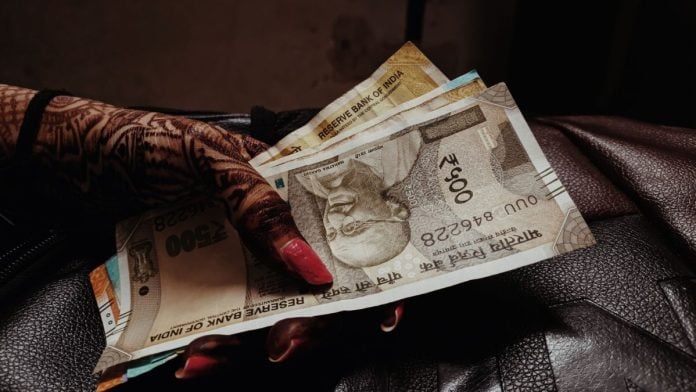
Andhra Pradesh Chief Minister N Chandrababu Naidu has called upon the Union government to scrap Rs 500, Rs 1,000, and Rs 2,000 currency notes, proposing that only Rs 100 and Rs 200 notes remain in circulation to help curb corruption and promote digital payments. Coming on the 10th anniversary of the demonetisation announced by the Narendra Modi government on 8th November 2016, Naidu’s statement appears to have been made after deep thinking rather than a random suggestion.
He argues that scrapping notes of a larger denomination will help eradicate corruption and will also nudge people to switch to digital methods for larger payments. However laudable his suggestion may be, Naidu needs to study the objectives of the demonetisation announced 10 years ago and its socio-economic impact on people and the economy.
At the time, in a sudden and surprising move, Prime Minister Narendra Modi made an announcement, believed to have been kept a secret even from the members of his cabinet, that Rs 500 and Rs 1,000 banknotes were declared invalid as legal tender from midnight that day. This affected nearly 86 per cent of the currency in circulation with immediate effect.
The government argued that demonetisation was necessary for five main reasons. One was that it would help eliminate black money, unaccounted money, that was fuelling a parallel economy in the country. The second was to channel this unaccounted wealth into the formal economy. The third was to mop up the cash in circulation and facilitate the introduction of a digital economy, which made it harder to generate large amounts of cash, thereby curbing corruption. The fourth was to stop the generation, printing and distribution of counterfeit currency that was being funnelled into the economy at all levels. The fifth, considered a strategic decision made for national security, was to strike at the root of terror financing.
Also read: US midterms a signal for India—build bipartisan ties & work on policies, not personalities
The demand for a second demonetisation
Ten years later, one of the allies of the NDA government is asking for a second demonetisation, precisely for some of these five objectives — combating corruption and scaling up the digital economy, which will drastically reduce the circulation of cash.
For political reasons the government may not reject Naidu’s suggestions, after all he is one of the pillars supporting the coalition government. However, accepting his suggestion would also be tantamount to accepting that the main objectives of demonetisation were not achieved.
As was planned, the extent of counterfeit currency, estimated to be around 86 per cent of the cash in circulation, witnessed a massive dip. The RBI reported a fall of about 50 per cent in the printing and distribution of fake notes. But critics of demonetisation argue that with strict monitoring and a swift crackdown on criminals and illegal cross border operators, such notes could have been flushed out of circulation. Besides, currency notes embedded with easily detectable codes and watermarks, along with machines to read the codes could have solved this problem.
What could have been achieved through smart policing, strict rules, and strong punishment was attempted through a very complex method. Demonetisation was like using a cannon to kill a fly. Meanwhile, the counterfeit currency business seems to have regained its foothold in the last couple of years.
According to the RBI’s 2017–18 Annual Report, currency worth Rs 15.417 lakh crore was demonetised. Currency worth Rs 15.310 lakh crore returned to the banking system which means approximately 99.3 per cent of demonetised currency was returned. Depositing undisclosed cash into banks could still help tax authorities identify suspicious transactions. However, much of the unaccounted money was successfully deposited into the banking system, making it legal and traceable. This suggests that very little ‘black money’ as it is popularly known, was actually taken out of circulation. The Income Tax department must explain this anomaly.
However, there is an important aspect of black money that has escaped the demonetisation net — property, gold, benami assets and overseas accounts.
The government has not officially acknowledged that demonetisation failed to make a substantial amount of black cash worthless, as was expected.
On the digitalisation front, the government takes credit for the automation, net banking system, and the robust UPI payments module that has revolutionised the economy and mopped up cash at several levels. But all of these existed before demonetisation and giving a fillip to these did not actually require a big effort.
The government did put its best foot forward and took a bold step in rolling out the demonetisation process. The initial serious approach should have continued for some more time to meet the objectives. It appears that this determination was found to be lacking as things began to get sorted out. It would do good if the government seriously made efforts to review demonetisation and correct the anomalies and plug the loopholes. The earlier the better.
Seshadri Chari is the former editor of ‘Organiser’. He tweets @seshadrichari. Views are personal.
(Edited by Janaki Pande)