



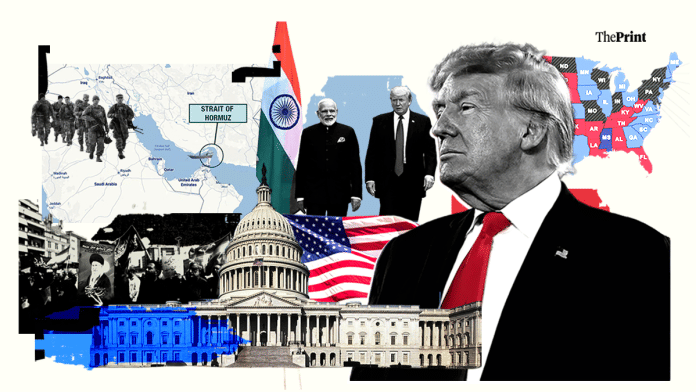
The fractured mandate at the Knesset in Israel following the 27 October elections and the 4 November mid-term poll outcome in the US could prove to be a watershed moment in global geopolitics, leading to massive economic and political policy changes globally. But it is too early to conclude that these election outcomes will herald the changes very soon.
Out of the 120 seats in the Knesset, Israeli Prime Minister Benjamin Netanyahu’s Likud party has managed to emerge as the single majority party, winning 53 seats without getting the majority 61 seats required to form a government. The main opposition, the centrist Yashar party, led by former Army chief Gadi Eisenkot, has won 48 seats, which can form a coalition government with 19-seat-strong Arab parties. While the arithmetic looks simple, the ground realities in Tel Aviv are extremely complicated.
Four possible scenarios could emerge in the coming days.
One is that the outgoing prime minister might form a minority government that would be short-lived. In that case the speaker will have to call Gadi Eisenkot to form a government who in turn will have to seek the support of the Joint List, a left-wing political alliance of Arab-led and mixed Arab-Jewish parties in Israel who have 11 seats in the 120-member Knesset. Combined with Ra’am’s (United Arab List party) 8 seats, Arab-led parties have secured a historic 19 seats in the parliament, making this block a potential key player in shaping the post-election government landscape.
If this happens, ironically, parties enjoying the support of Israel’s Arab population will influence the policies of a Jewish state. Incidentally, Gadi Eisenkot, during the campaign, had outlined four core principles that any potential partner or lawmaker must accept to join or cooperate with a government led by him. Besides recognising Israel as a Jewish, democratic, liberal, and egalitarian state, commitment to the values of Israel’s Declaration of Independence and accepting mandatory military, national, or civilian service for all Israeli citizens. The fourth significant demand was recognition of Hamas as a terrorist organisation and a commitment to destroying its military and governing capabilities in the Gaza Strip.
The third possibility of a national unity government looks bleak due to lack of consensus and disagreement on a common minimum agenda among the parties.
Finally, if no government is stable, there will be another election called by President Isaac Herzog early 2027 as the caretaker government can continue only for 12 weeks. In any case, the next few weeks could witness significant political uncertainty, having serious implications for the ongoing conflict in West Asia, combining unpredictability and increased military operations and counterattacks by non-state actors.
Also read: Rubio’s India visit shows US is putting energy and business before diplomacy
Congress of Democrats
The aftereffects of the Israeli elections on West Asia will have to be assessed in the context of the results of the mid-term polls in America. The massive defeat of the US President Donald Trump-led Republican Party in the Senate and the Congress severely decreases Trump’s power in his final two years in office by forcing him to rely on Democrats to get work done.
Trump has announced the end of the Obama administration’s ten-year military aid of four billion US dollars to Israel, a demand made by the Democrats. Trump may have to tweak his MAGA (Make America Great Again) agenda to accommodate the Democrats’ demands to seek their support for his domestic policies.
A large section of Trump’s supporters has voted against his domestic policies, price rises, and the worsening economic situation, effectively highlighted by his opponents during the poll. But this itself does not give Democrats the power to make course correction. They will have to project alternate policy models; keep the promises they have made to the voters and pull America out of the conflicts that it has gotten into. These are easier said than done. So, it is doubtful that there will be major changes in immigration and foreign policies.
Netanyahu has been urging Trump to resume attacks on Iran and neutralise its nuclear capabilities. He needs escalation to cobble a minority government and remain in power as long as possible. Trump may not oblige, as Vice President JD Vance’s recent letter to Mohsen Rezaei, secretary of Iran’s Supreme National Security Council, suggests. The US would prefer to renew the diplomatic process.
In a candid admission, VP Vance blamed the Iran war for the election defeat, saying, “it’s ‘obvious to almost everyone that war on Iran is ‘the reason we lost’ midterms’”. Only time will tell if the Democrats succeed in using their majority in Congress to keep Trump and Netanyahu away from escalating the nine-month-old conflict.
The White House needs to do a sincere introspection of its policies toward India, the tariff war it has unleashed, and the shabby treatment meted out to Indian professionals in the US. The trust deficit between the over six million Indian voters and the Republican Party and the disillusionment over Trump’s immigration and visa policies have resulted in the poll debacle.
There is a lesson in this for the Democrats too. If they wish for their candidate to occupy the White House in 2028, it would do them immense good to develop good relations with New Delhi through India-friendly economic and domestic policies.
As for New Delhi, it is time to build bipartisan relations with Democrats and Republicans, disabuse leaders of both parties of the risk of estrangement from India, and work more on policies and less on personalities.
Seshadri Chari is the former editor of ‘Organiser’. He tweets @seshadrichari. Views are personal.
(Edited by Ratan Priya)
Not personalities. That is a broader, constructive takeaway for Indian diplomacy. There are no personal relations, or chemistry, in international relations. Cool calculation on both sides, agnostic to personages.
Both India and USA are in the process of re evaluating their utility to each other. Evidently in relation to dealing with China. Also more broadly, including economic issues. 2. Dr Shashi Tharoor has expressed surprise, disappointment over how little the Indian diaspora has contributed to arresting the slide under Trump 2.0. They are US citizens. Their prosperity is woven around USA, not India. They are also conscious of a changing mood towards immigrants, non white, non Christian, MAGA its most virulent form. Unrealistic to consider them a strategic asset for India.