




The first phase of the Gorkhaland agitation in Darjeeling ended with an accord, but only for so long. All three parties to the Darjeeling Gorkha Hill Council Memorandum of Settlement had their own reasons. Signed at the Kolkata Raj Bhavan on 22 August 1988, it was between the Government of India, represented by Union Home Secretary GC Somiah; the Government of West Bengal, through its Chief Secretary RN Sengupta; and Gorkha National Liberation Front supremo Subhas Ghising.
By acting as a guarantor to the accord, the Centre ensured that the GNLF formally dropped its demand for a sovereign or separate state of Gorkhaland in exchange for a semi-autonomous hill council established under state legislation. The Union government was concerned about the large number of ex-servicemen mobilised by Ghising for the Gorkhaland movement — particularly in the light of a section of Sikh troops deserting the Sikh Regimental Centre in Ramgarh Cantonment in June 1984 after Operation Blue Star.
Meanwhile, the Left Front government in Bengal had been able to retain the territorial integrity of the state. Any concession in Darjeeling could have led to a flurry of similar demands for a ‘Jungle Mahal’ by the Santhals, Mundas, Bhumijs and Lodhas in contiguous blocks of Jhargram, Bankura and Purulia, as well as by Rajbanshis in the North Bengal districts of Cooch Behar, Jalpaiguri and Alipurduar.
A dominant section within the Left Front, especially the North Bengal lobby, looked upon the accord as a short-term palliative to buy time before CPM cadres could regain control over tea gardens and workers’ unions and thereby ‘capture’ the Darjeeling Gorkha Hill Council (DGHC) in much the same way as they controlled all Zilla Parishads in West Bengal, with the exception of Malda and Murshidabad.
As for ex-serviceman Ghising, he not only got a Council with unbridled powers, but also the protocol and status of a state minister, with a pilot and an escort, and two exclusive Gorkha Bhawans in Kolkata and New Delhi.
The powers granted to the council under the DGHC Act of 1988 were significantly more expansive than those of a standard Zilla Parishad. The DGHC was assigned over 20 subjects, including hill roads and public works, primary and secondary education, tourism, public health and hospitals, and small-scale industries. It also had a distinct Council Fund, with provisions for direct consolidated budget allocations from the state and central governments.
The Council got its own Principal Secretary and secretaries to look after the development departments such as health, education, agriculture and so on. But the DGHC did not directly control either the funds or the functionaries. All proposals from the DGHC were referred to the Hill Affairs Department and, more often than not, the charge was held by the Home Secretary.
Also Read: Has 6th Schedule outlived its use? Political deals do the work now, Darjeeling to Nagaland
On-ground implementation
Unlike in other districts of the state, where the Left Front regime had transferred effective control of development administration to elected panchayats and placed BDOs as executive officers, this was not the case with the DGHC. Neither were the revenue and police officials under the control of the Council, thereby making the DM of Darjeeling structurally more powerful than the Council chairman, whose jurisdiction did not even cover the entire district.
Whether or not Ghising understood this structural anomaly back then is unclear. He was certainly basking in his own glory, with both the Congress and the CPM seeking his support for the Darjeeling parliamentary seat. In 1989 and 1991, he extended support to Inder Jit, first as a GNLF candidate and then as a Congress candidate. In the next three elections — 1996, 1998 and 1999 — he indirectly supported CPM candidates Ratna Bahadur Rai, Ananda Pathak and SP Lepcha.
By this time, Ghising had also realised that running the DGHC under the West Bengal statute was quite difficult, and started looking for Sixth Schedule status. When his third term at the helm of the DGHC ended in March 2004, he was appointed its sole caretaker administrator. Both the CPM and the Congress supported his demand for Sixth Schedule status for the Darjeeling Hill Council.
In 2007, the Constitution (One Hundred and Seventh Amendment) Bill was introduced in the Lok Sabha to bring the hill areas of Darjeeling under the Sixth Schedule through the creation of the Gorkha Hill Council, Darjeeling, while protecting the existing representation and rights of non-tribals. This would have required amendments to Articles 244 and 332 of the Constitution, but was opposed by the BJP.
Meanwhile, Ghising lost his grip in the hills, and post-Nandigram and Singur, the CPM too was on the edge.
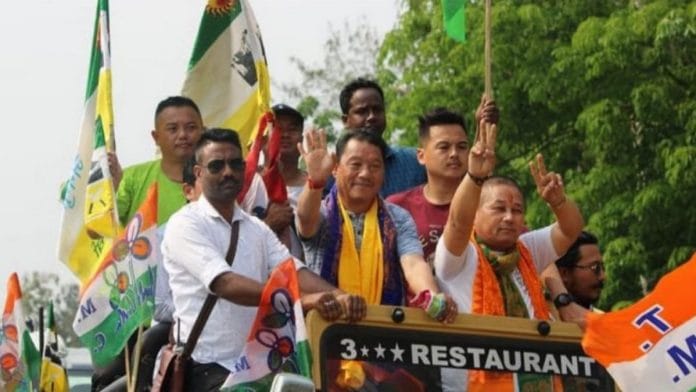
Ghising’s former acolyte Bimal Gurung broke away from the GNLF to constitute the Gorkha Janmukti Morcha (GJM) in 2007. He argued the Sixth Schedule fell short of the ultimate goal of a separate state of Gorkhaland and accused Ghising of compromising.
Ironically, as the GJM consolidated its leadership, it entered into tripartite talks with the Central and state governments and briefly agreed to accept Sixth Schedule status as an interim arrangement (signing a memorandum of settlement in 2008 to accord Sixth Schedule status to the DGHC).
In 2009, the GJM under Gurung extended support to the BJP for the Darjeeling parliamentary seat after the party agreed to “sympathetically examine and appropriately consider the long-pending demands of the Gorkhas, the Adivasis and other people of Darjeeling district and the Dooars region” — in other words, everything short of statehood.
Also Read: The North East does not need sympathy. It needs sincere constitutional commitment
Sixth Schedule status in limbo
After Mamata Banerjee came to power in West Bengal, the issue of Sixth Schedule status faced fierce political resistance in the Assembly and among Bengali linguistic groups in the plains. The GJM moved away from the Sixth Schedule demand and eventually settled for the Gorkhaland Territorial Administration (GTA) in 2012.
The GTA had formal control over 59 departments, expanded from the roughly 20-odd subjects under the DGHC. Key sectors like public health, primary and secondary education, tourism, engineering and sports were integrated under a unified regional administrative umbrella. However, subjects such as law and order, police, general administration and land revenue remained firmly with the West Bengal government, mirroring the structural limitations of the older DGHC.
Strains also appeared when Mamata Banerjee announced the formation of the Mayel Lyang Lepcha Development Board in early 2013, followed by boards for other hill communities, including the Tamang, Sherpa and Bhutia communities. The GTA contended that these announcements were aimed at creating a wedge among the hill communities.
Banerjee’s May 2017 announcement regarding compulsory Bangla in all schools of Bengal again led to a major agitation in the hills, the cancellation of the 2017 GTA elections and fresh turmoil.
Although elections were held in 2022, the most prominent political forces stayed away from the ballot. Bimal Gurung’s GJM officially boycotted the polls, while the BJP-GNLF combine opposed them. This paved the way for the TMC-aligned Bharatiya Gorkha Prajatantrik Morcha (BGPM), led by Anit Thapa, to win a clear majority in the GTA, with Hamro Party, led by Ajoy Edwards, and the TMC also winning seats.
But after Mamata Banerjee’s ouster, when new BJP CM Suvendu Adhikari ordered an enquiry into alleged corruption and a teacher recruitment scam in the GTA, Anit Thapa submitted his resignation on 17 June 2026, leaving the Darjeeling hills in limbo again.
This, then, is the context in which the Centre’s interlocutor Pankaj Singh must try to find a ‘permanent political solution’ to the Gorkhaland issue. While Thapa did meet Singh in his capacity as the GTA chairman, the BGPM — which had polled the highest number of votes in the 2022 GTA elections — boycotted the Amit Shah meeting, calling it a partisan effort by the BJP and its allies.
A permanent political solution requires not only extensive consultation with all stakeholders, but also a clear understanding of the historical context as well as the long-term implications of a settlement or concession on similar demands elsewhere in the country. Extending ST status to a majority of the Gorkhas of Darjeeling, as is being considered by the Centre, is certainly not a silver bullet, for there are Gorkhas all across the country.
As such, this column suggests restraint and research, and one must never lose sight of the fact that the Fifth and Sixth Schedules had been created precisely to resolve issues of this nature. In fact, a national stakeholder consultation on how to make these Schedules effective could be a good precursor to attempts at resolving contentious issues such as this.
(To be continued)
This is the second part of a four-column series on political settlements in the Himalayan region of Darjeeling-Kalimpong and the eight northeastern states, now referred to as Ashtalakshmi — the eight sisters of wealth and prosperity.
Sanjeev Chopra is a Senior Fellow at the Centre for Contemporary Studies, Prime Ministers Museum and Library (PMML), New Delhi, where his Fellowship topic is Borders, Boundaries and Bluewaters of Bharat. Views are personal.
(Edited by Asavari Singh)