



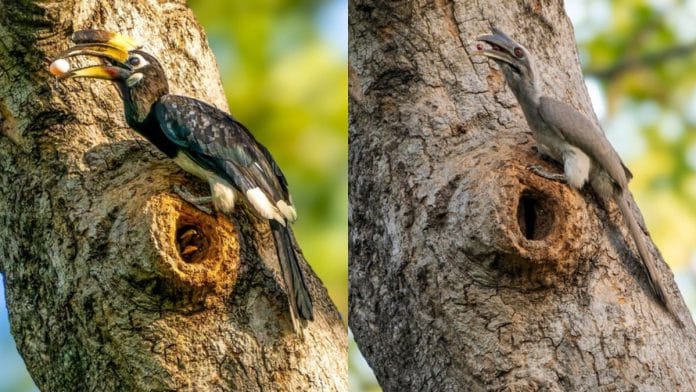

A mystery came to light in Delhi on Tuesday, 12 May 2026. The characters—three amateur birders, two Indian Grey Hornbills and one Pied Hornbill.
Anu Mathur, a retired school principal and amateur birder, was walking in Delhi’s Lodhi Garden, while her husband played golf in a club nearby. Mathur had come equipped with a Nikon P 1000, just in case she saw something of interest. It was a perfectly ordinary morning by any standards.
Around 8.30 am, she noticed two Indian Grey Hornbills, Ocyceros birostris, sitting on the branch of a tree. This was also no surprise—these birds thrive on old, tall trees, still found in and around Lodhi Garden. But what piqued her interest was their nest. It is unusual to see a nesting hornbill this easily. She watched.
Hornbills put themselves through a lot of hardship to breed. The nest is usually a hole in a tree. The female seals herself in, save for a narrow slit. She sits squeezed inside till her chicks hatch. The male feeds her through the slit every few hours for a few months. Then, when the chicks appear, their mother breaks the seal and leaves the nest. She joins the male to rear the babies.
What Mathur observed was even more fascinating. Not only was a male Indian Grey Hornbill feeding the female, but he was also surrounded by individual hornbills. They were likely helper birds. Scientists use this term to describe offspring from a previous litter—young ones learning the ropes.
Then, it happened—the twist that has since flummoxed birders and scientists across India.
A female Pied Hornbill photobombed this harmonious scene. This is a large, black-and-white bird with a dramatic casque on its head that looks nothing like the Grey Hornbill. What was it doing at the nest—and whose nest was it anyway? Mathur posted the image and her observations on a WhatsApp group devoted to birding in the NCR region.
Also read: The Asian Koel makes other birds raise its young—it lays eggs in their nests
The value of citizen science
Birders are also classified into several species. At the top of the list sit senior birders. They have been actively birding for several years, they know the birds across seasons, recall the history of places that were or are good sites to see specific birds, and notable moments from previous decades.
Nikhil Devasar is easily the most recognisable senior in the Delhi region. When he saw the post on the group he founded, he couldn’t believe his eyes. He rushed to the spot and informed the community that Mathur’s report was spot on.
Nature educationist and another senior birder, Sheila Chabbra, went to the spot the next day—and has been visiting almost every day since then. Along with dozens of others, her reports —and those of other occasional visitors—deepened the mystery.
It is clear that the nest—and the chicks inside—is that of the Grey Hornbills, because there is no male Pied Hornbill reported in the Delhi region. With so many birders now, it would be hard to miss such a large, dramatic bird.
Another individual has been reported around Jamia Milia Islamia area, in South Delhi. She is also female. Clearly, the much-photographed female could not be the mother of the chicks in the nest. But then, why was she feeding the female Grey Hornbill, sealed inside, along with the male Grey hornbill? This isn’t usual behaviour.
Note that the female inside accepted food from both individuals. One exception was when the Pied Hornbill made an offering that was too big. Is it that we are seeing unusual co-parenting? Or has chemical contamination impacted the hormones of the Pied Hornbill? What next? We will know soon, because the female sealed inside is expected to pop out anytime now. She is already breaking open the seal.
Devasar sums it up with relish. “Nobody knows what is really happening, but whatever it is, it hasn’t been reported before.”
Whatever the reason for the Pied Hornbill female to co-nurture the Grey Hornbill chicks, this episode underscores the value of citizen science. Not to over-emphasise a parallel, but one can’t help thinking how writer and marine biologist Rachel Carson’s interest in DDT was reignited when her friend, journalist Olga Huckins wrote her a letter in 1958, bemoaning the death of birds because of DDT spraying in Massachusetts, USA. This prompted her to investigate and write her iconic book Silent Spring. We may not all produce classics, but together, as casual observers of nature, we can shine a light on a magical world we barely understand.
Bharati Chaturvedi is an avid birder. She is the founder of the environmental non-profit organisation, Chintan India. She tweets at @Bharati09. Views are personal.
(Edited by Theres Sudeep)
Only the Pied is rare to see, the Grey is seen often in some parts.
hormbill in delhi itself outsider right?