





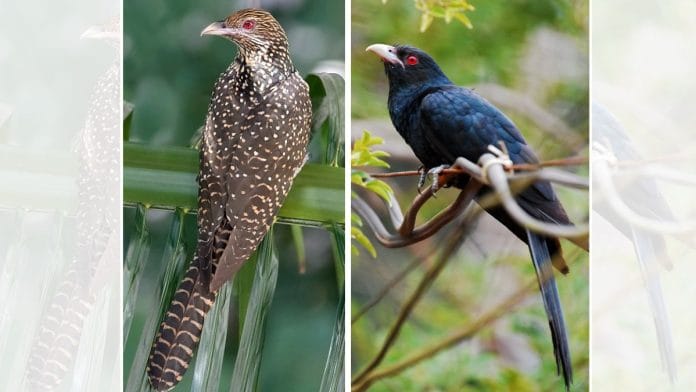


Many of us are forced to wake up at 5 am to the piercing calls of a bird. It’s like an alarm that has no snooze options. But that call isn’t for us. It’s for its partner of the moment.
For several years, my summer mornings began with this alarm from nature. Now, as Indian cities become more concretised, I feel grateful for their calls. The Asian Koel has taught me to wake up early with a smile, happy that a living creature has found a way to exist in the midst of our urban jungle. You have probably heard it too—a long, multi-syllabic cry, peaking at dawn and dusk.
Freedom fighter and poet, Sarojini Naidu, seems to have enjoyed listening to it. In her poem, Love Song from the North, she writes about missing the person she loved, alluding to birdsong:
I hear the black koel’s slow, tremulous wooing,
And sweet in the gardens the calling and cooing
Of passionate bulbul and dove….
But what is their music to me, papeeha
Songs of their laughter and love, papeeha,
To me, forsaken of love?
Perhaps she didn’t realise that generation after generation of the Koel hasn’t experienced much love either. The call is not a love song as she imagined it—it is for short-term transactions only.
When she is ready to lay her eggs, the female quickly tips them into the nest of other birds and leaves. Forever. That is the only engagement Asian Koels have with their offspring. The host, as we call Koel victims, are often, but not always, the same—Long-tailed Shrikes, Common Mynahs and House Crows.
Mansi Jindal and Manoj Kumar from the Department of Zoology at the Punjab Agricultural University in Ludhiana suggest that the bird may dump parental duties on others, but it is still picky about the nests it chooses. Their observations show that the Koels proactively preferred nests in tree plantations, instead of agricultural fields and residential areas. This could be because the nest is better hidden, with greater chances of the chick’s survival.
Also read: Blue, bold, and brutal—the Verditer flycatcher kills its enemies with kindness
The resourceful Koel
The process is a sophisticated one. Both parasite and host must breed at the same time, and the koel cannot just lay an egg before its host. Sometimes, the Koel may even lay its eggs in more than one nest, to give its species the best chances to survive. And this mellifluous bird could also get rid of a host egg, so there’s no shortage of food for its chicks upon hatching.
You might expect that the Koel evolved to mimic its hosts’ eggs over the centuries. Science doesn’t have a definitive view on this. While the koel’s eggs might differ slightly from nest to nest, they do not look similar to the host eggs, according to a study carried out by Bangladeshi and Norwegian scientists.
Strangely, it does look similar to the eggs of the Red-billed Blue Magpie—a stunningly beautiful bird you can see in the mid-Himalayas. It sometimes plays host to Koels in those parts.
Since the Asian Koel is still around, one can assume that the hosts haven’t evolved to efficiently eliminate the interloper egg yet.
The Asian Koel also reminds us that spring is here, fragrant with mango blossom. This year, climate change stole our spring and plunged us into a strange blend of heat stress and showers. This disarray forced me to confront my spoiled, younger self, who wished the bird would stop disrupting her sleep. I felt guilty for cursing a bird that brought in a season we are losing slowly.
In March, on a strangely warm morning, I saw the male of the species, rich black with its round blood-red eye, chasing the black-brown female. She was characteristically covered with pale specs.
Millions of Indians have seen this bird; it is the quintessential summer bird. I watched them dive into trees, call out loud and race out into other canopies. I listened deeply, knowing that in the 5th century, when he wrote RituSamhara, this is what Kalidas considered the sound of the spring.
Bharati Chaturvedi is an avid birder. She is the founder of the environmental non-profit organisation, Chintan India. She tweets at @Bharati09. Views are personal.
(Edited by Theres Sudeep)
An eerie parallel of how the logic of ‘maintenance’ is perverted today.
Maybe the Asian Koel is some feminists’ ‘spirit animal’ ?