





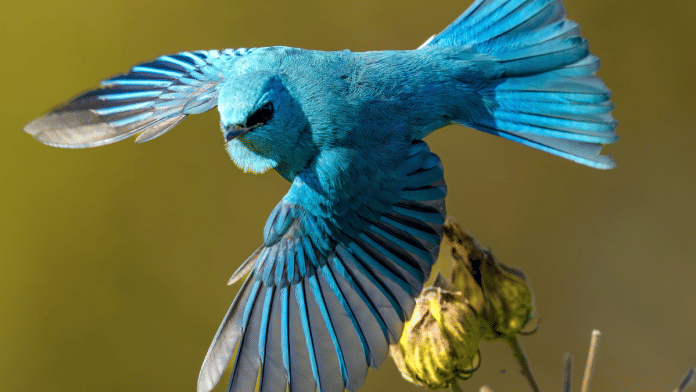


“Jewel Bird,” my father pronounced confidently, as my sister and I stared ahead at a bright blue, Bulbul-sized bird. With a ridiculously refreshing sea-blue plumage and just a hint of green, the bird has a dark strip extended from its beak to its eye, giving it character. As we stared at it sitting on a shrub much taller than us, it stared back. It was, however, not the “Jewel Bird”. That name appears to have been a spur-of-the-moment invention by my father, perhaps to keep his children entertained and interested in birds. But that moment and the image of that bird stayed with me. Many years later, when I began to watch birds more consciously, I saw it once more, and learned its true name: Verditer flycatcher.
Few birds are as descriptively named as this one. Verditer comes from the Old French phrase, vert-de-terre, which means earth green. Language is dynamic, so by the 17th century, the same word that once implied “earth green” began to mean a synthetically manufactured blue often used by artists of the time. The Latin name for flycatcher, on the other hand, has retained its original meaning, Eumyias thalassinus, the second half of the bird’s name is derived from the Greek word thalassa (sea), which refers to the sea-blue colour of its feathers. Just like the bird itself.
Breaking stereotypes
The phrase “bird brain” has always irked me; iit belittles how sophisticated these feathered creatures can be. It is commonly known that Cuckoos are brood parasites, meaning they lay their eggs in the nests of other birds, and leave it to the hapless hosts to hatch and bring up both their own fledglings and the Cuckoos’. It’s the ultimate outsourcing.

Of course, this is a sign of extreme efficiency on the part of the Cuckoo. Which human parent hasn’t experienced the occasional utter exhaustion and indescribable frustration of bringing up their own brood? Which human parent wouldn’t mind someone else taking the load off them as they collapse under the pressure of child-rearing? But the Verditer flycatcher is no pushover. It has developed a refined protocol to ward off the Cuckoo.
According to researchers from China’s Hainan University, the Verditer flycatcher accepts all eggs but feeds the chicks beetles and grasshoppers, which are hard and difficult to digest. The flycatcher’s chicks are biologically designed to digest these, but Cuckoos are not. As a result, the Cuckoo chicks can’t survive this diet.
“Flycatcher exploits a trophic niche that no other sympatric bird can exploit, and that any cuckoo lineages that switch from their original hosts to the flycatcher have no possibilities for establishing viable populations,” the authors noted. In other words, the “jewel bird” kills the Cuckoos slowly with its food.
But this beautiful, fearless bird is not uncommon.
Also Read: From central Asia to India—the annual migration of Rosy Starling
Searching for the “jewel bird”
The bird is not from faraway lands, nor is it rare within its range. The IUCN (International Union for Conservation of Nature), a global network of governments, civil society organisations and the scientific community that uses studies and data to advocate for nature conservation, classifies the Verditer flycatcher as a species of “Least Concern”.
Moreover, depending on where one might live or travel in India, it is possible to spot it in one’s own backyard at some point during the year. The bird migrates from the mid to lower Western Himalayas in the winter to North, Central or even South West India. From Mukteshwar to Goa, from Delhi to Kerala, there is a good chance of getting an unforgettable glimpse of the bird. This bright blue bird and its duller muddy blue female companion can also be found flying through the wilderness across the continent, from the Afghanistan-Pakistan border across Nepal, Bhutan, Myanmar, South-Eastern China, all the way to the South-North Korean border. The bird is a common sight in Asia.
If you are expecting to spend time in the Himalayas this summer, look out for it. You might wonder how you are supposed to magically see something like this.
The bird sits straight, on a perch. When it sees something it wants to catch, it flies out, swoops and often returns to the same place—a classic flycatcher trait. And even in the shade, it won’t look black, but grayish-blue. You can’t miss it. And when you spot it, remember the Verditer flycatcher is much more than its appearance.
Bharati Chaturvedi is an avid birder. She is the founder of the environmental non-profit organisation, Chintan India. She tweets at @Bharati09. Views are personal.
(Edited by Insha Jalil Waziri)