







Last week, the Jharkhand High Court acquitted a man who had been sentenced by a lower court to seven years in prison and slapped with a heavy fine under the Narcotics and Psychotropic Substances Act, 1985. The facts relating to the case, or the factual matrix if you prefer ossified legalese, were not in doubt.
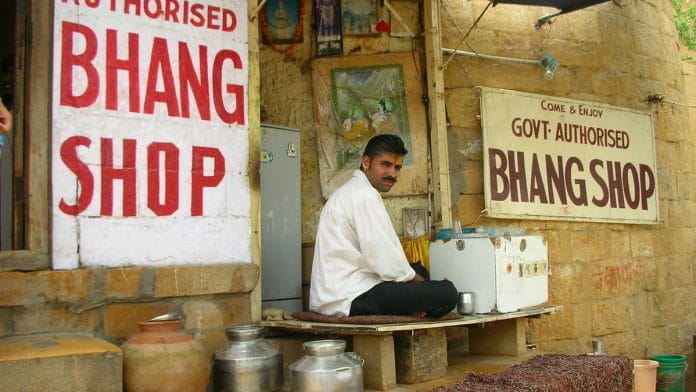
The man was apprehended carrying 11 kg of marijuana packed neatly in 12 polythene bags in a briefcase. He fled when apprehended and had to be chased down and caught. His successful appeal in the High Court rested on a single ground. Yes, of course he was carrying marijuana, but his neat little packets did not contain either ganja (the flowering or fruiting tops of the cannabis plant) or charas (the resin from the plant), but bhang (the seeds and leaves unaccompanied by the tops). As the High Court pointed out, ganja leaves and seeds are excluded from the definition of ganja in Section 2 (iii) of the NDPS Act; also, nowhere does this stringent legislation refer to bhang as a prohibited drink or drug.
People will take away from this judgment what they will. One narrowly legal response is that the NDPS Act contains a serious loophole which is exploited time and again; unsurprisingly, there are judicial precedents that have relied on the same reasoning.
An illogical exemption
I am unsure how many Indians are aware of this fine legal distinction between flowering tops and leaves and seeds. But if you studied in Delhi University at the time I did, the chances are you knew that bhang thandai (with its mix of milk and nuts) could be had at Holi for the mere asking from more than one roadside paan shop in neighbouring Kamla Nagar. Rajasthan, for instance, is one of the states where bhang is dispensed in government-licensed shops. It is around this very time, when followers of Lord Shiva observe the holy month of Shravan, that bhang consumption routinely spikes in the state, as liquor sales decline in parallel.
So why does bhang get a free pass? The THC levels, the compound that gives you that psychoactive kick, may be lower in bhang than charas or ganja, but it can be significantly heady. (Ask anyone who has experimented with a Kamla Nagar vendor. All right, ask me.)
The argument that there are good socio-cultural reasons to exempt bhang from proscription may have a merry liberal ring, but it is strictly illogical. If the severe penalties that ganja and charas attract as narcotic substances are justified, what is the basis for giving bhang a religious wink? Bail is notoriously hard to come by for cannabis offences in India, and the penalties under the NDPS Act vary between one year of rigorous imprisonment (for small quantities), up to 10 years (for intermediate quantities), and up to 20 for commercial quantities.
From a strictly logical perspective, there are only two correct ways to address this — plug the bhang loophole for the sake of consistency or liberalise cannabis policies by exercising a far greater legislative tolerance. Between the two, I favour the latter approach.
Also read: AI favors gun control, legalisation of marijuana, and feminism, finds Oxford study
The lesser evil?
Cannabis, of course, is far from harmless. We know, for instance, that repeated use can impair cognitive function and increase the risk of mental health conditions such as psychosis. At the same time, there is a scientific consensus that weed is less physically toxic and hazardous than tobacco, alcohol, and hard drugs. The latter are also far more addictive, even if cannabis is not entirely blameless in this regard, with recent studies showing that its frequent use can lead to an unhealthy dependency.
Given this, it is worth asking whether there is a case to decriminalise marijuana or, at the very least, treat it very differently from other drugs. The justification for this is not grounded only on the fact that it is a lesser evil. The former software engineer who was arrested for growing cannabis on his terrace in Hyderabad a couple of months ago is only one among many users that the NDPS Act has routinely targeted.
Lok Sabha MP Dr Dharamvir Gandhi, who authored a private members bill in 2016 to decriminalise and regulate marijuana, maintained that almost 90 per cent of those put behind bars under the Act were users — traffickers and distributors constituted a mere fraction.
While his bill, more controversially and arguably less advisedly, also sought the decriminalisation of other ‘non-synthetic’ intoxicants (such as opium), he argued that the ban on ‘softer’ and more traditional recreational drugs had led to the proliferation of more potent and destructive alternatives such as heroin. The former Biju Janata Dal MP Tathagata Sathpathy, who also favoured decriminalising marijuana, advanced a similar argument, claiming the ban had led villagers in his state to turn to alcohol. He also felt that the NDPS, which was enacted to align with the United Nations’ policy on drugs, was elitist as it discriminated against what was traditionally a poor man’s fix.
Whether marijuana bans lead to the consumption of more expensive and more dangerous intoxicants is something that needs to be established by solid empirical evidence. But it is difficult to ignore that we live in a world where a number of countries, far-flung and well over two dozen, have decriminalised cannabis for personal use. The laws vary relating to possession (how many grams), may differ by state (as in the United States), and with respect to cultivation (Germany allows an individual to grow up to three cannabis plants for personal use).
Earlier this year, the Delhi High Court asked the Centre to examine whether the provisions of the NDPS Act require to be diluted when it came to cannabis. It is not clear what is on the Centre’s mind regarding this, but I cannot help thinking back to what three young doctors from a famous institution said when I was an undergraduate in a Madras college. They were asked by the authorities, worried that the campus was under a fug of pot smoke, not uncommon in colleges during that post-Woodstockian era, to warn students about the dangers of cannabis.
Yes, I remember them saying that marijuana is far from a good thing. But they spent much of their time warning against tobacco and alcohol, which they implied were much worse. Our lecturers were not pleased, leading a buddy, who fancied himself as a wag, to quip that their “plan had gone to pot”.
Mukund Padmanabhan is a professor of philosophy at Krea University and former Editor of The Hindu. Views are personal.