



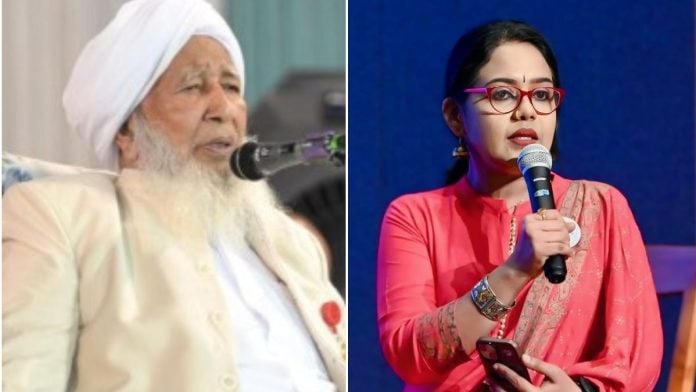
If journalist Aparna Kurup feels she is in a very lonely place right now, it is only because she is. The well-regarded Big TV news anchor in Malayalam has continued to be severely smeared and menaced on social media, in the face of very little support, within Kerala and without.
Her predicament reflects a number of things, including the chilling effect on free expression, the fraught questions around religious insult, and the underlying biases that shape Kerala’s political life and public discourse.
Kurup’s problems began after a show she hosted on the controversial remarks made by Kanthapuram AP Aboobacker Musliyar. The powerful Muslim cleric, the Grand Mufti of India, is the leader of a powerful faction of the Samastha Kerala Jem-iyyathul Ulama (informally, the Samastha), an influential body of Sunni Islamic scholars in the state.
The Samastha had recently issued a circular directing religious bodies under its authority to ensure that women are kept off public stages and prevented from mixing with unrelated men. A little later, Kanthapuram, no stranger to controversy, followed this up by saying women should stay at home and refrain from sharing public platforms with men.
The manner in which Kurup introduced the debate on Kanthapuram’s statement became a flashpoint, triggering a torrent of social media abuse. She was coerced into apologising unconditionally to anyone whose sentiments were hurt; her channel, Big TV, pulled the debate from its online platforms. But matters became worse after panellist Abdulla Basil, a Muslim youth leader who stoutly defended Kanthapuram during the TV debate, posted a video attacking Kurup’s comments and suggesting they smacked of Islamophobia.
The abuse against the anchor took an even more ominous turn. Money was offered to make her see the light, and she was reminded of what happened to TJ Joseph. (In 2010, the professor’s hand was severed with machetes by members of the extremist Popular Front of India for setting an allegedly sacrilegious question in an examination paper.)
Kurup filed a case against Basil for criminal intimidation and circulating rumours to promote hatred. But two days later, she found herself charged under various sections of the BNS and the Kerala Police Act, including intent to cause a riot. The centrepiece around which the charges were framed, of course, is the notorious and grossly misused Section 299 of the BNS (earlier Section 295A of the IPC), which deals with religious insult.
The Congress-led United Democratic Front (UDF) government, under pressure from one of its constituents, the Indian Union Muslim League (IUML), has ordered that the case against Basil be put on hold. Ironically, the case against Kurup remains very much alive.
Very few people have come to her support since the controversy broke. Yes, the Kerala Working Journalists Union described the case against her as an assault on press freedom and the Kerala High Court on Monday ordered the police to provide her protection, but there has been next to nothing from the spaces you might have expected a defence — the feminist, the progressive, the political, the intellectual.
Part of the reason for this conspiracy of silence is a fact often underplayed in debates on free expression. Nothing, not even censorship laws, has a greater chilling effect on free speech than social intimidation. The threat of a backlash, with possibly severe professional and personal consequences, has a way of making people – commentators, TV anchors, academics and others – realise what topics are much too risky to broach. This is not about speech that is silenced; it is about speech simply not attempted.
Also read: What Grand Mufti Kanthapuram needs to know about Islam before ordering Muslim women inside
The chilling effect of intimidation
Much of the offline chatter has been restricted to the appropriateness of Aparna Kurup’s remarks as an anchor. Could she have been less confrontational, more measured? Could she have framed her remarks differently? If all she was trying to say was that women were being selectively policed while men got away with such things as drugs and sexual misconduct, could she have done this without reference to the Sunnah or the Quran?
Focussing on such questions risks ignoring the fact that religious insult laws, like all legal provisions relating to offence, are inherently subjective. There is no objective measure to gauge offence, no way of guessing who will be offended or pretend to be offended. This opens the door for the gross misuse of our religious insult laws.
All religious groups have weaponised them to trigger prosecution, sometimes taking this to absurd lengths. My favourite example is the FIR filed under Section 295A of the IPC against commentator Ravi Shastri, who said on television, during a lunch break in a cricket match in South Africa, that he loved biltong (dried, cured meat, usually made from beef). Ridiculously, this apparently upset a Bajrang Dal functionary, who filed a case in an Indore court alleging that Shastri had hurt the feelings of Hindus.
Although Section 299 of the BNS makes it clear that it applies only when there is a “deliberate and malicious” intention of outraging religious feelings, the mechanical registration of FIRs and the perfunctory cognisance accorded by lower courts has made it an instrument of targeted harassment.
Inherent subjectivity and gross misuse are not the only reasons why this provision, an ill-disguised blasphemy law, deserves to be scrubbed from the statute book. There is no logical justification for privileging religious insult over other forms of insult in a modern society, which allows, and very rightly, our other deep-seated beliefs, philosophical or political, to be savagely critiqued.
Would our religious leaders be willing to accept that atheists, regarded in many religious texts as being beyond the pale, have a right to be offended by such theological scripts? Is there a rational basis for this profound asymmetry, which is inherent in provisions such as Section 299?
Also read: Dear Rahul Gandhi, your smash patriarchy push must cover Kerala cleric on Muslim women too
Kerala’s politics of religious offence
Coming back to Aparna Kurup, it is manifestly clear that she did not deliberately or maliciously intend to insult a religion or outrage religious feelings. But this seems immaterial to the two mainstream political formations in Kerala. The UDF is dependent on the support of the IUML, which has defended Kanthapuram’s controversial remarks. This is significant since the IUML and Kanthapuram have traditionally been opposed to each other, the party being closely tied to the cleric’s rival faction, the EK Samastha.
If anything, it was the CPI(M) that has been extremely cosy with the Kanthapuram faction, giving rise to the expression ‘Sickle Sunnis’ to describe his following in an ironic way. The IUML has clearly been emboldened to back Kanthapuram’s remarks openly since its spiritual spine, the EK Samastha faction, stood firmly by him. At a larger level, all this could reflect a redrawing of the map of Muslim support in Kerala.
While there has been some criticism of Kanthapuram’s remarks in political quarters, some of it no more than gentle rebukes, there is a deafening silence over Aparna Kurup. In this saga of twists and contradictions, another irony is that the BJP is the only party that has come forward in her support. The anchor told a digital news website that she was no stranger to cyberbullying, having been targeted earlier by right-wing organisations, including the RSS.
It is difficult to believe the BJP would have rallied behind Kurup if her remarks were directed at a Hindu priest. The transactional nature of who is supported and who is greeted with silence in India’s debates over freedom of expression and its broader socio-religious wars is never to be underestimated.
Mukund Padmanabhan is a Professor of Philosophy at Krea University and the former Editor of The Hindu. He is the author of The Great Flap of 1942, a narrative history of India and World War II.
(Edited by Prashant Dixit)