





Dear Rahul Gandhi,
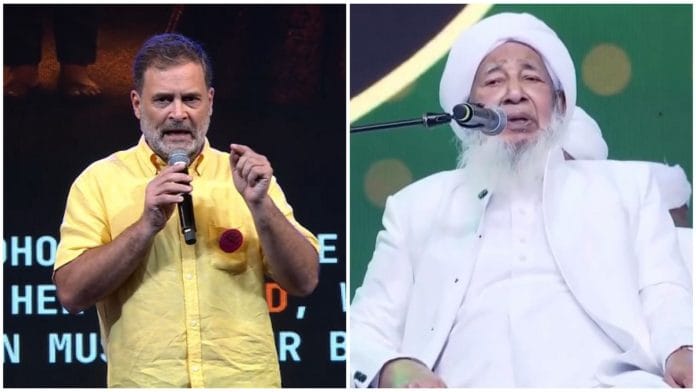
When you spoke about patriarchy and invoked the Manusmriti, you said something that should not be controversial in a modern democracy: a woman belongs to herself.
Not to the father who raises her. Not to the husband she marries. Not to the son who may one day inherit from her. To herself.
As a woman born of Indian soil, I felt that this is exactly what you want to hear from a political leader — a vision of an India where a woman is treated as an individual in her own right, not defined by her relationships.
Those words sound progressive, inclusive, and vast. And if we could actually build a society around that idea, it would be a beautiful society to live in. We have already been trying to build it, shattering old glass ceilings and rewriting our destinies. But I know it is not enough. The foundations are laid, but the storms still crash through. The laws exist on paper, but fear still lingers on the street. Its boundaries survive in families, communities, institutions and, sometimes, in the language of tradition itself.
While I was happy listening to you speak about women as individuals in their own right, another voice was being heard from a state where your alliance holds political power. It was the voice of a Muslim cleric, carrying the weight of centuries of patriarchy and declaring a silent war on the freedom of Muslim women.
A few days ago, Kerala cleric Kanthapuram AP Aboobacker Musliyar, the Grand Mufti of India, said women should remain confined to their homes and stay away from public platforms. He warned that bringing women into public life could bring “great destruction”.
And then came the comparison with gold. Imagine, sir, the bitter irony of this hour. He did not just reduce us to a family name or define us by the men who walk beside us. He looked at living, breathing human beings and compared us to gold locked inside a box.
Also Read: What Grand Mufti Kanthapuram needs to know about Islam before ordering Muslim women inside
Can you raise your voice for Muslim women too?
Tell me, sir, is it too much to ask to raise your voice for us too? For Muslim women? With the very same fire and passion you brought to your call to smash patriarchy? Because patriarchy does not become less patriarchal when it comes wrapped in religion. If a woman truly belongs to herself, she belongs to herself in every street, every faith, and every corner of this land.
You are also the leader who spoke for girls wearing the hijab. You argued that what a girl wears should be her choice. I do not entirely agree with you there, because sometimes what we call a woman’s “choice” is shaped by the family and society around her. A choice is truly a choice only when a woman is also free to say no without fear, pressure or punishment. Creating that environment is precisely why we need to challenge patriarchy in the first place. But I understood the sentiment behind what you were saying. You were defending a woman’s right to decide for herself.
So, Rahul Gandhi, where is your voice now?
If patriarchy is wrong when it comes from the Manusmriti or conservative Hindu traditions, why should it become acceptable when the same idea comes from a Muslim religious leader?
Also Read: Questioning the hijab does not mean questioning Islam
Don’t protect minority patriarchy
When a cleric like Kanthapuram tells women that they should remain inside their homes and stay away from public platforms, I expect progressive leaders to speak.
As Muslim women, we often find ourselves trapped between these two sides. There are people who suddenly discover our rights only when they can use us to attack Muslims. And then there are progressive politicians who speak passionately about women’s freedom but become strangely careful when patriarchy comes from conservative voices within the Muslim community.
We are not weapons in somebody else’s political battle. We are not representatives of a community who must remain silent to protect its image. We are individual citizens with our own ambitions, beliefs, disagreements and rights.
The question is, sir: if the cry to “smash patriarchy” has no religion, why does the room turn cold the moment a Muslim woman speaks out against mistreatment within her own community? Why does the voice that boomed so loud suddenly drop to a cautious whisper?
This is a path we have walked before. We saw the sudden stutter during the debates over triple talaq. We see the averted eyes when we question halala or polygamy. We feel the heavy, uncomfortable silence whenever the Uniform Civil Code enters the air.
A Muslim woman does not cease to have a claim to equality because the person restricting her freedom speaks in the language of religion. Nor should questioning a conservative cleric automatically be treated as hostility toward Muslims.
Religious freedom cannot mean freedom for powerful men to decide the boundaries of women’s lives without challenge.
This is precisely where progressive politics has often failed Muslim women. That is not minority protection. It is the protection of minority patriarchy.
Amana Begam Ansari is a columnist, writer, and TV news panellist. She runs a weekly YouTube show called ‘India This Week by Amana and Khalid’. She tweets @Amana_Ansari. Views are personal.
(Edited by Asavari Singh)
Agreed. Rahul Gandhi should respond. But wait. Kerala CM, a Congressman, responded. Why are you silent on that?
One more thing. Why are you not asking why Modi is not talking about NEITHER manusmruti treatment of women NOR Kerala Mufti treatment of women? Atleast the second one, the Muslims are not BJP vote bank and they could have made Hindu votebank happy.
Are the Mullahs, Maulanas, Deobandis, and self-proclaimed Islamic theologians listening to Ms. Amana? Someone check on Deoband…they must be panicking.
This self-delusion of sitting in a bubble, writing an op-ed to a politician, and believing centuries of hardline clerical control are going to melt away because you tweeted ‘smash patriarchy’ is what it always has been…. A neverending comedy.
Ms A,
Maulanas don’t care about your op-eds, your ‘Dear Rahul’ open letters, or your media clicks. Expecting hardline religious dogmatists to surrender their power because someone threw a a tantrum on ThePrint isn’t activism. It will not move even a blade of grass.