






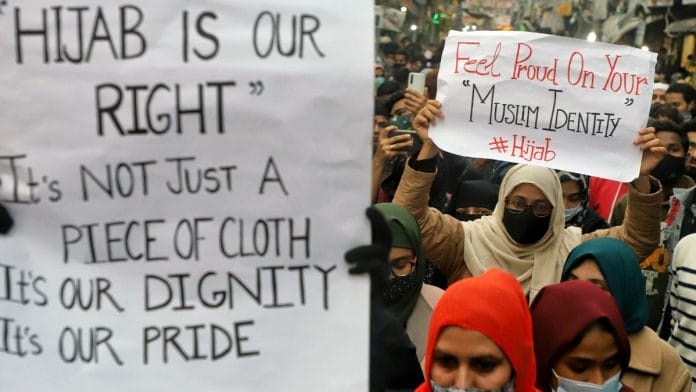

Hijab has become such a controversial word today. For some Muslim women living in free societies, it represents choice, faith and the freedom to dress according to their beliefs. But for women elsewhere, it can represent forced modesty and a restriction they are desperately fighting to remove.
While some Muslim women are going to court for the right to wear the hijab or niqab in colleges and public spaces, women in countries like Iran have risked—and even lost—their lives fighting for the right not to wear it. Somehow, there seems to be very little middle ground left in this debate.
Recently, the Allahabad High Court rejected a Muslim student’s challenge to her school’s dress code, holding that having attended classes wearing a headscarf for years did not automatically give her the right to continue doing so. Justices Indrajeet Shukla and JJ Munir also held that her claim that she wore it out of religious necessity was a “bare assertion” lacking sufficient evidence.
In a matter that involves religion, personal freedom and the autonomy of a school to make and enforce its own rules, which one should take precedence?
Religious freedom vs school uniform
Many people say students should be allowed to wear religious clothing in school. While that argument is understandable, I do believe that schools have legitimate reasons to restrict the hijab, especially if they want to create a neutral environment where children come as students first and the same uniform applies to everyone.
There is another side that we rarely talk about. Not every young girl wearing a hijab is necessarily doing so entirely out of her own choice. In some families and communities, there can be enormous pressure to dress in a particular way. A school can be one space that offers a girl some distance from those expectations, giving her the opportunity to develop her own identity and decide for herself what she believes.
But the court’s reasoning brings us back to a familiar question: is the hijab an “essential religious practice” under Article 25 of the Constitution, as the Karnataka High Court had also considered?
And it made me wonder: why and how did the hijab become mandatory in Islam in the first place? What exactly is the idea behind it? And what is such a big deal if a Muslim woman does not wear one?
While the court’s judgment is based on what qualifies as an essential practice of Islam, what goes on inside the mind of a Muslim woman who follows a traditional interpretation of the religion is very different. She genuinely believes that by not wearing the hijab, she is committing a sin and failing to follow the modesty prescribed by God.
I understand that choosing between what she considers necessary to be a good Muslim and continuing her education must be tormenting. I would never dismiss that struggle or simply tell her, “Just take it off.”
Also read: Hijab is a choice. Why are we so uncomfortable when Muslim women freely choose it?
Questioning hijab ≠ questioning Islam
But it also makes me ask a more uncomfortable question: who created this idea that to be a pious Muslim woman, she must hide herself? Who decided that modesty has to look like a hijab? And how did a piece of clothing become such an important measure of a Muslim woman’s relationship with God?
For me, true modesty—haya—is much bigger than a piece of cloth. It is about how you behave, how you treat others and what you carry in your heart.
For centuries, the traditional interpretation has told Muslim women that covering their hair is a religious obligation. But I think we should be able to question that interpretation without being told that we are questioning Islam itself. Asking whether a headscarf is necessary today does not mean abandoning faith.
Take one of the Quranic verses most commonly used to argue that the hijab is mandatory, Surah An-Nur 24:31. It tells women to draw their khimar over their chests. The khimar, or head covering, was already worn by women in seventh-century Arabia. One modernist reading, which I find convincing, is that the verse was not introducing a new command to cover the hair. It was asking women to use the clothing they already wore to also cover their chests. That distinction matters.
The larger message, to me, is about dignity and modesty. The particular clothing belonged to the time and culture in which the verse was revealed. We can preserve the principle without insisting that every Muslim woman, in every country and every century, must dress exactly like women in seventh-century Arabia.
Dr Saad al-Din al-Hilali, a professor of comparative Islamic jurisprudence at Al-Azhar University, has also argued that the headscarf should be understood as a matter of personal choice rather than an absolute religious obligation.
Also read: Hijab doesn’t become progressive just because a woman chose it
Why the burden on women?
What makes me sad is how, as Muslim societies, we have created such rigid rules and expectations around women that sometimes they seem to have no room to simply live. Standards of modesty shaped centuries ago are still imposed on women as if nothing around us has changed.
And sometimes our priorities feel completely misplaced. We fight passionately for a woman’s right to wear the hijab, which is important if that is genuinely her choice. But where is the same outrage for Muslim girls who are denied education under the Taliban, or for women in Iran who have been punished for rejecting compulsory hijab?
I also keep wondering why this burden of religious practice seems to fall so heavily on women. Where are the equally strict rules constantly policing men’s clothing, movement and access to education? I rarely see Muslim men being told that their education must come second because they may miss Friday prayers, or going to court demanding that their studies be reorganised around religious obligations.
If faith is supposed to guide both men and women, why does modesty so often become a woman’s responsibility to carry?
Amana Begam Ansari is a columnist, writer, and TV news panellist. She runs a weekly YouTube show called ‘India This Week by Amana and Khalid’. She tweets @Amana_Ansari. Views are personal.
(Edited by Prashant Dixit)