






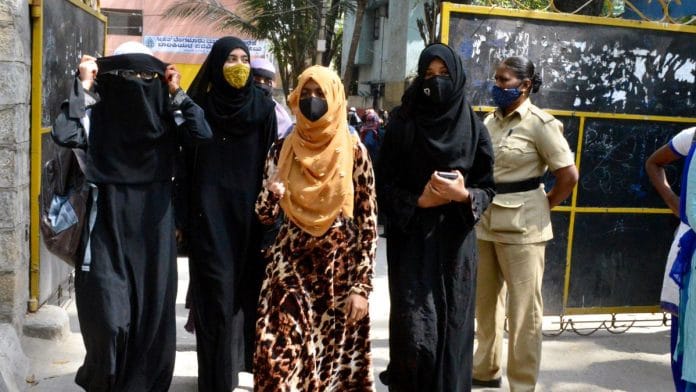

The Allahabad High Court’s recent refusal to allow a schoolgirl to wear a hijab in school rests on a familiar line of reasoning. The court’s verdict rested on the fact that schools have the right to prescribe uniforms, provided the rules are uniform, non-discriminatory and intended to maintain institutional discipline.
The court also observed that no authoritative religious text, expert material or other evidence had been placed on record to establish that wearing a headscarf inside the classroom was obligatory upon the petitioner or that not doing so would alter the fundamental character of her faith.
Legally, the judgement may fit within institutional autonomy and religious freedom. But it reveals a deeper discomfort in how India discusses and judges the hijab. We seem unable to view it as anything other than either a symbol of oppression force-fed to women or as a theological practice that is now too redundant.
In reality, for many Muslim women, it is neither. Rather, it is an act of faith and a matter of personal identity and conviction.
No concept of force
The modern debate on hijab is viewed through a singular lens: patriarchy. It is an obvious statement, rather than evidence of female subjugation, something from which women should be liberated. And I agree; anyone subjugated through religion as a tool of patriarchy must be freed. Religion should not be a dog collar around someone’s neck.
But the fundamental flaw in this assumption is that this framework assumes that the women who wear the hijab are not capable of making meaningful choices about their own lives. It strips them of agency in the very act of claiming to defend it.
The other issue is the claim that there is no authoritative religious basis for hijab. Hijab is understood as an obligation in the Quran as well as in the Hadith and has been affirmed by generations of Islamic scholars. But there is no concept of forcing it upon women.
A woman forced to wear a hijab is undoubtedly experiencing coercion. But so is a woman prevented from wearing one when she wants to. The principle at stake in both situations is the same—the denial of choice.
The irony here is that contemporary feminism has rightly fought for decades to establish that women should have control over their own bodies and appearance. In this case, if a woman chooses to wear a headscarf, her agency doesn’t become invalid just because her choice is informed by religion.
The hijab is also routinely misunderstood. In Islamic tradition, “hijab” doesn’t merely refer to a piece of cloth covering the head. It is a broader concept encompassing modesty, and the obligation doesn’t just befall women but men too. Men, too, are instructed to dress modestly, lower their gaze and conduct themselves with restraint. Whether every Muslim observes these principles in the same way is not a discussion for today.
Also read: Hijab doesn’t become progressive just because a woman chose it
A misplaced dismissal
Like many aspects of faith, practice exists on a spectrum.
That is precisely why the court’s dismissal of the petition based on the lack of religious text feels misplaced. Religious choices and practices are rarely as straightforward as the courts would want them to be. Faith is not a checklist of obligations.
The question should not be whether the petitioner could conjure up enough evidence to prove to the court whether the headscarf is obligatory and an indispensable part of her faith. The question should be whether wearing a simple headscarf undermines the school’s authority, uniformity and discipline or disrupts its educational mission.
Uniforms are undoubtedly important; they reduce economic differences, foster a sense of community and encourage discipline. But a headscarf surely can’t disrupt all that.
What makes this all the more troubling is that the girl had already been wearing the hijab for many years. Her religious practice had coexisted with institutional discipline. So what changed? Was the problem the headscarf itself or the growing politicisation around it?
The hijab has increasingly become a political object that carries the weight of the religious anxieties of the society along with the brandishing of secularism and women’s rights. Lost in these ideological battles are women and girls who are more often spoken about but seldom listened to.
A liberal society must be wary of telling women what they must or must not wear. The state should protect women from coercion, not become another tool in it.
The right to wear a hijab should not depend on proving that every other Muslim woman has to. The freedom to dress according to one’s convictions, religious or otherwise, is meaningful when it protects choices we may not make for ourselves. Otherwise, it is no freedom at all.
(Edited by Saptak Datta)
With respect, I was dismayed by the Allahabad high court judgment. There was no need to do a deep, scholarly dive on what Islam enjoins, what are its essential features and observances. . Modesty in dress is widely observed amongst Muslim girls and women in India many other parts of the world. It does no harm to others.