






Bengaluru: In 2019, Gaurav Sen’s soon-to-be mother-in-law had an accident, while avoiding a pothole on the two-wheeler she was riding. She required a steel rod in her leg after the accident.
She is back on her bike now, but the incident stayed with Sen.
With artificial intelligence still in its infancy at the time, Sen’s mission to address the growing number of pothole-related accidents remained. During the Covid-19 induced lockdown, he frequently revisited the plan, but never made significant headway. His business of teaching AI took precedence.
In 2020, another engineer claimed to have devised a technology that could detect a pothole. But was this enough? “I thought that detecting a pothole would be super easy. But it would mean more if I find the person (or authority) responsible for it,” Sen tells ThePrint.
In July this year, he started working on the tech after mulling over the idea for a week. “Most of the research was where we could get more information on the contractor who made the road and other details, ways to source this out as well as looking up if there were any existing products or apps that did the same job,” he says.
While all earlier attempts have been a manifestation of years of research, Sen gamed the system with AI, creating the app before the frustration fizzled out.
Sen has joined a new generation of AI-powered start-ups and entrepreneurs who are reimagining road safety, turning smartphones into more than tools of content consumption. “It is a one-day effort now, otherwise it would have taken me two months otherwise. Because of AI, I can make it in a day. So the frustration that comes for a day, and likely to fizzle out soon, is actually resulting in something,” he says.
He created what was simply and directly called, ‘Pothole Reporter’.
With just one click from the mounted phone on a dashboard, the app he created can now access all public records of the contractor who built the road, details of the tender, and even send all these details in a pre-registered e-mail to the Chief Commissioner of the Greater Bengaluru Authority (GBA).
The poor road conditions in Bengaluru have long overshadowed its more endearing monikers, such as India’s ‘IT and Startup Capital’, and made the city a template of urban ruin. The city’s treacherous roads have given Bengaluru the dubious distinction of retaining the top position for most deaths caused by the negligence of civic bodies among India’s biggest urban centres.
Also Read: Why the Bengaluru-Mysuru corridor has become Kumaraswamy’s latest weapon against Shivakumar govt
‘Small, medium & large pizza’
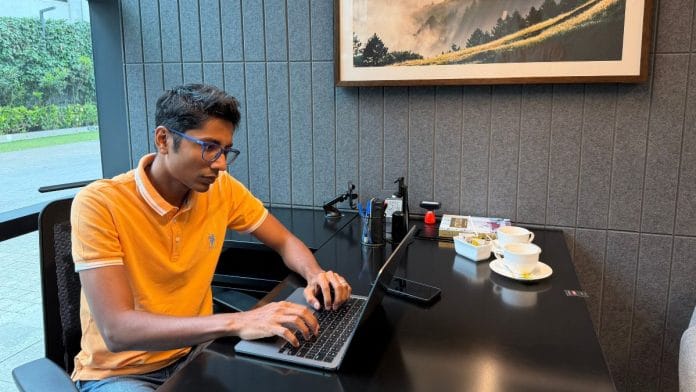
Sen teaches AI to working professionals who want to upskill. Sitting in his swanky office on Bengaluru’s Cunningham Road, the 33-year-old engineer decided to make the ‘Pothole Reporter’ a project he hoped would bring respite to a city plagued with the problem.
The app takes up just 10MB and can easily be installed on a cellphone without taking up much space. When mounted, the app works in the background, taking pictures of potholes at distances between 15-20 metres and uploading them.
The information is then parked, a human checks if it is indeed a pothole, and the app itself drafts an email with details—including a subject line—to the GBA’s Chief Commissioner. “The app classifies potholes as ‘small, medium, and large’, much like how pizzas are classified,” Sen says.
The app, however, searches through thousands of government contracts, fetches the exact tender details, attaches a photo with geolocation, which generates an email draft that can be sent to the BDA commissioner with just one click.
However, the app requires the user to have an OpenAI pass key, which comes at a price, limiting its use so far only to developers who have access. “This is the blocker for adoption right now for this app,” Sen says.
“The key is free if you add, let’s say, $100 to it. The higher the number of images and the cost comes down to Re 1 each. If I take up the cost, it becomes expensive.”
Sen says that the app has created more interest than perhaps its usage at this moment. Several Bengaluru residents have shared Sen’s viral video on the app, touting it as much-needed technological intervention.
“Fascinating use of AI for civic good. This is the kind of grassroots #AI application India needs more of,” Kiran Mazumdar Shaw, the Biocon Chief said on social media platform X.
However, Sen plans to help the app evolve and prevent it from meeting the fate of several others similar technological interventions.
‘System integration’
Since Sen’s video, multiple authorities have reached out, checking to see if similar technologies can be implemented elsewhere. Incidentally, the Bengaluru Development Authority (BDA) has interacted with him, not the GBA, who are primarily responsible for the city’s roads.
He has since garnered interest from politicians in West Bengal, the Chennai city corporation and even Andhra Pradesh Deputy Chief Minister Pawan Kalyan. However, for the app to be widely adopted, it must have an impact and Bengaluru’s civic apathy and corruption are widely known.
One of Sen’s discoveries showed that a pothole detected on the roads was being handled–or handed–by multiple contractors.
“Some of these potholes are under warranty and can be fixed for free. But I also noticed that for many of these potholes, one contractor built the road, and the corporation awarded another to fix them despite the work being under warranty,” Sen says.
Between 2013-23, the Bengaluru city corporation allegedly spent Rs 43,600 crore on roads; nearly Rs 25,000 crore of this was earmarked for road ‘improvement,’ ‘resurfacing,’ ‘relaying,’ or ‘asphalting’ roads, data shows.
The city civic corporation has spent around Rs 25,000 crore just on road-related infrastructure in the last 10 years, with nearly Rs 200 crore spent just on covering potholes, despite many still being under warranty.
For most Bengaluru residents, potholes, traffic jams and endless congestion have become part of their daily commute. Those who can afford it buy bikes with bigger tyres or purchase a car to insulate themselves from the civic crisis.
Sen says he was no different, persuading his mother-in-law to drive a car instead of a two-wheeler. “The way we solve problems is by throwing money at them. But fundamentally solving the crux is always hard,” he says.
He is now trying to integrate his app directly into the corporation. “We need to integrate with the systems that have logs for uncleared garbage, open manhole covers, potholes etc. But the Bengaluru corporation’s system requires manual login and Captcha. There is no publicly available Application Programming Interface (API),” he says.
He says this would go beyond just sending an email to the GBA chief which may or may not have any impact on the ground. Sen says the app has a lot of attention right now and if he manages to integrate with the system, it could impact lives.
“If not, this could all just be noise.”
(Edited by Nardeep Singh Dahiya)
Also Read: Bengaluru ‘hospital rave’ was meant to boost ‘bliss per minute’. Sparks memes and anger
Most bureaucrats just don’t have the zeal to work on public projects. I am happy that there are entrepreneurs who pick such problems up.