





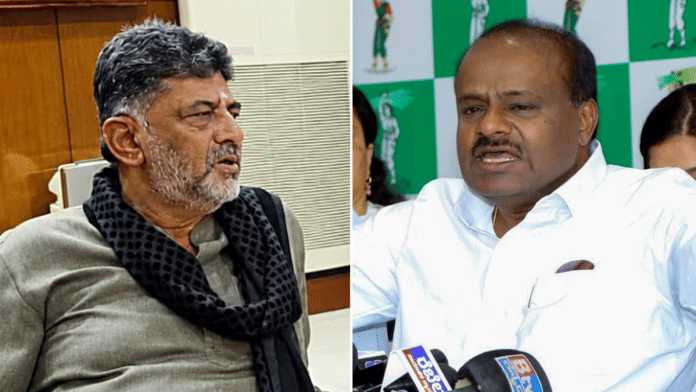

Bengaluru: Janata Dal (Secular) state president H.D. Kumaraswamy placed front-page ads in leading national dailies on Sunday, quoting the Karnataka High Court’s recent observations to reinforce demands for the state government to take over the long-delayed Bengaluru-Mysuru Infrastructure Corridor Project (BMICP) from the private contractor.
The full page ad, saying ‘one of the biggest scams in the state of Karnataka’ in bold, also featured quotes of what it called all the high court observations on the case, along with key details of the project.
The Union Minister demanded that the D.K. Shivakumar-led Karnataka government immediately stop “illegal” toll collection by Nandi Infrastructure Corridor Enterprise (NICE), entrusted with executing the undertaking.
“I am not asking only JD(S) workers to rise against NICE. The taxpayers and public of Karnataka must rise against it. A scam of this magnitude has taken place. People have elected us to question misgovernance,” he said Sunday.
Ashok Kheny, a former legislator and entrepreneur who heads NICE, has long been at odds with JD(S) patriarch H.D. Deve Gowda whose son Kumaraswamy has now taken the feud forward, adding to the uncertainty that has loomed over the project ever since it was approved in 1995.
The project
During Deve Gowda’s term as chief minister of Karnataka, he envisioned a road that connects Bengaluru and Mysuru—two of the state’s largest urban centres—and to establish a new business corridor.
Existing highways (SH-17 and SH-86) were narrow and passed through major towns. Their inability to take additional traffic, and increasing accidents and rampant encroachments were cited among reasons for a new corridor between the two cities, about 140 km apart.
On 20 November 1995, the Gowda-led government passed the order to implement the corridor and a Memorandum of Understanding to this effect was signed. This entire project would have to acquire 8175 hectares, or about 20,193 acres, of land.
Also envisaged was a 41-km peripheral ring road, now an operational toll road that arches around Bengaluru. There were also plans to develop five townships, the Local Planning Area comprising a total area of 70,100.96 hectares, including 140 revenue villages, 54 part villages and Maddur Town, which was to promote economic activity along the corridor, according to the government.
Also Read: AI hubs across Karnataka, $3 tn economy by 2047—what CM Shivakumar promised in maiden I-Day speech
Progress, or lack of it
Apart from the 41 km of operational ring road or NICE road, the BMICP has been engulfed in political controversies and legal entanglements, crippling the project.
Kumaraswamy has alleged that out of the total 111 km sanctioned in the MoU for the BMICP, only 5 km have been built since the early 2000s even though most of the farmland needed has been acquired. The project also provided for extending the sanctioned road to six lanes, allowing it to acquire 90 m on either side.
It is, however, alleged that Kheny acquired more than twice the sanctioned width, amassing fertile lands that were taken from farmers who were not compensated. The JD(S) alleged that 554 acres of “excess” land had been handed over to NICE.
“For 20 years, farmers’ land has been taken for the NICE Road project without paying them compensation. Those who measure land with a tape, grab it and cheat farmers are now talking about development. Land was acquired from farmers in the name of development, while unauthorised toll collection has continued for two decades. This is one of the worst scams in the history of Karnataka,” Kumaraswamy, a two-time chief minister, said.
Politics behind the project
Ever since the project’s initial implementation in the early 2000s, allegations that Kheny acquired more land than was sanctioned have been doing the rounds. The stretch from Bidadi to Mysuru is called the Vokkaliga belt, as it has a concentration of the dominant land-owning agrarian community. Vokkaligas and the farming fraternity are the two main focus groups from whom the JD(S) draws most of its political might.
Relations soured between Gowda and Kheny, turning it into a fierce political battle which has now been taken over by Kumaraswamy. The JD(S) has intensified attacks on the project as an extension of its ongoing struggle against the proposed Bidadi Township undertaking, a pet project of Shivakumar.
The agitation also provides an opportunity for Kumaraswamy to revive the fledgling JD(S) whose identity is perceived to be fading and overshadowed by its alliance partner, the Bharatiya Janata Party (BJP).
(Edited by Nardeep Singh Dahiya)
Also Read: Why 500+ Bengaluru companies want Shivakumar govt to defer revamp of arterial Outer Ring Road