





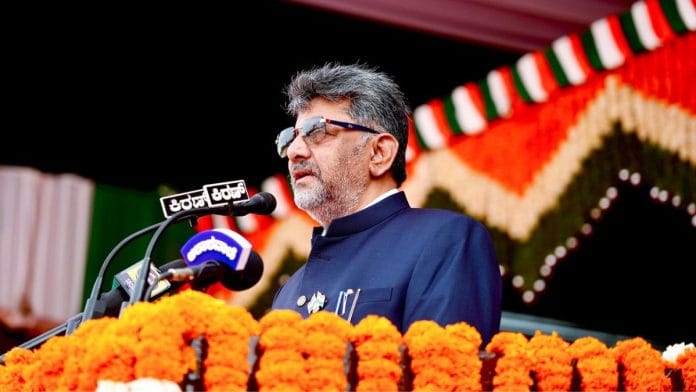


Bengaluru: The D.K. Shivakumar-led Karnataka government Saturday proposed the introduction of AI-related education in schools from Class 6 onwards to enable young students to develop coding skills. In his maiden Independence Day speech in Bengaluru, the chief minister said the new era warrants more focus on artificial intelligence.
“Accordingly, we are introducing AI education from Class 6 onwards in all schools across the state. To achieve this, I am pleased to announce two major initiatives today: the ‘AI Akshara Abhiyana’ and ‘Coding Gurukul’,” Shivakumar said, adding that Coding Gurukul will provide students with opportunities to learn AI from a young age.
He further said that Karnataka has already proposed to launch India’s first public AI university, which will be established in Bengaluru. Although the state capital has become synonymous with crumbling infrastructure, the CM hopes to change the perception by trying to turn it into India’s ‘AI capital’. “AI Certificate Courses will commence by January 2027. In addition, AI Hubs will be established across the State,” he said.
Shivakumar has barely two years left before his term ends, and has been announcing several schemes and infrastructure projects to counter the criticism over lack of development that the Congress government has faced since before he took over as CM from Siddaramaiah.
“Over the next two years, we will develop 1,000 Government schools into Karnataka Public Schools, providing modern infrastructure, bilingual education, digital classrooms, vocational education and student transportation under one roof from LKG to Class XII. This initiative will benefit nearly 10 lakh students,” the CM said Saturday.
Even Prime Minister Narendra Modi, in his Independence Day speech at Red Fort, placed emphasis on AI as part of his outreach to Gen Z and Gen Alpha. “We have resolved that in the coming one year, we will work to provide AI skill training to one crore youth, so that the youth of our nation possess the capability to lead the world in the domain of AI as well,” Modi said.
Also Read: RSS chief Bhagwat adds to PM’s Gen Z outreach on I-Day—‘dissent central to democracy’
‘$3 trillion economy’
Karnataka has been among the most industrious states in the country over the years, a key destination for foreign and domestic capital, with the second highest GST collections attributed to it, and has a per capita income twice the national average.
However, the growing regional imbalance has been a cause for concern with most of the development limited to southern districts, especially Bengaluru, leaving much of the northern parts behind.
Shivakumar said that based on the recommendations of the Prof Govind Rao Committee, which undertook a comprehensive study of 236 taluks, the state government has deployed various measures for more equitable growth.
The government now plans to establish five Global Technology Centres in Kalaburagi, Belagavi, Hubballi-Dharwad, Mangaluru and Mysuru. “To achieve this, we have put in place a transparent mechanism for the effective utilisation of Rs 4,291 crore during the financial year 2026–27,” the CM said. He added that a special incentive package is being prepared to attract new industries to backward taluks and even offer incentives to job creators.
“The Government will provide incentives to entrepreneurs who create new employment opportunities in the 10 most backward districts of the State. For every new job created, the Government will provide an incentive of Rs 2,500 per month. This incentive will be available for a period of two years. The initiative is expected to create one lakh new jobs,” Shivakumar said. He added that these measures are meant to strengthen Karnataka with investments in education, healthcare, agriculture, technology, industry and infrastructure.
Shivakumar further said that the state’s Gross State Domestic Product (GSDP) reached Rs 32.81 lakh crore, and these investments will help it reach the desired target over the next two decades.
“My goal is to further strengthen Karnataka’s economy by investing in education, healthcare, agriculture, industry and infrastructure. Through this, I have set a goal of transforming Karnataka into a USD 3 trillion economy, equivalent to Rs 320 lakh crore, by 2047,” Shivakumar said.
New investments, 5 Police Commissionerates
Shivakumar said that investments were proposed in all sectors of the economy, including filling up around 72,000 government job vacancies in various departments. He said that a new initiative called “Yuva Udyoga Setu” will be launched as a comprehensive digital platform to connect young people with employment opportunities in the private sector.
“This platform will bring together job seekers, employers and educational institutions on a single platform. 100 Government ITIs will be transformed into employment-oriented campuses. In partnership with private industries, employment opportunities will be created for 10,000 young people,” he said.
Additionally, an Advanced Manufacturing Cluster will be established at Doddaballapura, near Kempegowda International Airport with investments of Rs 20,000 crore already secured for the purpose and the potential to generate nearly 1 lakh jobs. He also said that infrastructure projects to the tune of Rs 1.5 lakh crore have been taken up in Bengaluru.
“Works have commenced to develop the city’s major roads at a cost of Rs 5,000 crore. The long-pending Peripheral Ring Road project, which had remained stalled for over two decades, has now been launched in a new form as the Bengaluru 45 Business Corridor (BBC), with the construction of a 117-kilometre Ring Road at a cost of Rs 26,000 crore,” Shivakumar said.
He also said the city’s Police Commissionerate will be reorganised into five Commissionerates for better maintenance of law and order, much like how the Greater Bengaluru Authority (GBA) split into five smaller corporations.
The government will also introduce a vehicle insurance corporation to provide affordable and reliable insurance services for the state’s residents.
(Edited by Mannat Chugh)