





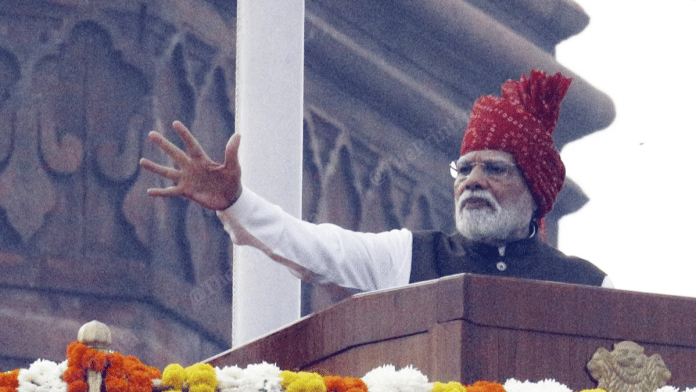


New Delhi: In his shortest Independence Day address in the past four years, Prime Minister Narendra Modi made a major outreach to the youth, stressing that the greatest beneficiaries of ‘Viksit Bharat (Developed India)’ will be the country’s youth.
The Prime Minister’s outreach to the young generation, including Gen Z, was amply clear as he mentioned the words ‘youth’, ‘young’ and ‘younger’ 43 times in his 75-minute speech. He used the term ‘youth’ 20 times, ‘young’ 22 and ‘younger’ once in his speech.
“When I speak of a ‘Viksit Bharat’, when I speak of taking the country forward at a rapid pace, who is the greatest beneficiary of all these efforts? Who is the greatest force driving these efforts? If there is one, it is the youth of my country, the youth power of the country,” the PM said Saturday.
His speech packed with announcements for the young generation assumes significance, especially against the backdrop of the protest that took place across the country, particularly in New Delhi’s Jantar Mantar over the NEET-UG paper leak and concerns about the integrity of other competitive exams.
The BJP and the Modi government faced flak over the condition of India’s overall education system and the lack of job opportunities for the youth. The protest finally concluded with the resignation of Education Minister Dharmendra Pradhan in July, but it also led to growing concerns within the party about its inability to connect with the aspirations of the youth.
In fact, the party had faced criticism from several quarters including from RSS ideologues such as Ratan Sharda, who severely criticised the BJP’s media team, including its IT cell, over its handling of the protests in New Delhi, pointing out that they had no idea about youth anger because they are not in touch with ground realities.
For the BJP that came to power riding high on the success of social media and WhatsApp, advice came from the PM himself as he directed his Cabinet ministers to become more active on Instagram, post reels, and use interactive sessions to connect with the youth—something he did himself to reach out to the protesting youth.
The PM, in his Independence Day speech, announced free online coaching classes for competitive examinations, showcasing it as a way to ease financial burden on poor and middle class families. In another outreach to the youth, Modi announced a programme to train one crore young people in AI skills over the next year.
Moving beyond Gen-Z, the PM extended his outreach to even children from Gen Alpha and announced a nationwide talent hunt for identifying sports talent.
It comes as the Cockroach Janta Party (CJP), which spearheaded the Jantar Mantar protest, has taken the shape of a pressure group and has launched the ‘School Thik Karo” campaign.
The campaign was launched after scores of Gen Alpha students across several states launched protests demanding better school infrastructure including clean water, functional toilets, roads, teachers among others.
Experts point out that the youth outreach announced by Modi shows that the government is thinking seriously about the growing youth discontent.
“The fundamental offerings and youth outreach announced by Prime Minister Modi in his Independence Day speech show one thing quite clearly: the government is thinking seriously about growing youth discontent,” said Sayantan Ghosh, political analyst and author.
He called the emphasis on AI infrastructure, online tuition for competitive examinations and job creation as important.
“The problem is that these themes have appeared repeatedly in election manifestos, government budgets and policy promises across states. Employment, education infrastructure, online learning and, increasingly, AI have become recurring features of political messaging. The real question is not what is being promised, but how much of it is actually being implemented,” he added, pointing out that the speech did not sufficiently address the question of accountability.
“The larger question is whether youth discontent will be viewed merely as an issue of jobs, education and technology, or whether the government is willing to understand it as a deeper demand for accountability and responsiveness.”
However, many like Yashwant Deshmukh, founding director of CVoter,
pointed out that it will also depend on whether these announcements help generate employment, something which has been a major concern for the youth.
The announcements, he said, were expected especially after the Jantar Mantar protest.
“The kind of anger the youth had expressed as long as these announcements practically result in generating jobs, and new opportunities, it will definitely have some impact. However, if it remains rhetorical and on papers, then the issues will remain the same and so will be the concerns of the youth,” Deshmukh said.
The Mood of the Nation tracker has been highlighting that inflation and unemployment are major concerns and need to be resolved, he said.
“If every year these issues are coming up, then surely there is something wrong,” he added.
Social scientist and political analyst Badri Narayan pointed out that PM Modi doesn’t want to leave any room for uncertainty amongst the youth and is reaching out to even the section that was questioning the party.
“This is a positive step and we must welcome it. The BJP’s core support has traditionally come from the youth, and there has been some confusion among the young people, rather amongst a section, that the party is now trying to address which is what his speech indicates,” Narayan said.
He further said that while Modi’s popularity among the youth remains strong, he is also reaching out to the segment that had begun to question the party.
“We should welcome this effort, as it aims to rebuild trust and dispel the doubts that had arisen. A certain narrative has been created, and he does not want to leave any room for uncertainty among young voters about the BJP.”
However, Congress leader Pawn Khera termed the announcements as “too little, too late and too desperate”.
“Today’s grand announcements are just another Modi-era pipe dream with no real implementation plan. This is a desperate attempt to recover the government’s lost legitimacy by dangling fancy announcements before the youth,” he said.
“Free online coaching and AI sound impressive. But this government has a terrible record of last-mile delivery. During COVID, millions of students were left behind because they lacked smartphones, devices, electricity or reliable internet needed for online classes.”
Khera said these same students — those from marginalised backgrounds who most need support to complete their education in an increasingly extractive and exploitative system — are likely to be left behind again under this fresh push for online coaching and AI.
“In reality, BJP is a party of the rich, for the rich. It neither understands nor cares about the interests of the poor and marginalised,” he said.
Author and researcher Chandrachur Ghose said the PM’s address to the youth had two components.
“Firstly, reiteration of all the policies and programmes of the past decade to emphasise how these have opened new horizons in terms of productive opportunities,” he said.
“The second component was to present to the youth a picture of a whole new world of opportunities-expansion of infrastructure, focus on spotting talent in specific areas and providing training and development with definite goals. These opportunities would be in the form of integration with the new economy, deployment of new technologies and involvement in national service.”
Ghose pointed out that a few words on addressing systemic weaknesses would have given the picture of a promising future, a more solid grounding, but perhaps the speech from the Red Fort was not quite the occasion for it.
“The promises were finely balanced not to appear as an effort to counter the grievances of a section of students and youth, but to portray that despite the problem areas a promising future is waiting for them,” he said.
(Edited by Tony Rai)
Also Read: Protesting doesn’t make Gen Z anti-national, their grievances genuine—RSS chief Mohan Bhagwat