






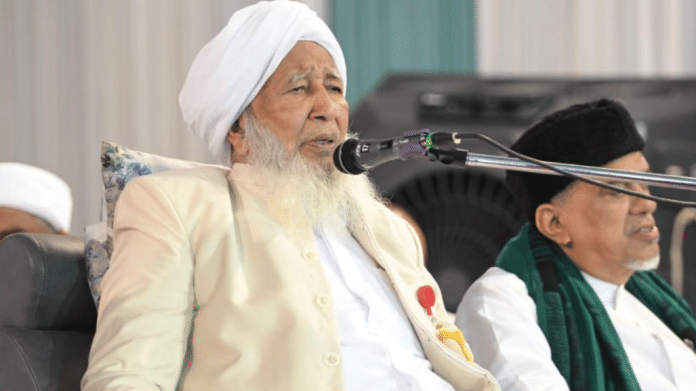

At the Hubbu Rasool Conference in Kochi, India’s Grand Mufti Kanthapuram AP Aboobacker Musliyar from Keralam compared Muslim women to a gold necklace that must be locked safely inside a box so it does not lose its shine or value. He warned that women who step into the public sphere invite “great destruction.” The Quran, he declared, requires them to remain confined to their homes.
He is wrong. Not offensive-wrong. Theologically wrong.
And as a Muslim woman who prays, fasts, and reads her own Quran instead of waiting for a man to read it to her, I want to explain exactly why.
Islam’s first convert wasn’t a man. It was Khadijah bint Khuwaylid, a wealthy, independent businesswoman who ran her own trading caravans across Arabia. She employed the Prophet, Muhammad, judged his character and reputation, and then proposed him for marriage herself. This is recorded across the earliest biographical sources on the Prophet’s life known as Seerah.
However, there is no recorded account of the Prophet commanding Khadijah or even requesting her to abandon public economic life. Khadijah wasn’t hidden away. If female public presence did cause “great destruction,” Islam’s very first supporter would have been a walking contradiction of her own faith.
Then there is Aisha, the daughter of the first caliph, Abu Bakr, and the Prophet’s wife. Known as a prolific scholar, she narrated over 2,000 hadith — recorded reports of the Prophet’s sayings and actions — playing a signficant role in preserving his teachings and contributing to Islamic law and scholarship.
Even male companions and later scholars came to her for knowledge of fiqh (deep understanding of Islamic laws), medicine, poetry, and the Prophet’s life. They actively sought her out on these matters, and she corrected and taught them.
A prominent companion of Prophet Muhammad, Abu Musa al-Ash‘ari famously said: “Never was a hadith unclear to us, the Companions of the Messenger of Allah, and we asked Aisha about it except that we found knowledge concerning it with her.” Historians count around 88 scholars, men included, who studied directly under her.
Apart from scholarly knowledge, women also accompanied armies to carry water, treat the wounded, and provide nursing support, while some also took up weapons when circumstances demanded it. A well-known example is Nusaybah bint Ka‘b, who fought at the Battle of Uhud and defended Prophet Muhammad when the Muslim lines broke.
None of these are mere historical claims; they are the bedrock of Sunni hadith literature that clerics like Kanthapuram claim to represent.
Centuries later, a woman named Fatima al-Fihri inherited her father’s fortune in Fez, Morocco, and used it to establish a mosque in 859 CE, which eventually became an educational centre. Today, the University of al-Qarawiyyin is recognised by UNESCO and the Guinness World Records as the oldest continuously operating, degree-granting university on Earth, older than Oxford (UK) and Bologna (Italy). A Muslim woman founded higher education as we know it. Centuries before Europe even had it.
Also read: ‘Ghazwa-e-Hind’ didn’t come from Islamic scholarship. It came from modern politics
Muslim women in public sphere
Kanthapuram invoked “the Holy Quran” as his source. But as the examples above show, women were never written out of public life in the Quran. The real requirement was modesty, not only for women, but for men too. Surah An-Nur, verse 24:30 tells believing men to lower their gaze and guard their chastity first, before women are even addressed. Only in the next verse, 24:31, are believing women given the same instruction, with additional guidance on covering.
Hadith also lay down clear standards of modesty for men — from what they should cover to warnings against silk, gold, and pompous display. So, modesty in Islam was never a woman-only rule; it applies to men’s bodies and behaviour too.
However, nowhere in this passage, or anywhere else in the Quran, does it say women must be barred from public life.
Today, across the Muslim world, women continue to refute such claims. Indonesia, the largest Muslim-majority country, has had a woman president, Megawati Sukarnoputri. Singapore has also seen Halimah Yacob, a practicing muslim woman, serve as president for six years. Western countries, like the United States, are still waiting for one. Malaysia has also had Wan Azizah Wan Ismail serve as Deputy Prime Minister.
Women teach in seminaries, issue fatwas, and serve as judges and parliamentarians in many Muslim societies. Their existence alone dismantles the claim that public visibility or positions of leadership are somehow un-Islamic.
Some of the women occupy the same seat that conservative Muslim scholars assume only they can occupy. Ingrid Mattson was the first woman to head the Islamic Society of North America. Scholars such as Dr Zainab Alwani, Dr Farhat Ishtiyaq, and Yasmin Mogahed are part of a growing, global body of Muslim women doing serious theological work; not asking permission to exist in public, but producing the scholarship itself.
Yet, the idea that Muslim women belong only in the private sphere keeps resurfacing in its most extreme form in the modern world. The Taliban’s extreme restrictions, such as banning girls from secondary education, silencing women’s voices in public, or confining them almost entirely to the private sphere, are often presented as pure Islam. But they are not. They mix rigid, controversial interpretations of certain texts with deep-rooted Pashtun tribal codes of honour and control. Many Muslim scholars and communities worldwide reject this model when discussing the broader vision of Islam.
Honour and dignity are not maintained by locking women away. They are preserved through knowledge and mutual respect. The Prophet elevated the status of women in a society that buried daughters alive. That legacy cannot be honoured by pushing women back into the shadows.
(Edited by Prashant Dixit)