






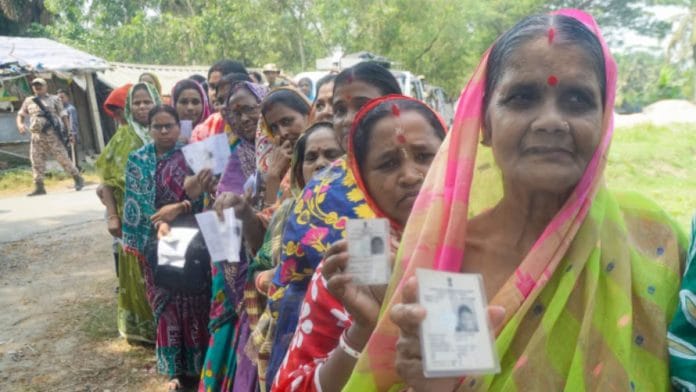


From the mountains of Darjeeling to the Jangalmahal, in the middle of the forests of Purulia district—once the Red Corridor of the Maoists—the first phase of the West Bengal Assembly elections of 2026 witnessed a historic voter turnout of over 92 per cent, around eight points higher than the 2021 Assembly election’s. This is significant because the election followed the Special Intensive Revision of the voter roll. It sparked a massive political confrontation between Chief Minister Mamata Banerjee’s Trinamool Congress government, the Election Commission of India, and the Bharatiya Janata Party.
The SIR has become the sole political discourse driving one of the most high-voltage campaigns of recent times. It deleted over 91 lakh names from the voter rolls, including around 27 lakh removed after scrutiny of over 60 lakh voters for logical discrepancies, a phenomenon exclusive to Bengal. These deletions show a trend of targeting Muslim-populated districts, affecting minority communities and women, the most—key vote banks for Mamata Banerjee.
CM Banerjee is fighting her toughest battle, cornered by the BJP machinery through central agencies and the Election Commission’s massive crackdown. She has lost control of her administration as the Election Commission has replaced key officers with its own appointees. The crackdown intensified with Enforcement Directorate and Income Tax raids on Trinamool Congress candidates and the arrest of Indian Political Action Committee (I-PAC) co-founder Vinesh Chandel, forcing the firm to halt operations in Bengal just 120 hours before polling.
The massive voter turnout has happened for several reasons beyond the simple arithmetic that if the total number of voters in a constituency reduces, then the turnout numbers will be higher. Politics, and most importantly Bengal politics, is rarely about arithmetic but all about the chemistry. ‘
This turnout proves one point very clearly, what Banerjee wanted from day one, that this election must not be about Didi vs Modi but the people versus the Election Commission. Being a street fighter, she knew that this was her best bait to completely shift the focus from the huge anti-incumbency of 15 years with issues like corruption, to women’s safety, to unemployment, toward an issue that resonates emotionally to the people: the right to vote. Banerjee has politically tied this to questions of citizenship and Bangali Ashmita (Bengali pride), countering the BJP’s high-voltage push around “ghuspetiya” (illegal Bangladeshi immigrants and Rohingyas) narrative.
Being a border state, West Bengal is sensitive to the BJP’s illegal immigration discourse—and Banerjee knew it would hit the Bengalis hard, given that many have their roots in Bangladesh. So, her entire campaign in this election is based on a message that after SIR, if a person does not vote, then their name will be deleted forever. She has also alleged that this entire process of deletion is nothing but a warm-up to the National Register of Citizenship, by which, she alleges, the BJP-led central government could take away the citizenship rights.
In this light, the record turnout suggests that this election has become a referendum on the Election Commission of India—one that might otherwise have been centred on the TMC government had the Election Commission crackdown not happened. That is why the general political analysis—that high turnout signals anti-incumbency—is hard to apply in this case.
Emotional voting
Emotional voting has long shaped elections across the world, where raw sentiment, not cold calculation, drives citizens to the ballot. In West Bengal today, that emotional surge has defined the record turnout. Millions voted not merely out of duty, but out of deep anxiety and a fierce sense of injustice after the controversial SIR of the voter rolls.
Every family in the state lived through months of tension, desperately scrambling to ensure their names remained on the voter list. The process left ordinary citizens gripped by fear that years of residency and citizenship could vanish due to minor technicalities. Many watched in disbelief as their names, initially listed, were suddenly shifted to adjudication over trivial issues, such as slight spelling variations or because a father had six or seven children. These were not abstract errors. They struck at the heart of genuine Indian citizens.
Across remote rural villages, entire families found names of parents, siblings, or spouses—people who had voted in every previous election without question—missing from the rolls. The pain was personal and collective.
People widely perceived these deletions as targeted, hitting hardest in Muslim-majority areas. In Murshidabad and Malda districts, where Muslim communities form the overwhelming majority, constituencies recorded an astonishing 95 per cent turnout, precisely because voters believed their names and rights were under systematic threat due to their minority identity.
This was not routine electoral enthusiasm. It was a collective cry of defiance born from a profound fear that the democratic right to vote, and by extension the right to belong, was being snatched away. Banerjee turned that fear into fuel, transforming polling stations into sites of emotional resistance.
Vote For Existence
From migrant labourers to white-collar employees working in distant states, thousands rushed back to West Bengal to cast their votes. They returned home because they saw this election as a battle for their very existence. A powerful fear had gripped the ground: if they failed to vote despite their names appearing on the voter list, those names could be deleted forever, pushing their citizenship into scrutiny and grave danger, precisely as Mamata Banerjee had repeatedly warned.
This was no routine homecoming. It was a desperate pilgrimage for survival. At Howrah railway station, Sealdah, and Kolkata International Airport, waves of anxious voters poured in from across India, determined to defend their right to belong in the land they call home. For them, the ballot had become their last shield against an uncertain and terrifying future.
Also read: The myth of the Muslim vote in West Bengal. We aren’t a monolith
The fear factor
West Bengal’s politics is unfortunately consumed by fear once again. This time the fear had nothing to do with violence, booth capturing, or fake voting. The Election Commission had enforced an unprecedented crackdown, deploying record numbers of central forces, imposing an undeclared curfew, blocking two-wheeler movement, shutting liquor shops early, and restricting travel while ordering hotels to vacate out-of-district guests.
But the real fear ran far deeper than these restrictions. It was the dread that one’s own absence from the polling booth could destroy not just one life, but the future of entire families. People believed that if their names were deleted later for not voting, the same fate would befall their loved ones. Many remembered the SIR rule that automatically included names from the 2002 list and feared the reverse logic, if one family member’s name vanished due to non-voting, others in the household would suffer too.
This turned the act of voting into a desperate necessity to protect parents, children, and siblings from losing their rights as citizens.
The geographical skew of the first phase, which favoured districts where the BJP traditionally holds ground, is merely a preamble. The true storm is gathering in the Trinamool bastions of South Bengal and the Presidency, where an equally explosive turnout is inevitable on 29 April. To view this through the tired lens of partisan arithmetic, however, is to miss the tectonic shift happening on the ground. This year, the Bengali electorate did not merely vote with raw emotion. They voted with a profound, jagged empathy and a fierce, unyielding solidarity for the friends, kin, and neighbours whose fundamental right to exist was stripped away by the cruelty of the SIR process.
This is no longer a simple election; it is a mass insurrection of the spirit. The people of Bengal have risen in visceral defiance against an establishment that dared to disenfranchise their own blood. The 2026 West Bengal Assembly election has, therefore, ceased to be a referendum on the incumbency of Mamata Banerjee. It has become a raw, existential referendum against the Election Commission of India.
Sayantan Ghosh is the author of two books, ‘Battleground Bengal’ and ‘The Aam Aadmi Party’. Views are personal.
(Edited by Ratan Priya)