






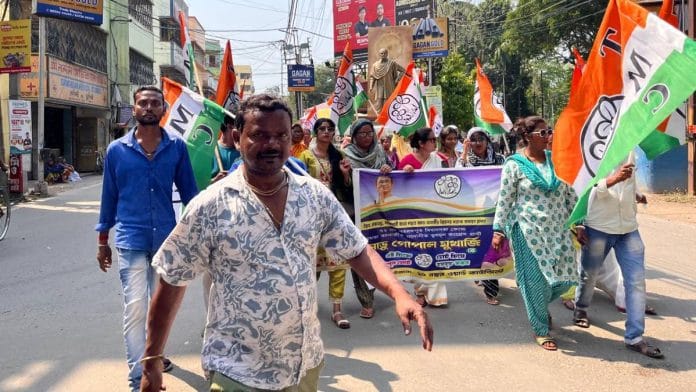


With the controversy around SIR and an increasingly intense political campaign, the West Bengal Assembly elections have taken the attention away from elections in Assam, Kerala, Tamil Nadu and Puducherry.
What makes West Bengal so important?
The Bharatiya Janata Party has been working toward a win in the state since 2014. Among its supporters, and Hindutva believers, a victory here is seen as more than just an electoral success. It carries an ideological weight. It is tied to the idea of Hindu interests and a unified Hindu political identity.
However, what caught my eye is that this election has been picked up by international outlets as well. For example, The Guardian reported concerns about Muslims and other minorities being disproportionately removed from electoral rolls ahead of the elections.
In a state where it is widely believed that Muslim voters largely support the incumbent CM Mamata Banerjee, such developments take on a different meaning. Reports suggest that around 9.7 million names have been deleted, with about 2.7 million people challenging their removal. TMC claimed it was vote theft.
But what is interesting this time is that the contest for Muslim votes is no longer as straightforward. Mamata Banerjee now has to deal with a new challenge. Humayun Kabir—once part of her own party—is now getting support from AIMIM’s Asaduddin Owaisi.
In a state where Muslims make up nearly 30 per cent of the population, the emergence of leaders positioning themselves as the sole representatives of Muslim interests adds another layer to the contest. It complicates the effort to consolidate votes on the basis of broader, secular positioning, and gives the Muslim voter more options to choose from. And like any other community, Muslims will choose based on their own priorities.
Also read: TCS Nashik case begs the question. Why do Muslims get so defensive every time?
Not a uniform bloc
Growing up in Uttar Pradesh, I saw this up close. Within my own family, political discussions were anything but uniform—some supported Congress, some leaned toward SP, others toward BSP, and over time, I even saw support emerging for AAP. It was never a single line of thinking, but a mix of opinions, often debated quite intensely. What I haven’t seen till now is support for BJP, apart from local body elections, or for a communal Muslim political party like Owaisi’s.
That is why I often found myself confused by the idea of the “Muslim vote” being treated as a single, fixed bloc—almost as if everyone already knew whom to vote for. I remember a Hindu acquaintance, someone educated and well-read, telling me that before meeting me, he believed Muslims had some kind of central authority that guided their voting decisions. He believed that people simply followed those instructions, and the entire community became a powerful mobilised vote-base.
That bizarre idea stayed with me. It reveals how easily complex realities are reduced to simple assumptions. Even today, whenever I read or write about Muslim politics in India, that memory comes back—reminding me how persistent and misplaced these perceptions can be.
Also read: Indian Muslim intellectuals struggling to make sense of Iran crisis. Ummah isn’t the answer
What’s at stake
At a time when women’s reservation is being widely discussed, it is interesting to see how political parties are positioning themselves. To its credit, The All India Trinamool Congress has fielded more women candidates than any others and has a significant (37 per cent) share of women parliamentarians, led by Mamata Banerjee herself.
To its credit, The All India Trinamool Congress has fielded more women candidates than any others and has a significant (37 per cent) share of women parliamentarians, led by Mamata Banerjee herself.
In that context, it is worth pausing to notice something that is rarely acknowledged. Muslim voters, often spoken about in narrow or binary terms, have also played a role in shaping these outcomes. In a way, they become part of a process that brings more women into political leadership. A community that’s seen as regressive and misogynistic, where women don’t even get equal legal rights, are indirectly contributing to increasing women’s presence in political institutions.
There’s been a lot of discussion of the implications of this election for the balance of political power in India. However, much more is at stake.
With drives like the SIR, where millions are contesting their exclusion—with even polling officers denied the right to vote—it begins to feel less like a routine exercise and more like an intentional stress to the system itself.
No matter who wins in West Bengal, democracy loses.
Amana Begam Ansari is a columnist, writer, and TV news panellist. She runs a weekly YouTube show called ‘India This Week by Amana and Khalid’. She tweets @Amana_Ansari. Views are personal.
(Edited by Theres Sudeep)