





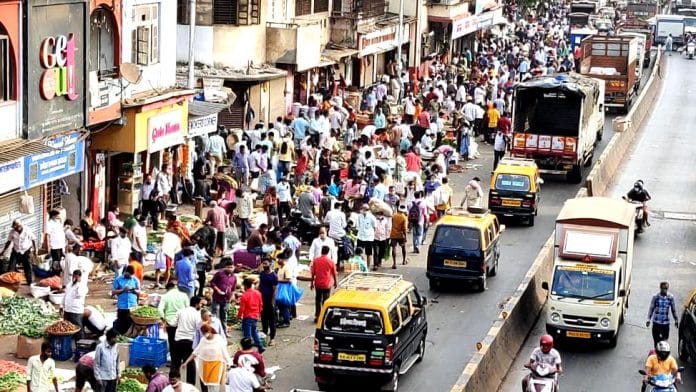


Mumbai: Announcing that cab and auto drivers across the state will have to speak Marathi from 1 May, Transport Minister Pratap Sarnaik Thursday confirmed the government’s enlistment of two private organisations—Konkan Marathi Sahitya Parishad and Mumbai Marathi Sahitya Sangh—to teach Marathi to non-Marathi drivers.
The Maharashtra government will begin testing taxi and auto drivers, including those working with app-based platforms, on their proficiency in Marathi from 1 May. As a pilot, the transport department has begun checking how many auto permit holders in Mira Bhayander—a town in the larger Mumbai Metropolitan Region—know the Marathi language.
The drive will continue across 59 regional/sub-regional transport offices in the Mumbai Metropolitan Region, where officials will test drivers on their proficiency in Marathi.
Sarnaik clarified that there would be no written exam; drivers will be tested on whether they understand or can speak Marathi. Drivers found proficient will be given a certificate, which the government will accept as proof of their proficiency in Marathi, he added.
“Non-Marathi drivers should be able to speak professional Marathi with customers,” Sarnaik said Thursday. For this, the Konkan Marathi Sahitya Parishad and Mumbai Marathi Sahitya Sangh will propose a teaching module, he added.
The Konkan Marathi Sahitya Parishad is an organisation tasked with preserving the Marathi language and releasing literature in Marathi. It is based in Ratnagiri with offices in Konkan, Raigad, Thane, and Mumbai. Mumbai Marathi Sahitya Sangh is another organisation that promotes Marathi literature, culture, and theatre.
“We are drafting a policy. The motive is smooth conversations between drivers and customers and also to create a cordial feeling towards the Marathi language,” Sarnaik said.
On Thursday, Sarnaik held a meeting with educationists, litterateurs, cultural experts, and linguistic experts to chart a plan to implement the Central Motor Vehicles Rules, 1989, as well as a 2014-15 Maharashtra government-issued rule under the Act, mandating that cab and auto drivers know the “local language”. Under the Act, states can impose conditions via permits.
“We received a lot of complaints from people who find it difficult when drivers don’t speak with them in Marathi, and this [language requirement] is not new. The rules already exist under the Motor Vehicles Rules. We are just strictly implementing them,” Sarnaik told the media.
A two-page booklet for testing Marathi proficiency of drivers will be prepared Thursday. From 1 May, the government will distribute the booklet among RTOs to test drivers. The drive that follows would not only test Marathi proficiency but also weed out fake permit holders and, if such cases are found, the RTO officers concerned would be questioned.
“If you have to do business in Maharashtra, one has to know Marathi, and this is what the RTO believes. So for all those drivers who find it difficult to learn the language, Konkan Marathi Sahitya and Marathi Sahitya Sangh people would teach them,” Sarnaik said Thursday. “But if they have an arrogance towards not learning Marathi, that is not right.”
Under the 2014 motor vehicles rules of Maharashtra, all cab and auto drivers have to submit a domicile certificate to prove they have lived in the state for at least 15 years, as well as have knowledge of the local language and geography. Their character is also tested.
Also Read: What plea in SC contends against 2023 Uttar Pradesh law abating trials under Motor Vehicles Act
Mira Bhayandar: Pilot project
In Sarnaik’s constituency—Mira-Bhayander—the testing of Marathi proficiency has already started. Registered auto drivers are being evaluated by RTOs.
Speaking to ThePrint, Hemangini Patil, RTO officer, Thane—under which Mira-Bhayander falls—said that officials were testing drivers for their spoken Marathi and that the checking would not be random.
Patil also said that there was no template or written question paper and that the test focussed on the drivers’ spoken Marathi. He said RTO officers would ask basic questions, such as “What is your name?”, “Where have you come from?”, and “Where do you live?”, and “some driving directions, about general weather conditions” in Marathi.
She said that in Mira-Bhayander, registered drivers were being called at the RTO for this evaluation. So far, 2,385 drivers have been tested, and out of that, over 200 drivers have failed the tests.
Patil said that for drivers who failed the test, the department would take a final call whether their licenses would be revoked.
The evaluation is ongoing, and the transport department will obtain the final report on Mira-Bhayander by 28 April.
The drive will then be replicated across MMR.
Bablu Singh, originally from Pratapgarh in Uttar Pradesh, arrived in Mumbai after COVID-19. He said that he had been driving an auto from Sion to Mumbai airport and that he understood Marathi but was not fluent in it.
“Customers speak with us in Hindi, so I never thought I need to learn Marathi. But I have picked up a little bit hearing some customers. It is good that now, the government will teach us. I will be happy to learn,” Singh told ThePrint.
Opposition to the test
Shashank Rao, president of Autorickshaw Chalak Malak Sanghatana Sanyukt Kruti Samiti Maharashtra, told ThePrint that revoking licenses was something the unions would oppose tooth and nail. He said that this could happen when new permits were granted, but for those who already had permits, there was no need to cancel them, Rao asserted.
“They took permits after giving tests and following rules. Now, suddenly, you say you will take tests and revoke licences. This is absolutely wrong, even by law. And we will oppose this. This is not called for,” said Rao, who also announced that if the decision was not rolled back, drivers would protest from 4 May across the state. “We are not going on strike, but we will definitely hold protests across the state if such a decision is not rolled back. I’m not ‘anti-Marathi’. But, when the government department handed out permits to drivers, they already tested them. So how come suddenly they want to snatch away those permits?”
He also questioned how the app-based taxis and auto drivers would be tested, because their registration would happen at the operator level.
Azam Shaikh, who drives a black-and-yellow taxi in Dadar and has been living in Mumbai for the past 20 years, gave up his domicilebefore obtaining his permit. He opined that revoking licences for lack of Marathi proficiency was not a good route to take.
“I drive this taxi and work hard to earn whatever little I get. Already the employment situation is not good, and if they revoke the permit, what will I do? I don’t mind learning fluent Marathi. But I need somebody to teach,” Shaikh said.
Sarnaik said that he would hold a meeting with Rao and other union members on 28 April to find solutions to the issues raised by Rao.
“I want to tell him that this is Maharashtra and insisting that everyone who is working here should know Marathi is not wrong. If you go to Karnataka, Telangana, Tamil Nadu, they are of the opinion that their local language should be respected. So if drivers here are interested in learning, Shashank Rao taking an aggressive stand against it is not right,” Sarnaik said.
He clarified that if a Marathi passenger sat in the cab, taxi, or auto, conversing in Marathi, the driver should be able to communicate at least at the basic level.
“We don’t expect them to know Marathi literature, or anything like that. Our module will also be like that. It is simple to understand. Our position is not to snatch away anybody’s employment. We don’t want to do that,” he added.
(Edited by Madhurita Goswami)
World is talking about AI and our incompetent leaders are taking us to a lesson of language what a total waste of time and resources completely out.
What absurdity ! If you want a language to flourish truly, teach it well in schools and colleges and encourage creativity when students pursue vocations in their mother tongue. Making auto drivers, vegetable sellers speak the language forcibly will only bring brashness to the language. A working knowledge of a states language is anyway acquired if the non natives spend entire days at a stretch for months outside. This language shenanigan is just another sly attempt by politicians to stay relevant and in power under the garb of protection of language.