



French philosopher and writer Ernest Renan argued that forgetting is as necessary to a nation as remembering. The Argentine sociologist Elizabeth Jelin made a less serene proposition: public memory is contested work, shaped by “memory entrepreneurs” who decide which version of the past may govern the present.
Bangladesh is now conducting a somewhat similar exercise through its post-Hasina foreign policy. The problem is not that it has kept the geopolitics of 1971 on the side to ‘move on’. It is that repudiating one custodian of 1971 – Sheikh Hasina – is beginning to give Bangladesh’s foreign policy borderline strategic masochism – the country is pushing itself to sleep with its killers – and it is asserted as the new normal.
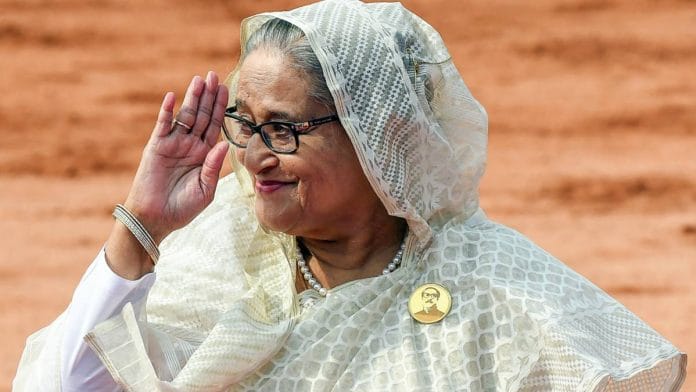
Prime Minister Tarique Rahman’s first proposed visit to India offers the immediate peg. Preparations had begun, but the visit stalled after Hasina addressed a virtual press conference from New Delhi on 5 August, attacked Bangladesh’s government and promised to return. India said it had neither organised nor endorsed a private event, but Dhaka chose to see little distinction between endorsement and permission. It demanded Hasina’s extradition and insisted that a “propitious environment” must precede Rahman’s visit.
So, how normal is the new normal?
Forgetting is a political act
Collective memory has been a serious scholarly pursuit since French philosopher Maurice Halbwachs described its social construction a century ago. Today, universities at Aberdeen, Tampere and SOAS teach the politics of memory through foreign policy, historical analogy, transitional justice and reconciliation.
Countries emerging from war have treated memory differently. After Franco’s death in 1975, Spain’s transition to democracy rested partly on the Pacto del Olvido – the pact of forgetting so that the country could avoid reopening the atrocities of the 1936-39 Civil War and stabilise democracy. It also deferred justice and left later generations to reopen graves, archives, and arguments if they deem fit. Spain showed that official silence could postpone memory, even if it didn’t abolish it altogether.
France and Germany built reconciliation through acknowledgement, reparations, treaties, and institutions – not by pretending Verdun or occupation or Auschwitz had never happened.
Of course, these are comparisons and not templates.
Bangladesh has every right to practice reconciliation in a changed global landscape, but one is not sure how far this goes because Pakistan has never delivered the unambiguous apology Bangladesh has repeatedly sought. The 1974 tripartite agreement recorded Pakistan’s condemnation and “deep regret” for crimes that may have been committed; Pervez Musharraf expressed regret again in 2002. But regret is not acknowledgement.
Bangladeshi lawyer and writer Khan Khalid Adnan aptly describes this as substituting regret for accountability. Even other countries like Turkey and Saudi Arabia, that Bangladesh courts today, have prioritised Pakistan’s stance in 1971, while China opposed the creation outright.
Who owns 1971?
The debate inside Bangladesh is richer than a binary contest between secularists and Islamists. Bangladeshi scholars identify two histories of liberation: one centred on the Awami League’s mandate and another on the longer popular, intellectual and military struggle. Both defend 1971, but what they dispute is its custodians.
Bangladeshi journalist Mahfuz Anam makes the essential separation: Mujib’s role in liberation must be distinguished from his failures after 1972 and Hasina’s later authoritarianism. Hasina’s dynastic use of Mujib tied his image to coercion and reduced the Indian relationship to one built around the Awami League rather than Bangladesh.
Breaking completely with Bengali nationalism could discard 1971’s emancipatory promise. Hasan Ferdous explicitly calls out India: New Delhi expects gratitude, while young Bangladeshis see Hasina as someone who violated the Liberation War’s democratic values.
The intellectual shift therefore has three important points. The state-led turn began after Ziaur Rehman took over in 1975; inter-party competition entrenched it after 1991; and India’s support for Hasina turned an old ideological pendulum into a generational and irreversible rupture.
The change is also measurable. A Pew survey in early 2026 found that 54% of Bangladeshis viewed Pakistan favourably, up from 40% in 2024. India’s favourability stood at 42%, down by 15 points; many named India as their greatest threat. This change didn’t come in two years but reflects a politicised emotional experience of their own past.
Bangladeshi analysts do not speak with one voice about India. Some argue for rules-based interdependence and multi-alignment, not “running into China’s arms” and exchanging one dependence for another. Others say the Pakistan outreach became a pointed counterweight to India, blurring multi-vector diplomacy with overt balancing.
But there is an added risk. Jamaat-e-Islami and its allies won 77 seats in 2026. Scholarship shows that Islamisation was pushed by both Islamist movements and ostensibly secular factions. The concern is a more strident Islamisation in which minorities, women and secular voices face coercion, and hostility to India becomes proof of religious and, by that extension, national authenticity.
Also Read: Sword of Hasina hangs over Bangladesh’s India policy as Tarique juggles pro & anti India powerplay
Cost, Constraint and Opportunity of Geography
Geography can be a cost, constraint or opportunity; policy decides which path to take. The Treaty of Westphalia remains the foundation of the modern territorial state. Borders are war’s most stubborn after-life: drawn and redrawn through victors, vanquished, and the survival of peoples for whom it becomes a lived reality.
Bangladesh shares a 4,096.7-km land border with India and is enclosed by it to the west, north and east. Rivers, roads, rail, supply chains and families crosscut this space. China may provide capital and weapons, Pakistan military bonhomie and Islamic appeal, and Turkey cost-effective defence technology. Even the US remains Bangladesh’s largest export market – but none can move closer on the map.
This does not provide special entitlements to India. The same geography produces border killings, refugee influx, unequal bargaining and the unresolved Teesta question. Bangladesh has accused India of forced push-ins; both governments nevertheless agreed in June to coordinate patrols. Indian electricity supplied roughly 15.6% of Bangladesh’s power in 2025, and the demand has grown in recent weeks.
Therefore, a post-Hasina course correction is both expected and in the making. But it didn’t start in 2024 and doesn’t change the fundamentals of geography. Multi-alignment is a refuge of the middle powers, but unnecessary strategic masochism is not. Bangladesh may choose how it reads history, but it cannot choose its geography – and foreign policy is ultimately tested by whether it can reconcile the two.
Swasti Rao is a Consulting Editor (International and Strategic Affairs) at ThePrint. She tweets @swasrao. Views are personal.
(Edited by Maryam Hassan)
India’s over the top support for Hasina. Not wise statesmanship at work. Her departure two years ago provided an opportunity to move on. Didn’t happen. Before her “ private event “ the government of Bangladesh had conveyed its disapproval to the Indian high commissioner. With respect, if we want a better relationship , we will have to work for it.
I worry about Bangladesh. More precisely, about where our relationship with Bangladesh is headed. It will be a huge setback if it joins the Mecca Accord. It has always bought weapons from China, is now planning purchase of fighter jets a well.