



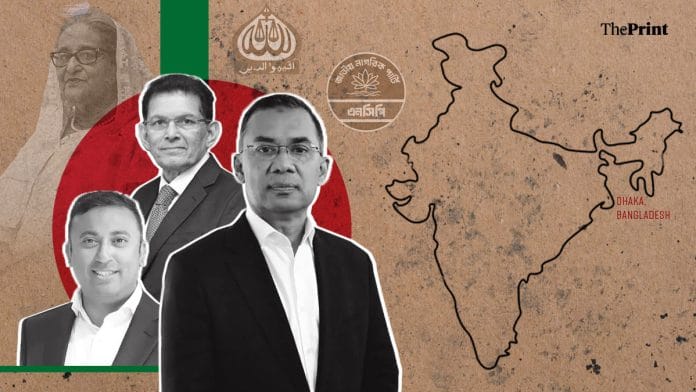
New Delhi: Political divisions in Dhaka, within the government and among the political parties, have left its India policy in limbo. The push for extradition of Sheikh Hasina as a condition for Prime Minister Tarique Rahman’s visit to New Delhi has raised the political temperature between the two governments.
The condition highlighted in a statement by A.K.M. Shahidul Karim, spokesperson for Bangladesh’s Ministry of Foreign Affairs Sunday tamped down the speculation of an early visit by Tarique to India sometime in the third week of August or early September. Last week, ThePrint had reported that both governments are in discussion for a visit in the third week of August or early September ahead of the BRICS leaders’ summit.
However, as ThePrint now reports, the visit may be off the cards until Hasina is returned, highlighting the challenges Tarique faces within his party—the Bangladesh Nationalist Party (BNP)—and from the Opposition led by the Jamaat-e-Islami (JeI) and the National Citizens Party (NCP).
The strain in ties since Hasina’s ouster in August 2024 has become a lightning rod for Bangladeshi politicians to assert their domestic legitimacy with an explicitly anti-India stance.
Nahid Islam, founding convenor of NCP and a key coordinator in the student demonstrations that led to Hasina’s ouster, declared that “no initiative to establish normal diplomatic relations” with India should be taken until Hasina’s extradition is resolved. Islam’s comments last week, came a day after Tarique met with India’s High Commissioner to Bangladesh Dinesh Trivedi.
The opposition leader went a step further in calling for a “democratic South Asia” and saying that Bangladesh does not consider itself as a part of a “shared dream” with India. He also criticised the Bangladesh foreign ministry’s initial statement on Hasina’s press conference in New Delhi on 5 August—which triggered the fresh strain in India-Bangladesh ties.
Days later, the foreign ministry released a new statement with much stronger language, laying out the conditions for Tarique’s possible visit to India.
The divide is not just between the government and the Opposition in Dhaka, but also seemingly within the ruling establishment. The political divisions between Foreign Affairs Adviser Humayun Kabir and Foreign Minister Khalilur Rahman have left Bangladesh’s relationship with India scrambled.
Amidst the domestic political churn in Dhaka on its India policy, New Delhi moved to change its language describing the relationship with Bangladesh, calling for ties based on “reciprocity”, a first. The language seems to imply that the ball is now in Dhaka’s court on how to proceed forward.
Government sources have indicated that both sides remain in negotiations over the visit, with India willing to host Tarique for a state visit and open to discussion on all facets of the relationship.
Also Read: Can India extradite Sheikh Hasina back to Bangladesh? The treaty, the law and the questions
Duelling centres of power
There is a growing sense in New Delhi that growing brinkmanship in the relationship is a part of BNP’s attempts to strengthen its own domestic positioning vis-a-vis the Jamaat-e-Islami and NCP.
Foreign Minister Rahman has remained in touch with the highest levels of the Indian leadership, including National Security Adviser Ajit Doval, over the past year. The Doval-Rahman communication channel was set up, while the latter was Bangladesh’s NSA in the previous interim government led by then Chief Adviser Muhammad Yunus.
Trivedi is increasingly being viewed positively within Dhaka, with the Indian High Commissioner pushing hard for Tarique’s India trip, as a means to break the political deadlock between the two governments.
Kabir, who was appointed to his role by PM Tarique, has sought to more effectively stamp his political approach on Bangladesh’s foreign policy, especially with regards to India. High Commissioner Trivedi met with both the foreign minister and adviser earlier in August, highlighting the duelling centres of policy-making currently at play in Dhaka.
Sources in the Bangladesh government highlighted that the foreign minister and the bureaucracy have continued to push the necessity of staying in touch with India as a number of issues, from illegal migration to water-sharing of 54 transboundary rivers, need to be dealt with. The landmark Ganges Water Treaty is set to expire in December, with negotiations on its extension remaining in limbo as the two PMs are yet to meet.
Kabir, in his meeting with Trivedi on 3 August, was more categorical on the call for Hasina’s extradition than the statement released by the Bangladesh foreign ministry after the Indian High Commissioner called on Foreign Minister Rahman. Notably, by the time Trivedi met Kabir, the announcement for Hasina’s 5 August press meet in New Delhi had been circulating for a few days.
Bangladesh government sources further said that Dhaka had raised the issue diplomatically with India ahead of the press conference, urging New Delhi to restrict Hasina’s public appearances. A source in the know from Dhaka highlighted that while the PM wants a mutually beneficial relationship with India, the sense remains that New Delhi must “stop” Hasina from making public comments.
“I mean first keep her quiet and then we [Bangladesh] can talk. But that is what India has been unable to do. We do not know if it’s by choice or not…but just make her stop. She can live as a private citizen in India, but do not let her conduct political activities that destabilise Bangladesh,” the source told ThePrint.
The source added that a number of ministers in Dhaka, including former BNP general secretary Mirza Fakhrul who was elected the country’s 23rd President Thursday, have called for stabilisation of ties with India, while there are others who are more attuned to public sentiment, especially in relation to Hasina’s return—including Kabir.
The Indian government was quick to distance itself from the former prime minister’s press conference, with spokesperson Randhir Jaiswal highlighting that it was a “private event”, during a regular press briefing earlier this month. This response did not cut ice within Bangladesh’s political establishment.
Calibrated stabilisation under strain over Hasina
The back-and-forth over Hasina has raised a challenge to the calibrated approach taken by New Delhi and Dhaka to stabilise and normalise ties since PM Tarique assumed power earlier this year. A number of high-level exchanges, including India’s Research and Analysis Wing (R&AW) chief Parag Jain’s Dhaka visit last week, underlines the sense within the bureaucratic levers of government.
Foreign Minister Rahman made a stopover in New Delhi in May and met with External Affairs Minister S. Jaishankar. Bangladesh’s Defence Adviser Brig. Gen. A.K.M. Shamsul Islam (Retd.) attended the meeting of the national security chiefs of the Bay of Bengal Multi-Sectoral Technical and Economic Cooperation (BIMSTEC) grouping last month in New Delhi.
Bangladesh’s Director General of Forces Intelligence (DGFI) Major General Mohammad Kaiser Rashid Chowdhury travelled to Delhi in March, and met with Jain as well as Doval. However, at the political level, the relationship remains stalled. High Commissioner Trivedi called on PM Tarique last week, and made a dash to Delhi the following day to meet Prime Minister Narendra Modi.
A diplomatic source indicated that the steps taken over the last 10 months, including the high-level exchanges, have been seriously damaged, with domestic politics within Bangladesh on Hasina’s extradition being part of the reason to stall Tarique’s potential visit to New Delhi.
Fears remain that with the lack of an exit ramp, the diplomatic relationship will be pushed further back even as the expiration of the Ganges Water Treaty nears.
A source in the know in Dhaka went so far as to suggest a visit by Modi to Bangladesh to break the dead-lock, rather than having Rahman travel to India. Bangladesh has not extended any invitation to Modi to travel to Dhaka yet.
This highlights the degree to which the political atmosphere has been vitiated over Hasina.
The sense in New Delhi remains that it has consistently tried to meet Dhaka half-way, ensuring the flow of diesel the last few months as the war in West Asia impacted petroleum supply, moving quickly to apprehend the alleged killers of political activist Sharif Osman Hadi, and extending at least two invitations for a Prime Ministerial visit.
Mubashar Hasan, a Bangladeshi political analyst, explained to ThePrint that the recent statements by Dhaka increases PM Tarique’s “domestic legitimacy”, by burnishing his credential as a leader who “stands up to India”.
“It is a reactionary policy rather than an innovative one. That means the control of this policy is not at Dhaka’s end. It is mostly in the hands of India. If such a relationship goes on for long, it may become costly,” Hasan said.
(Edited by Mannat Chugh)
Also Read: In 1st visit to J&K, Gor calls UT ‘important part of India’, hints at downgrading travel advisory
Things are not going swimmingly well with the relationship. Feel exceedingly diffident to be more candid. Act now before things get much worse.