



New Delhi: India Tuesday shifted its position on Bangladesh, highlighting the necessity of “reciprocity” in ties, as Dhaka continues to raise the political temperature over the extradition of former Prime Minister Sheikh Hasina.
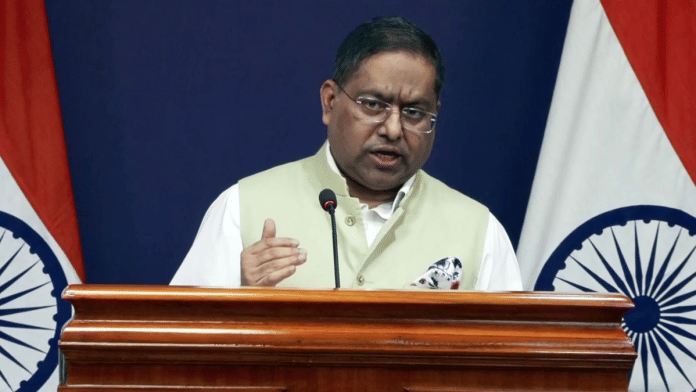
“India desires positive, constructive and forward-looking relations with Bangladesh based on mutuality of interests and reciprocity. Our position on the press conference by the former Prime Minister needs no repetition. On the issue of extraditions, our consistent position has been that these requests are being examined as part of our established processes,” Ministry of External Affairs (MEA) spokesperson Randhir Jaiswal said at a regular press briefing Tuesday.
The language marks a shift in India’s diplomatic posture with regards to Dhaka. This is the first time India has used the term “reciprocity” when it comes to the relationship with Bangladesh, amid Dhaka’s own insistence that ties must be “based on sovereign equality, mutual respect, non-interference in each other’s internal affairs, and national dignity.”
Ties between the two neighbouring countries are at a tense crossroads. Bangladesh Prime Minister Tarique Rahman, as ThePrint exclusively reported Tuesday, has “no plans” of undertaking a bilateral visit to India anytime soon and is set to skip the BRICS Leaders’ Summit—to which he was invited by India as a special guest—scheduled next month too. Rahman’s government seeks a substantive political gesture if ties are to move forward, ThePrint has learnt.
A Sunday statement from Bangladesh made by AKM Shahidul Karim, spokesperson for the Ministry of Foreign Affairs, had laid conditions including the extradition of Hasina and others before any visit by Rahman.
India has consistently maintained, even during the term of the previous interim regime in Dhaka, that it is keen to “strengthen” the relationship. The additional language used Tuesday points to New Delhi’s evolving view of the situation in Dhaka, following the statement by Bangladesh’s Ministry of Foreign Affairs. Dhaka has also called for extradition of the accused killers of political activist Osman Hadi, and has raised the temperature between the two countries.
This offers little room for further diplomacy, as it extends Dhaka’s own domestic situation to its foreign policy with regards to India. Diplomatic sources highlighted that with the new position outlined by the Ministry of Foreign Affairs Sunday in Dhaka, any movement in ties is now solely through political channels.
Dhaka-New Delhi ties have faced significant challenges in recent weeks, following Hasina’s Delhi press conference. The ousted leader left Dhaka for New Delhi in August 2024, and has remained in India since. India was quick to distance itself from Hasina’s press conference, with Jaiswal pointing out that it is a private event, when questioned on the issue earlier this month. However, Dhaka’s furore only increased.
Also read: Exclusive: Bangladesh PM Tarique Rahman ‘has no plans’ to visit India soon, set to skip BRICS too
A series of high-level exchanges
India has sought to showcase its keen interest in improving ties with the Rahman-led Bangladesh Nationalist Party (BNP) government with a spate of high-level exchanges in the last nine months.
External Affairs Minister S. Jaishankar travelled to Dhaka at the end of last year to attend the funeral of former Prime Minister Khaleda Zia, Rahman’s mother. The gesture was appreciated by Dhaka. In February, Lok Sabha Speaker Om Birla and Foreign Secretary Vikram Misri attended Rahman’s swearing-in ceremony.
Jaishankar met with Bangladesh’s Foreign Minister Khalilur Rahman in April in New Delhi. At the end of the meeting, the Indian statement said that Jaishankar underlined “India’s desire to engage constructively with the new Government and further strengthen bilateral ties. The two sides agreed to explore proposals for deepening the partnership through the relevant bilateral mechanisms”.
Bangladesh’s defence adviser Brig. Gen. AKM Shamsul Islam (Retd.) attended the national security chiefs meeting of the Bay of Bengal Initiative for Multisectoral Technical and Economic Cooperation (BIMSTEC) last month in New Delhi. Last week, Parag Jain, chief of the Research and Analysis Wing (R&AW) was in Dhaka and met with a number of senior officials.
The high-level exchanges were a part of the strategy to create a better environment for a potential meeting between Modi and Rahman. India had extended an invitation to Rahman for a state visit earlier this year, while also inviting the Bangladeshi Prime Minister to attend the BRICS summit next month, in his role as chair of BIMSTEC.
(Edited by Gitanjali Das)
Also read: MEA ‘examining’ Bangladesh’s additional diesel requests, refuses to comment on Tarique Rahman visit