








The 135th episode of Prime Minister Narendra Modi’s Mann ki Baat on Sunday rambled from self-reliance to superstition, faith, austerity, etc. It was predictable in the sense that it entirely skipped the burning issues agitating the minds of the people.
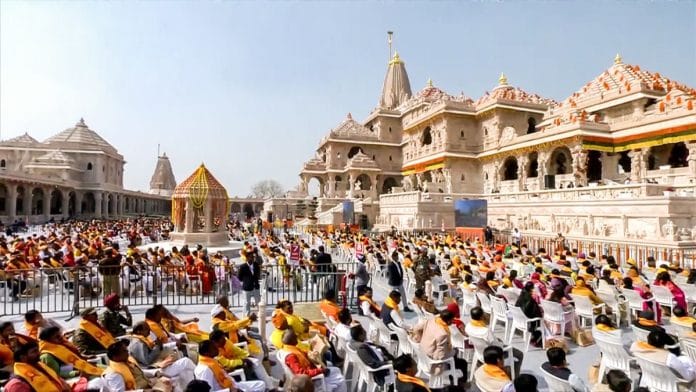
“Ram is the faith of Bharat; Ram is the foundation of Bharat. Ram is the thought of Bharat; Ram is the constitution of Bharat,” PM Modi had said at the consecration ceremony of Ram Lalla idol in Ayodhya in January 2024. Theft of donations at the Ram temple must be hurting him as much as it pains crores of Hindus, who must feel betrayed. No matter how much money is ultimately found to be misappropriated and who all are punished for this, the theft will leave a permanent scar on the Hindu psyche. They would be suspicious the next time someone comes asking for donations for the construction of a temple or any other religious purpose.
PM Modi would know it better than anyone. He had been associated with the Ayodhya temple movement since before LK Advani’s Rath Yatra. And he is credited with the construction of the temple in Ayodhya. Mann ki Baat was yet another platform for him to share his anguish but he chose not to.
The scam unveiled
In the 1980s and 1990s, when one travelled by road in the Hindi hinterland, the most familiar sight was groups of young men using bamboo barricades to stop vehicles and demand chanda or donations for nearby under-construction temples. They would be polite but firm. People would pay money, mostly of their own volition. Those temples would remain under construction for years.
In March 1990, an India Today report, titled “Suspected money bungling threatens to split VHP”, covered the heated debate within the Vishva Hindu Parishad and among the saint fraternity in general about the money spent in transporting bricks. “The VHP had collected a staggering Rs 8.29 crore from devotees participating in the Ramshila pujas. And when at the Allahabad Sant Sammellan held in late January, it claimed to have spent Rs 1.63 crore of this sum on the pujas and the foundation-stone laying ceremony at Ayodhya, many eyebrows were raised as the sum seemed astronomical,” reported India Today.
The publication quoted a mahant saying, “Can you believe that so much can be spent on transporting bricks. On what did they spend so much?”
What has happened at the Ayodhya Ram temple is far more serious. It’s not an allegation or suspicion of misuse of money as was the case in 1990. In the current case, theft of donations at the Ayodhya temple is established. Eight people have been arrested and over Rs 80 lakh has been recovered. It may be the tip of the iceberg, given the scale of the operations. These arrested are suspected to be small fries. If a thorough investigation is conducted, the trail may lead to big sharks. The VHP says it collected Rs 3,300 crore from 12.5 crore households. Think of over 60 crore people wondering who took away the hard-earned money that they gave for Lord Ram’s temple.
The government wasn’t involved in the day-to-day functioning of the independent trust but it can’t look the other way when millions of Hindus seek accountability for what has happened on the trust’s watch. It was the Modi government that instituted the trust, Ram Janmabhoomi Tirth Kshetra, and nominated 12 of its members. It was PM Modi’s former principal secretary, Nripendra Mishra, who was made the construction committee chief. Another trust member, IAS officer Prashant Lokhande, is considered close to Union Home Minister Amit Shah. He was joint secretary and additional secretary in Shah’s Home Ministry before being appointed chairperson of the Central Board of Secondary Education (CBSE) recently.
Two other IAS officers from Uttar Pradesh are there on the 14-member trust. Its general secretary is Champat Rai, VHP vice-president, who is considered close to Modi-Shah. Rai has offered to step down but a final decision is yet to be taken.
When the government of India nominated the members of the trust, how can Modi-Shah look away when temple donation money has been misappropriated on the watch of the same people? The VHP, an affiliate of the Rashtriya Swayamsevak Sangh (RSS), is in the eye of a storm because Champat Rai was an RSS pracharak and has been associated with the VHP since Ashok Singhal’s days. The fact is that the VHP has been very closely aligned with the Modi-Shah government since the ouster of Modi-baiter Praveen Togadia from the Parishad eight years back. So much so that VHP international president Alok Kumar is said to be instrumental in the appointment of Union minister Harsh Malhotra as Delhi BJP president.
PM Modi is not known to speak on controversial issues—not in the immediate aftermath, at least. He kept silent all through the NEET-UG paper leak scandal that affected lakhs of young students. He hasn’t reacted to the huge controversy over Madhya Pradesh Chief Minister Mohan Yadav and his family allegedly acquiring huge tracts of land. PM Modi’s silence on controversial issues is no surprise, though. Be it the Manipur crisis, Delhi riots, Galwan clashes or any other major incident that put his government in a tight spot, the immediate reaction is silence. He speaks up only after the government regains control over the narrative.
Silence as a strategy worked for the Prime Minister during his first two terms. In the public’s eyes, he could do no wrong. He was beyond reproach or blemish. PM Modi can’t carry on with the same strategy in his third term. The 2024 Lok Sabha polls showed that there might not be a dip in his popularity, but there is a limit to how much his persona and charisma can make up for lapses in governance. It would be a mistake to look at the Bharatiya Janata Party’s victories in subsequent Assembly elections as a verdict on PM Modi or his governance.
Also read: There is only one path to peace in Manipur—weapons must be surrendered
Eroding trust
Let’s look at a few C-Voter snap surveys. In the survey on donation theft, 86 per cent of respondents called it a serious issue. Two-thirds of the respondents said there was an erosion of trust in the management of donations at the Ayodhya temple. And 49 per cent believed there would be a fair investigation and the truth would come out; 44 percent disagreed. In the C-Voter’s previous survey on the NEET-UG paper leak controversy, 59 per cent blamed the Education Minister and the National Testing Agency. A majority of respondents, 52 per cent, didn’t trust the integrity of competitive and entrance examinations in India.
When asked whether they trusted the education system and the government to be fair to millions of students, 51.7 per cent said “no trust at all”, 22.7 per cent said “losing trust gradually,” and 8.1 per cent said “trust with misgivings”. To another question, whether those who suffered due to NEET and CBSE examination misconduct would alter their voting preferences in future elections, 71.7 per cent responded in the affirmative.
These are small samples and limited to just a couple of issues. They, however, suggest rising disillusionment and frustration with the state of affairs. After 12 years, PM Modi may still be popular as a leader but his governance is under increasing public scrutiny. The ruling party is relying too much on the absence of an Opposition or a leader in the Opposition camp who can match PM Modi’s mass appeal. But, in 2004, too, there was no opposition leader who could match then Prime Minister Atal Bihari Vajpayee’s public appeal. There are many other examples and lessons in Indian political history. PM Modi knows it better than us, of course.
DK Singh is Political Editor at ThePrint. He tweets @dksingh73. Views are personal.
(Edited by Ratan Priya)
Aah, the good old days of the UPA, when ministers used to at least tender resignations when reports of corruption, incompetence or mismanagement used to be out in public. In Naya Bharat, there’s no accountability.
Burden of a prolonged stay in power.
There comes a point when even powerful leaders start failing. It’s fatigue. But the addiction to power makes them not accept that the time is up.
Sadly Modi is risking his 3 term victory to be tarnished in the end.
I hope Pradhan gets shunted to an unimportant ministry, in the next cabinet shuffle.
Modi is Mounmohan Singh 2.0.
This erosion of popularity may also explain BJP’s keenness to control the ECI through laws and ensure victory through all means possible including the SIR process, as well as the upcoming delimitation.
They want to remain in power but want no accountability.
A special audit by the CAG is merited. Covering all donations, in cash and kind, received since the inception, the construction process and the finances of the Trust thereafter. For all practical purposes, this is a government undertaking.