






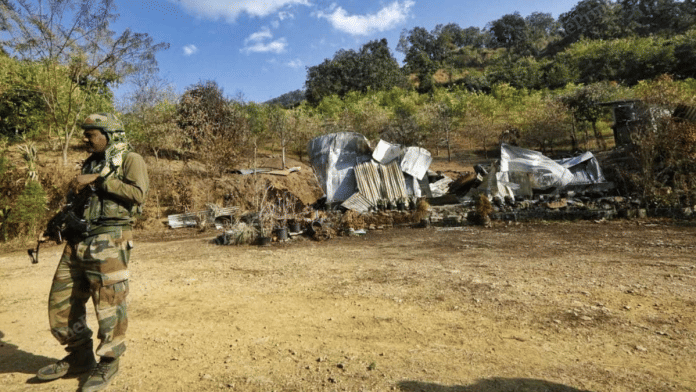


On 13 May 2026, six Naga civilians were abducted from Leilon Vaiphei village in Manipur’s Kangpokpi district. Their bodies, bearing signs of torture, were recovered weeks later on 10 June from a forested area nearby. Days of silence followed before the Kuki-Zo Council, in a rare public admission, called the killings a “grave mistake” made “in a moment of emotion” and apologised on behalf of the community.
Within hours the All Naga Students’ Association (ANSAM) rejected the apology, calling it insincere, demanding arrests and objecting even to the language the Council had used to describe Naga identity. No reconciliation, ANSAM said, could begin while the killers remained free and unnamed.
This single exchange captures what has been lacking in Manipur. An apology without accountability satisfies no one.
But there is a deeper truth none of the sides has addressed. Where did the weapons that killed these six come from?
Just like the weapons that have led to the death of hundreds of others since May 2023, the weapons that killed these six were never supposed to be in civilian hands.
Three years into Manipur’s ethnic conflict the question is no longer how the violence started. The question is why it refuses to end. The answer is an uncomfortable number: 6,000. That is how many weapons were looted from state police armouries in the early weeks of the conflict between the Meitei and Kuki-Zo communities. Six thousand firearms along with mortars, grenades, bulletproof vests and several lakh rounds of ammunition were stolen.
Three years on Manipur’s DGP put the recovery rate at roughly 70 per cent, but that still leaves close to two thousand sophisticated weapons unaccounted for. They remain in circulation, held by armed village defence groups, ethnic militias and insurgent organisations on both sides.
The violence has mutated from ethnic clashes into a complex multi-actor conflict involving all communities in Manipur. And apart from small periods of time, peace has been elusive.
Also read: New Delhi has worked with every Myanmar government. Why should junta be different?
Manipur follows a template
This is what a weaponised community looks like. Once one side arms itself for protection the other side has no choice but to do the same. The act of arming is individually rational and collectively catastrophic. The result is an equilibrium in which peace becomes impossible—disarmament by one side without a credible guarantee from the other is perceived as surrender. And credible guarantee is only possible when there is some level of trust. Today that trust is entirely missing.
This vicious cycle is not unique to Manipur. It has played out in every major ethnic and sectarian conflict of the past century across the world. And the cases where the cycle was broken share a common denominator starting with structured and politically supported disarmament before sustainable peace. Not the other way around.
For nearly three decades the Irish Republican Army (IRA) and Loyalist paramilitary groups sustained a conflict in Northern Ireland that killed over three thousand people and embedded weapons so deeply into community life that they became symbols of identity.
The 1998 Good Friday Agreement was a political breakthrough but peace remained fragile as long as guns remained in circulation. It was only in September 2005, when an international commission verified the IRA’s complete decommissioning of weapons in the presence of Catholic and Protestant clergy, that the conflict could finally be said to be over in any meaningful sense.
The security architecture behind this was equally important, consisting of a combined force of British Army and police together as a strategic lever. In the case of Manipur, getting that command structure right and fixing accountability may matter as much as the disarmament framework itself.
The Revolutionary Armed Forces of Colombia (FARC) provides another template where armed conflict—involving FARC, paramilitary groups and the state—came to an end in 2016 after a comprehensive disarmament, demobilisation and reintegration programme. The lesson from Colombia is that disarmament without genuine political inclusion and economic reintegration will fail.
There is a success story closer to home that receives little attention in the current Manipur discourse. The National Democratic Front of Bodoland (NDFB) waged an insurgency in Assam that left thousands dead from the mid 1980s. It was only in January 2020 that the Third Bodo Peace Accord was signed. It was critically followed by the actual surrender of arms. Over 1,500 NDFB cadres gave up their weapons and former combatants were rehabilitated with government support. Bodoland is not perfect today, but it is peaceful. The transformation was not achieved by military pressure alone nor by political negotiations, but when the weapons left community hands.
Also read: What are Western mercenaries doing in Myanmar? India must stay vigilant
Dangers of continued arming
What connects Northern Ireland, Bodoland and Colombia is not just the disarmament but the willingness of governments to pursue it despite the enormous political risk, and the support of communities to trust a process that required them to become temporarily vulnerable. This is precisely the fear that paralyses Manipur today. Meitei villagers holding rifles are afraid that if they put their weapons down Kuki militants will advance. Kuki communities are afraid that if they disarm they will be left defenceless against Meitei violence. And now there are the Nagas.
But here is what the government and civilians of Manipur need to hear clearly and without equivocation—the fear of disarmament is real, but the danger of continued arming is worse. Every weapon that remains in civilian hands is a future casualty. Every village defence group that hardens into a militia is a governance structure the state will eventually have to dismantle by force at far greater cost. The youth of Manipur will suffer because of the decisions of its elders. The central government must do what it has shown it can do elsewhere and negotiate a credible monitored disarmament framework backed by a rehabilitation programme substantial enough to give former fighters a reason to stay out.
Civil society groups, religious leaders and community elders on all sides need political cover to support this publicly, and the government has an obligation to provide it.
Yes, the conflict in Myanmar is a legitimate worry and weapons have trickled through the porous borders. But the primacy of the state should be established in such a way that fear of repercussions regarding indulging in any anti-national activity should become the deterrent.
Disarmament will certainly not be easy. In Manipur, it may even feel impossible. But the alternative is not a frozen conflict but a deepening one. The gun did not create the ethnic divide in Manipur. But as long as the gun remains the divide cannot heal.
Northern Ireland took seven years after the Good Friday Agreement to put its weapons down. Bodoland took twenty years of negotiation before it got to peace. The path is long. But it begins as it always has with the decision to lay down arms and the courage to demand that the other side do the same. In Manipur, history will look at the one who lays down arms first as not the one who surrendered, but the hero who saved Manipur.
Rami Niranjan Desai is a Distinguished Fellow at the India Foundation, New Delhi. She tweets @ramindesai. Views are personal.
(Edited by Theres Sudeep)
The only way to stop violence and bring peace in Manipur is to wipe out Kuki community from the face of Manipur. This is the only way to stop ethnic cleansing of Naga and Meitei.
Plus, of course, the process of bringing the communities emotionally closer.