




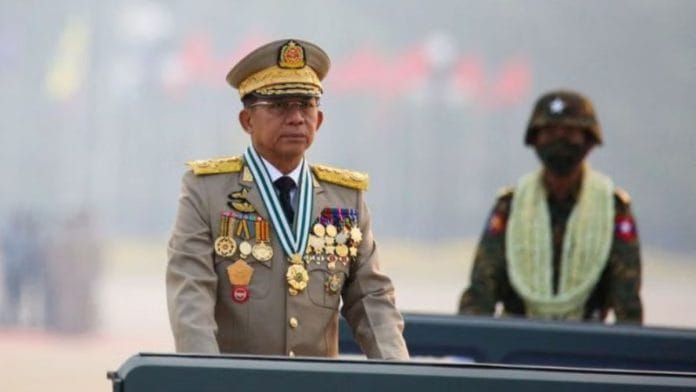

Myanmar President Min Aung Hlaing’s visit to India from 30 May to 3 June 2026 seemed a routine diplomatic engagement at first glance. It wasn’t supposed to be a bilateral event; Min Aung Hlaing was visiting primarily to attend the International Big Cat Alliance Summit scheduled for 1 June. But the summit was postponed after an Ebola outbreak in parts of Africa. New Delhi and Naypyidaw decided not to cancel the trip and make it a full-fledged bilateral visit.
For Myanmar, the visit carried particular symbolism. It was Min Aung Hlaing’s first overseas trip since assuming the presidency in April 2026. This is at a time when Western governments remain critical of Myanmar’s political transition and continue to limit high-level engagement. India visit provided Naypyidaw with an opportunity to demonstrate that it is not diplomatically isolated. Choosing India as the first destination also signalled Myanmar’s desire to diversify its external partnerships and avoid excessive dependence on China.
For India, the rationale was driven foremost by the importance it accords to its neighbourhood. The stability and prosperity of Myanmar concerns India because the two countries have had civilisational ties. Cultural affinities continue to shape bilateral relations today. India’s approach toward Myanmar therefore extends beyond immediate political developments. New Delhi’s diplomatic efforts here are also part of the Act East Policy. Moreover, sharing a 1,643 km of porous borders and serving as the only land bridge connecting India to Southeast Asia are strategic realities that have a bearing on India’s northeastern borders.
The ongoing conflict in Myanmar has contributed to narcotics trafficking, arms smuggling and cross-border militant activity that impact India’s northeastern states. The President’s visit provided a rare opportunity to address issues that have become increasingly urgent. Connectivity projects such as the Kaladan Multimodal Transit Transport Project and the India-Myanmar-Thailand Trilateral Highway remain central to India’s policy. Additionally, there is a geopolitical dimension to Myanmar as well, with Chinese infrastructure projects, energy corridors, and mining investments across India’s borders.
The itinerary of the visit itself reflected these priorities. Min Aung Hlaing’s trip to the Mahabodhi Temple in Bodh Gaya highlighted the Buddhist ties that continue to bind the two countries. Meetings in New Delhi focused on security, connectivity, trade, critical minerals and defence cooperation. Engagements in Mumbai underscored Myanmar’s desire to attract investment and expand economic ties with India. The people of Myanmar are facing repercussions not just from the conflict between the Ethnic Armed Organisations (EAOs) and the Tatmadaw but also because of international sanctions, making India’s engagement with Myanmar crucial.
Myanmar’s exports to India are heavily dominated by agricultural products such as pulses, beans and other farm commodities, which have grown remarkably in recent years. The value of exports increased from approximately $575.6 million in 2020 to $1.52 billion in 2024, representing growth of nearly 164 per cent over five years and more than 2.6 times from the 2020 level. This expansion has provided a crucial source of income for Myanmar’s farmers, traders and exporters at a time of significant economic uncertainty. Bilateral trade also increased, reaching $2.15 billion during 2024-2025, rising sharply from $1.29 billion in 2020-2021. Recognising the significant potential for further expansion, both sides agreed on a shared vision to scale bilateral trade to $5 billion by 2030.
Also read: India’s Captagon seizure shows it is becoming part of a new Middle East drug network
NUG’s criticism
This is the reality of the visit that Myanmar’s National Unity Government (NUG) has failed to recognise. “Min Aung Hlaing is not Myanmar’s legitimate leader in any sense that would survive scrutiny in India,” wrote Ro Ding, a NUG spokesperson in Indian Express. “Legitimising the Myanmar military junta is not pragmatism; it is self-harm.”
He contended that stability in Myanmar cannot be achieved solely through engagement with the military-led administration and urged India to engage a wider spectrum of political actors, including democratic forces and ethnic organisations.
“And it is the junta, not the resistance, that has made common cause with anti-India insurgent groups, using them to fight Myanmar resistance groups,” Ding wrote.
The article reflected the NUG’s concern that high-level diplomatic recognition could strengthen the junta’s international standing at a time when it seeks greater regional legitimacy.
However, the NUG has failed to take into account the history of India-Myanmar diplomatic relations. The coalition hasn’t even made commitments to India to alleviate legitimate concerns. In particular, the NUG could offer concrete assurances that territories under the control of NUG-affiliated Ethnic Armed Organizations (EAOs) will not be used for narcotics trafficking, arms smuggling, human trafficking, or as safe havens for Indian Insurgent Groups (IIGs). Such commitments would directly address issues that have long affected India’s northeast and demonstrate that the NUG is prepared to act as a responsible stakeholder in regional security.
India knows how to prioritise its national interests while maintaining contacts with multiple stakeholders in Myanmar. Expecting New Delhi to subordinate these interests to the NUG’s political objectives ignores the geopolitical and security imperatives that shape India’s Myanmar policy.
India’s engagement with Myanmar has been guided by strategic pragmatism rather than ideological preferences. Over the past six decades, New Delhi has worked with every government in Yangon and Naypyidaw, from General Ne Win’s military regime and the SPDC to President Thein Sein’s reform government and Daw Aung San Suu Kyi’s NLD administration (2016-2021). Prime Minister Narendra Modi visited Myanmar in 2017, and Suu Kyi visited India in 2016 and 2019. This consistent pattern demonstrates that India has worked with every government in Naypyidaw and Yangon, prioritizing strategic interests regardless of the political composition of the government in power.
If the NUG seeks greater engagement with India, it would benefit from recognising the shape of New Delhi’s Myanmar policy less superficially. India’s primary concerns are practical, and NUG should focus on demonstrating how it can contribute to India’s interests. This could include offering concrete proposals on counter-narcotics cooperation, safeguarding Indian connectivity projects, protecting Indian investments, and preventing anti-India insurgent groups from operating in areas under resistance control.
The NUG should also expand engagement with Indian strategic thinkers rather than relying solely on public advocacy campaigns. Importantly, it should acknowledge India’s long-standing practice of engaging all governments in Myanmar irrespective of their political orientation. However, the NUG has failed to take into account the history of India Myanmar diplomatic relations nor has it given any assurances to alleviate India’s legitimate concerns.
Ultimately, India’s support is more likely to be earned through demonstrated strategic value rather than through public appeals for diplomatic solidarity.
Rami Niranjan Desai is a Distinguished Fellow at the India Foundation, New Delhi. She tweets @ramindesai. Views are personal.
(Edited by Ratan Priya)
A great read!