






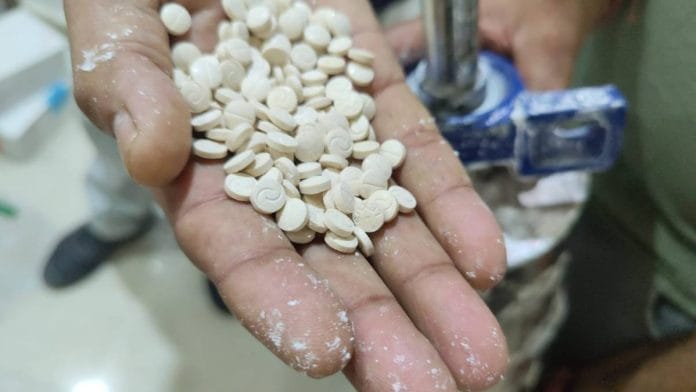


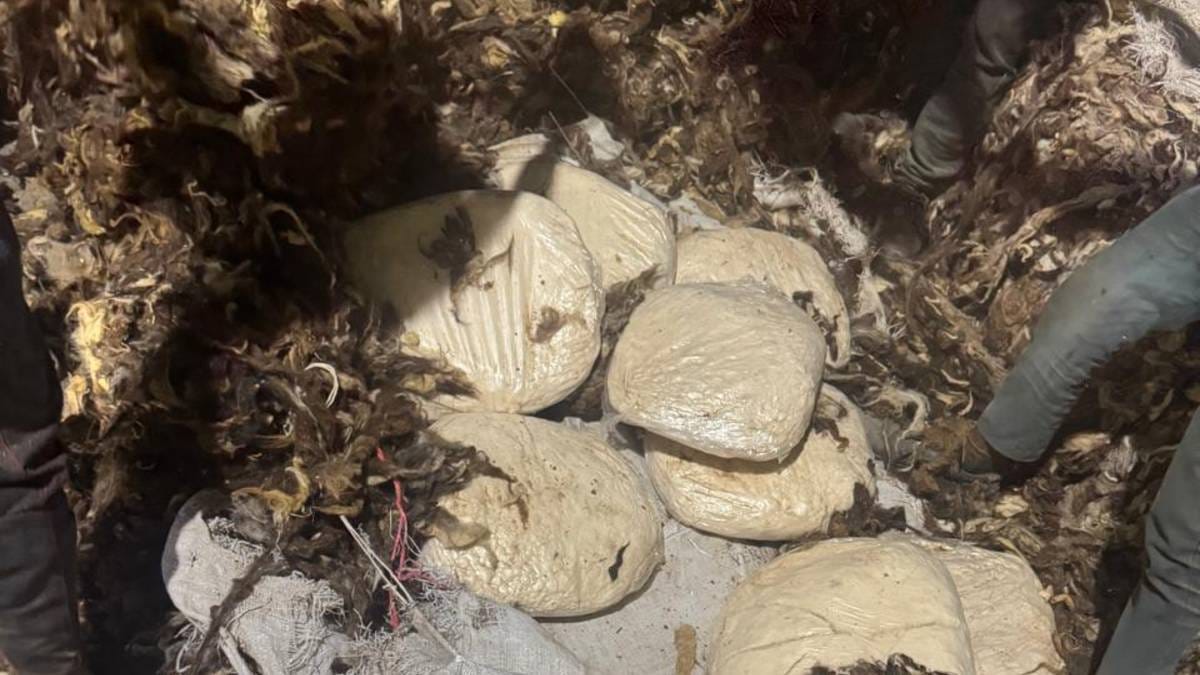
India’s first major seizure of 227 kilograms of the synthetic stimulant Captagon under Operation Ragepill was valued at approximately Rs 182 crore. The haul, recovered from Delhi’s Neb Sarai and Gujarat’s Mundra, marks a critical inflection point in the country’s security landscape.
The consignment intercepted at Mundra Port, weighing 196.2 kg, represents more than a record seizure. It signals a shift in the nature of narcotics threats confronting India.
For decades, India’s drug enforcement framework has been shaped by familiar supply chains such as heroin from the Golden Crescent and methamphetamine from the Golden Triangle. However, Captagon represents a qualitatively different challenge. It is not tied to traditional drug routes but to a conflict-driven narcotics economy rooted in the Middle East.
Created for medical use, Captagon has evolved into a major illicit drug, driving conflict and crime in the Middle East. Often termed the “Jihadi drug”, it is frequently used by militants to enhance combat endurance and suppress fear. It also serves as a critical funding source for extremist groups. Once an obscure pharmaceutical stimulant, it has transformed into one of the world’s most profitable illicit synthetic drugs, deeply connected to war economies, militia financing, and organised crime. This makes the recent seizure a strategic warning, indicating that India is entering the logistical architecture of a rapidly expanding Middle Eastern synthetic drug network. The implications extend beyond drug enforcement into maritime security, organised crime, terror financing, and regional geopolitics.
The Captagon network
Captagon was originally developed in 1961 by the German pharmaceutical company Degussa under the chemical name fenethylline. It was prescribed across Europe and parts of the Middle East for conditions such as attention deficit disorders, narcolepsy, depression, and chronic fatigue. During the 1960s and 1970s, the drug became particularly popular in parts of the Middle East because of its reputation for increasing energy, concentration, and endurance. However, addiction concerns soon emerged. By the 1980s, most countries had banned the drug and the United Nations classified fenethylline as a controlled psychotropic substance.
Prohibition did not eliminate the demand. Instead, it pushed Captagon into illicit markets where it evolved into a highly profitable synthetic narcotic. After the trade moved underground, production initially shifted to the Balkans and Turkey before centring in Syria, which became the world’s largest manufacturer, accounting for roughly 80 per cent of the global supply. After the collapse of the Assad regime in Syria, the production landscape shifted from state-sponsored manufacturing to a fragmented network of warlords and non-state actors. This decentralisation caused the trade to spill over into new regions such as Yemen and Sudan, complicating global law enforcement efforts to dismantle the multibillion-dollar industry. The drug, also known as Chemical Courage because of its tactical benefits on the battlefield, began to be used by militant groups such as ISIS. Captagon can suppress fear, fatigue, and pain, apart from maintaining prolonged wakefulness and endurance for stressful combat conditions. It also increases aggression and risk-taking behaviour during operations. The drug’s use is not limited to combatants. It is also consumed by civilians in war-torn areas to manage the horrors of conflict.
The traditional land routes for Captagon trafficking have been through Jordan and Iraq, but the Balkan-Turkey route has also become prominent. Major production and trafficking were concentrated in Bulgaria, Slovenia, Serbia, Montenegro, and Turkey. Traffickers have now diversified to West Africa, North Africa, and Europe. India’s recent seizure suggests an evolution in these trafficking geographies.
Also read: Why FM Nirmala Sitharaman must listen to investors on capital gains tax
What India must do
For India, the Captagon issue is fundamentally maritime. The Indian Ocean carries enormous commercial traffic, linking the Gulf, East Africa, South Asia, Southeast Asia, and Europe. Synthetic drug traffickers increasingly exploit container congestion and uneven inspection systems to move narcotics through global trade routes. India’s geographic position makes it especially attractive as a logistical waypoint because of its extensive port infrastructure, which is amplified by dense Gulf trade links in a massive cargo ecosystem. Indian ports may increasingly face attempts by Middle Eastern narcotics networks to exploit legitimate trade infrastructure for drug concealment. There is also the possibility that maritime narcotics routes could overlap with weapons smuggling and illicit finance systems operating across the Indian Ocean, creating concerns for India becoming a major transit corridor.
India’s seizure of 227 kg Captagon suggests that these geographies may now be expanding eastward. The challenge is therefore strategic rather than merely criminal. The country now sits at the intersection of multiple narcotics corridors involving the Golden Crescent, the Golden Triangle, and increasingly, the Middle Eastern synthetic drug networks. This requires a response that extends beyond conventional anti-drug policing into maritime intelligence integration supported by customs modernisation. Gulf security cooperation and coordination between counter-narcotics and national security agencies also becomes imperative.
The larger danger is not merely that Captagon enters India but that India gradually becomes embedded within the logistical routes of a rapidly globalising narco economy born out of war. This is particularly important because India already confronts narco-insurgency linkages in the Northeast. In 2024, the Indian Coast Guard intercepted a Myanmarese fishing boat in the Andaman Sea, which was carrying methamphetamines worth $4.3 billion. Through the ongoing conflict in Myanmar, the largest synthetic drug production in the world has emerged. The Syrian conflict also demonstrated how fragile states can evolve into centres of transnational illicit production integrated into global commerce.
India’s response to Captagon must shift from reactive seizures to proactive intelligence-led prevention. Port security must prioritise risk-based container profiling and expanded non-intrusive scanning, especially for Gulf-linked trade routes. This must be supported by an integrated intelligence grid connecting Customs, Narcotics Control Bureau, and the Coast Guard to enable real-time coordination. Equally critical is a tighter regulation of pharmaceutical inputs and precursor chemicals to prevent domestic manufacturing.
India must deepen intelligence sharing with Gulf countries to track consignments alongside shell firms. Financial surveillance must also be strengthened to disrupt hawala and trade-based money laundering networks that sustain these operations. The core challenge is not just preventing drugs from entering India but ensuring the country does not become a node in a transnational narco logistics system. This requires the immediate securing of ports as strategic assets and the alignment of counter-narcotics with national security priorities.
Rami Niranjan Desai is a Distinguished Fellow at the India Foundation, New Delhi. She tweets @ramindesai. Views are personal.
(Edited by Prasanna Bachchhav)