




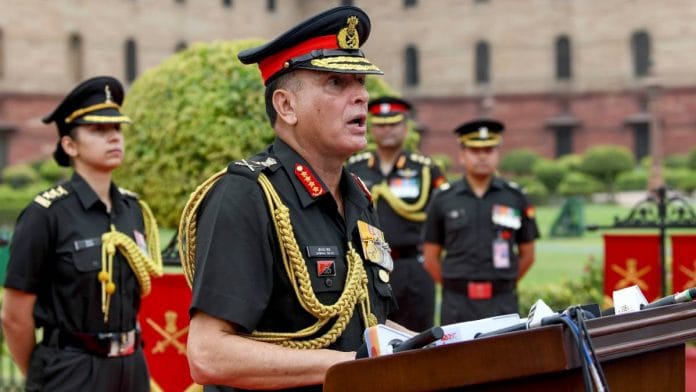

When Chief of the Army Staff General Dhiraj Seth declared at the NDTV Defence Summit that land remains the only tangible factor of victory, he articulated a view with deep institutional roots. Territory is visible, photographable and politically marketable. A surrendered army, the sight of a defeated general or a captured ridgeline offers a clean narrative. Yet treating land as the sole qualification for success is both historically inaccurate and strategically unwise.
It locks national security policy into a commitment trap that India has repeatedly chosen not to enter — and for good reasons.
War is politics by other means; therefore, military strategy and the logic of combat must always serve the governing political objective, rather than operating independently. Victory is a political outcome measured against stated objectives, not a cartographic scorecard. Accepting the land-only standard would force India to occupy ground every time it is politically necessary to initiate the use of force. India would have to gain, hold and sustain territory, incurring in the process the cost in blood and treasure, just to be able to call it a ‘victory’. The very framing constrains the flexibility that has served India well in limited wars and wars with limited objectives. Land would always remain a key strategic objective; however, calling it the only objective that matters would be ill-advised.
Should we subscribe to this single-metric framing of victory, we would have to rewrite a whole lot of our military history.
1965, 1971, Kargil and Op Sindoor
Consider the 1965 war. Indian forces captured roughly 1,840 square kilometers of Pakistani territory while Pakistan held about 540 sq km of Indian land. The Tashkent Declaration required both sides to withdraw to the positions they held before 5 August 1965. The territorial “gains” therefore disappeared.
However, the political objectives stood vindicated. It was clearly demonstrated, despite not holding onto land (as evidence), that Pakistan could not seize Kashmir by force and that India could fight back militarily to maintain the status quo. A land-centric framing of victory would deny India the opportunity to rightfully celebrate 1965 as a ‘win’. If land alone defines victory, 1965 becomes a draw at best.
Kargil in 1999 offers a clearer example. Pakistani troops occupied Indian positions across the Line of Control. India recaptured every height. No new territory was taken; the LoC was restored. The operation succeeded because the political objective was eviction, not annexation. India deliberately chose not to cross the LoC despite the operational temptation.
India won, despite no net territorial gain. The victory came at a great cost in blood and treasure — it was victory nonetheless — which was measured against the political objective of reversing an intrusion.
Operation Sindoor in May 2025 makes the mismatch starker. The four-day exchange was largely non-contact: long-range missiles, stand-off weapons, precision artillery, drones, electronic warfare and air defence. No Indian ground force crossed to seize and hold Pakistani soil. The stated objective was to target terrorist infrastructure rather than capture territory.
The ceasefire came after India said its military objectives had been achieved. Land was never the contested prize. To declare this operation something other than a victory because no territory changed hands would be grossly unfair.
The 1971 war is often cited as clinching evidence in support of land-centric framing of victory. The Army Chief also alluded to the famous picture of Lieutenant General Amir Abdullah Khan Niazi signing the surrender document. The war produced the most decisive result in India’s military history: the birth of Bangladesh. Even then, India returned captured territory in both the east and the west, under the post-war arrangements and the Simla Agreement. The political goals were achieved — the dismemberment of Pakistan’s eastern wing and the return of refugees. Permanent occupation of Pakistani land in the east or west was never the objective. Land was the means to an end — not the end.
The photograph of the surrender in Dhaka remains iconic precisely because it captured a political end-state, not because India captured Dhaka.
India-China war and skirmishes illustrate the same point from the opposite direction. In 1962 India lost land in Aksai Chin and parts of what was then called North-East Frontier Agency (NEFA). That territorial loss was real and we unhesitatingly call it a defeat or debacle. Yet subsequent clashes at Nathu La and Cho La in 1967 saw Indian forces hold their ground and inflict costs — land did not change hands but India called them victories.
The 2020 Galwan clash was followed by a prolonged military standoff. Subsequent disengagement arrangements created temporary buffer zones and restrictions on patrolling in some areas. From a policy perspective, this loss of territorial access is framed not as a permanent ‘loss’, but as a deliberate tactical arrangement to prevent escalation, in line with political directions. This framing, thankfully, steers clear of land-centricity and focuses on larger national interest and political directions.
Also read: Rafale dilemma sums up India’s defence paradox—security vs self-reliance
Why strategic flexibility beats rigid annexation
A land-only ledger creates a commitment trap. It inflates the political price of any future operation: if victory equals holding ground, then every operation must involve occupation or it will be labelled incomplete. For an operation like Sindoor to be called a victory, it would have to involve the annexation or permanent occupation of territory. This would take away strategic flexibility from the national leadership.
India has consistently chosen limited aims below the threshold of overall war, as the leadership is acutely aware of the dangers of getting involved in never-ending wars. A punishment strategy seeking compellence has been preferred over an outright war of annihilation. A situation may arise in which the political leadership may order the seizure of land, and this remains an option. However, it would be foolhardy to call this the ‘only’ viable option.
Critics of a broader definition of victory argue that contested borders make land operations primary and that ‘boots on the ground’ remain decisive. That is true in a limited sense: India must be able to hold its own territory, and take others’ when required; however, it does not follow that every successful use of force must produce a new line on the map.
The Army Chief is right that the soldier who occupies and defends ground is indispensable. However, to turn that observation into an exclusive test — making land the sole qualifier for victory — renders Kargil and Op Sindoor inconsequential.
Some have made the argument that to counter fake narratives, it is essential to physically capture an adversary’s land. While in a limited sense physical occupation presents an undeniable fact, it can also make a conflict harder to end. Eventually the political leadership may take that call, if considered necessary; however, that cannot be the only call available to them. Sometimes, measures such as controlling river waters can extract greater strategic benefits than holding territory.
Another distressing observation was the prominence of rhetoric over reason on social media while this subject was being discussed. Some even started framing it as an Air Force versus Army fight. This is a subject that has great strategic significance for how we equip, train and fight our wars. Innuendo, name-calling and the use of half-baked arguments add no value to the discourse.
National security policy must retain the freedom to choose among punishment, denial, deterrence and, when necessary, limited occupation. Binding it to a single framing — captured land as the only measure of victory — reduces options and raises the cost of every future crisis.
India’s record shows a consistent preference in several conflicts for restoring or defending the existing line rather than redrawing it. That preference is not weakness. It is a recognition that victory is the achievement of political purpose at an acceptable cost, not the accumulation of acreage that must then be garrisoned indefinitely. Growing beyond land-centricity is not a rejection of the soldier. It is a refusal to let one metric dictate strategy.
Group Captain Ajay Ahlawat is a retired IAF fighter pilot. He tweets @Ahlawat2012.
(Edited by Prashant Dixit)