






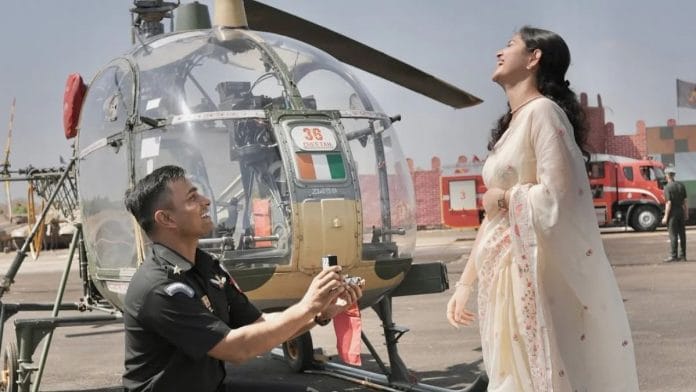


The social media controversy surrounding an Indian Army captain proposing to his girlfriend against the backdrop of Army helicopters after earning his wings at the Combat Army Aviation Training School, Nashik, generated a passionate debate.
Many saw it as a harmless heart-warming moment. Others viewed it as an inappropriate use of military symbols and ceremonial space for personal purposes and demanded strict disciplinary action.
Both sides missed the larger issue.
The controversy is not fundamentally about romantic enthusiasm. Nor is it about a young officer’s character or intentions. It is about military ethos in an era when social media increasingly shapes behaviour, identity and public perception.
More importantly, it raises uncomfortable questions about whether standards are applied consistently across the military hierarchy and whether senior leaders themselves are setting the example expected of a professional, secular and apolitical military.
The incident in perspective
Military traditions, uniforms, regimental flags, parade grounds, ceremonials, Sarva Dharama Sthals and even military weapon systems/equipment have a sanctity. They are tools for building cohesion, which is the most important factor that motivates soldiers to fight. A wings ceremony is not merely a graduation event; it marks the transition of a combined arms officer into a combat pilot flying helicopters worth Rs 125-250 crore. Seen in this context, concerns regarding the use of military symbols for personal purposes and breach of military decorum are understandable.
Yet perspective is equally important. The officer did not compromise operational security. He did not violate the chain of command. He did not engage in political activity. Nor was there any evidence of disrespect towards the institution. At worst, it reflected a lapse of judgement arising from youthful exuberance.
Professional militaries have traditionally distinguished between misconduct, professional lapses and youthful indiscretions. The Nashik incident clearly belongs in the last category. The question, therefore, is not whether the young officer should be counselled, but why such behaviour occurs despite detailed regulations governing military conduct and social media engagement.
The answer lies in understanding the powerful human impulses that social media exploits.
Also read: Don’t criticise Army captain’s proposal. You can’t curb josh in peace and expect it in war
Young officers have always stretched boundaries
The outrage suggests that officers from earlier generations were immune to such behaviour. Nothing could be further from the truth. Young cadets, officers and soldiers have pushed boundaries in every military and every generation.
The profession of arms deliberately cultivates confidence, initiative, competitiveness and a willingness to take risks. These qualities are indispensable in war. They are also qualities that occasionally manifest as adventurous indiscretions in peacetime. Military folklore across the world is replete with stories of young officers and soldiers attracting the displeasure of their seniors through acts of exuberance, creativity or misplaced enthusiasm.
What has changed is visibility. In previous decades, such incidents remained confined to the military academies, officers’ messes, regimental anecdotes or military folklore. Today, every smartphone is a broadcasting station.
The Nashik proposal, therefore, tells us less about the conduct of one officer and more about the realities of a generation that has grown up in a digital ecosystem where every significant life event is expected to be shared, documented and validated online.
Such situations are best addressed through mentorship and counselling rather than disproportionate disciplinary action.
The objective of military training is not to produce robots. It is to produce leaders. A military that punishes every display of individuality risks suppressing initiative and confidence. Conversely, a military that ignores every breach of convention risks eroding professional standards. The answer lies in balance. As per the grapevine, the Army did take cognisance of the incident and appropriately dealt with it through counselling of the officer.
Military values, security and social media
Human beings possess powerful needs for recognition, belonging, achievement and self-expression. For centuries these needs were fulfilled through family, community, profession and social institutions. Social media provides instant gratification of all four. Recognition comes through likes, comments and followers. Belonging comes through online communities. Achievement is publicly celebrated. Identity is projected and reinforced.
For military personnel, these impulses can be even stronger.
The military is a highly structured institution built on hierarchy, discipline and collective identity. Service before self is its defining ethos. Social media offers the opposite. It encourages visibility over anonymity, individuality over collectivity and personal branding over institutional identity.
A young officer or soldier who spends years conforming to military norms naturally experiences a powerful attraction towards platforms that reward personal expression. The contradiction is not unique to India. Like all other militaries grappling with the problem, Indian Armed Forces have modified their social media policies a number of times.
Historically, military officers and soldiers were taught that reputation should be earned, not advertised; that accomplishments should speak for themselves; and that the institution should always appear larger than the individual. Social media reverses these incentives. The result is an inevitable tension between military values and digital culture. And the Indian military is struggling to cope with it.
The biggest challenge of social media is security. The internet is flooded with anonymous posts and videos posted by military personnel or their friends that violate security regulations. There have been numerous cases of officers and soldiers being “honey-trapped” by foreign agents.
Also read: India’s military is apolitical. But hold up the mirror before it starts fraying
Senior officers are not leading by example
Leadership by example is the foundation of military culture. Soldiers learn far more from observing their leaders than from reading regulations. The relevant question here is: are senior officers leading by example in handling social and mainstream media? As per my assessment, they are not.
Over recent years, senior military leaders have frequently appeared in widely publicised visits to temples, religious ceremonies and, in some instances, alongside self-styled godmen. Such reports with images are often disseminated through official or semi-official channels and are deliberately amplified across social media and mainstream media.
These appearances not only violate rules and regulations but also create perceptions. The concern is not religion itself. The concern is the perception that the military institution may be identifying itself with particular religious narratives at a time when religion has become deeply intertwined with political discourse. And that too for perceived personal gains.
Every soldier and officer has an unquestionable right to personal faith. The Indian military has historically respected all religions while maintaining institutional neutrality. However, there is a distinction between personal faith and public display and social media exploitation of religiosity.
Similarly, there has been growing public discussion regarding the increasing visibility of senior officers giving political statements and being seen alongside political leaders in tune with narratives closely associated with the ruling establishment. Civilian control of the military is non-negotiable in a democracy. Military leaders must naturally interact with elected governments. But professional military norms also require visible political neutrality. The military serves the Constitution and the nation—not any political party or ideological movement.
The Indian Armed Forces have enjoyed extraordinary public trust precisely because they have historically remained secular, apolitical and professionally detached from political contestation. This reputation is a national asset. Its dilution has horrendous ramifications for the military of a multi-religious, multicultural, multiethnic and multilingual nation. So far, nothing in the public domain suggests that the military or the government has taken any cognisance of, or action against, these transgressions.
The issue, therefore, is not whether a young captain exercised poor judgement. The issue is whether the institution is equally willing to examine the conduct of senior leadership, which may carry far greater implications for military ethos. The former concerns a breach of etiquette by an errant young officer, but the latter concerns the very character of the institution. Needless to say, if the hierarchy cannot self-correct, the government must step in.
The way forward
The answer does not lie in harsher regulations. The military already possesses extensive rules governing conduct, media engagement and social media usage. The real challenge is cultural. A combination of education, monitoring, counselling and enforcement is necessary to address it.
However, senior leaders must also recognise that their own conduct shapes institutional norms. Military culture flows from the top down. If senior leaders embrace publicity, cultivate personal brands and blur the distinction between personal beliefs and institutional identity, the rank and file will inevitably draw their own conclusions about what constitutes acceptable behaviour.
The burden of preserving military ethos, therefore, falls heaviest on those at the top. The Nashik helicopter proposal controversy will soon disappear from public memory. The larger questions it has raised should not. The real issue is not whether a young captain crossed a line. It is whether the military is prepared to examine all the lines that may have been crossed—and by whom.
If the armed forces wish to preserve their hard-earned reputation as professional, secular and apolitical institutions, the same standards of judgement, restraint and propriety must apply from the newest soldier to the most senior general. Military ethos is not preserved by selectively enforcing rules against the young. It is preserved when leaders at every level embody the values they seek to uphold.
Lt Gen H S Panag PVSM, AVSM (R) served in the Indian Army for 40 years. He was GOC in C Northern Command and Central Command. Post retirement, he was Member of Armed Forces Tribunal. He tweets @rwac48. Views are personal.
(Edited by Prashant Dixit)