





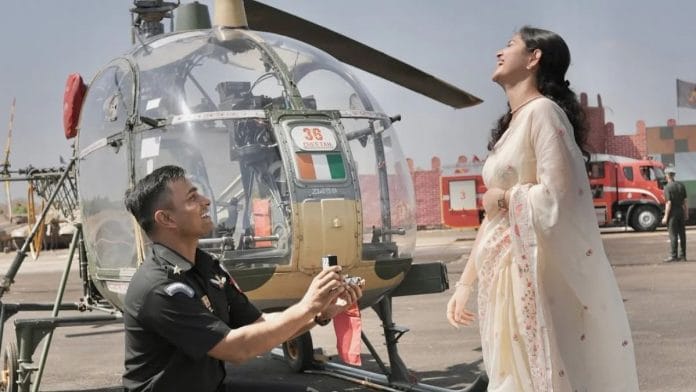

On 2 June, an Army Aviation pilot proposed to his partner, just after his passing out parade at the Combat Army Aviation Training School, in Nashik, Maharashtra. He did this dressed in his crisp ceremonial Army uniform with a Cheetah helicopter serving as his backdrop. The moment unfolded in full view of his batchmates, instructors, family members, and invited guests, who erupted into loud applause.
Since the media had been invited to cover the event, they took the opportunity to thrust the mike to an emotional captain’s face (his fiancée had just said ’yes’), who shared their beautiful story. They had known each other for five years and he felt there was no better day to celebrate their love than on the day of his professional achievement of receiving his flying wings.
The incident went viral, generating a nationwide debate and two distinct perspectives emerged. One, that it was a heartwarming narrative of a “fairytale, movie like moment”. The second was one of security, protocol and decorum criticism, in which several defence veterans were the most vocal critics, as were a significant segment of citizenry.
The critics, many of my generation, misunderstand how to read something like this. Anything that shows the Army and its officers in a positive light, especially on social media, must be welcomed with open arms. We must not curb the josh that makes our Army what it is.
A legitimate concern can be entertained but theirs is unfounded. Army equipment is on display for public viewing and photography on many occasions, including “Know Your Army” events and the graduation ceremony where the proposal took place. Therefore, there was no security breach. The helicopters were on display for the public; they were all taking pictures. The media had just covered the event, so photos and videos of these helicopters had already been telecast.
As to protocol and decorum, it was such an apt moment to propose after his passing out parade in front of his family, on the day that will define his service in the Army. He could not have changed into civilian clothes to do that, for he would have lost the mood, moment and mahaul (atmosphere).
Also read: An Army captain proposed. The morality police reported for duty
Nurturing the josh
Nurturing the mood of the moment is an important aspect in the Army. This proposal is not the first time the mahaul of a passing out parade has led to controversy.
Throwing the hat after a passing out parade is a global practice, followed worldwide. But it was stopped in India over 10 years ago after many of my generation argued that it was disrespectful to the uniform.
But I don’t see it that way.
When a band major throws up his staff and catches it on the march; when a base drummer twirls his drum above his head during a band display; when an Air Force drill team member twirls their rifles fitted with bayonets, and the squad commander walks through them, braving the risk of getting cut—all of these (and more) are mood of the moment and foster exuberance and josh, the hallmark of a soldier.
We live on that intangible josh that our soldiers display, in war and peace.
This is the josh that fires up 120 men to drive back 3,000 Chinese soldiers at Rezang La at 18,000 feet, despite orders to withdraw. It also powers a mere company of 120 men to hold off Pakistan’s Infantry Brigade and a Regiment of tanks for one whole night at Longewala. Both incidents have been immortalised by Bollywood, in 120 Bahadur and Border.
Celebrating the josh encourages it. If we curb our soldiers’ display of josh on occasions of exuberance like parades and displays, it can be demoralising. Josh is the essence of our spirit. It produces victories in war. You cannot curb it in peace and hope for it to surface in war.
Also read: Hero, simp & god’s favourite—how Captain Bhardwaj became an internet heartthrob
The Army on social media
The proposal also opens up a wider debate regarding social media.
It has been famously said that in Operation Sindoor, we won the war, but lost the narrative. This happened in the Balakot operation as well.
Not just the Armed Forces, but our nation is also shy to recognise and exploit the power of social media in the age of information warfare.
For a party that relies heavily on the power of social media for winning elections, BJP’s handling of social media when it comes to the Armed Forces leaves much to be desired. Pakistan, on the other hand, plays the narrative so well that they have sold not only Operation Sindoor, but even the 1971 war as a victory. This will continue to happen if we are recalcitrant in accepting that this is a powerful tool. We should educate our citizens and soldiers alike about how to employ it gainfully.
A decade ago, when I was the Corps Commander in Kashmir, I sought approval to start a Twitter, now X, handle for the Corps, to post the correct narrative from the Valley. In those days there was only one Army handle (ADG PI) and the narrative of the other side, designed by ISPR, ran the roost. It took three years or more for all Corps HQs to be allowed to operate social media. I bring this out only to illustrate that we need to move with time. In the era of spontaneous response, we do not have the luxury to respond even after a few hours; the world would have moved on to the next story.
Presently, the Indian Army does not permit any serving personnel to post pictures in uniform. But we must recognise that a photo of a soldier in uniform serves as motivation for the citizens.
Yes, there is a need to educate soldiers about the security considerations. While posting a picture from the LoC would be wrong, it would also be wrong to condemn someone posting his picture from a parade, where the media is covering the event. Barring soldiers from doing that is like saying since there is risk of getting shot, soldiers shouldn’t venture into the battlefield. You train them to take evasive action and protective measures in war. Similarly, educating soldiers on responsible use of social media is better than a ban on its use.
Most armies in democracies across the world permit their officers to post their pictures on social media, albeit with a disclaimer that the views expressed are personal. The British Army actively encourages command figures, regiment pages, and designated media officers to maintain public profiles on X and Instagram to aid recruitment and public relations.
The Indian Army enforces a strict “passive participation” policy, completely banning its personnel from actively posting, liking, or commenting on X and Instagram, restricting them to view-only modes to counter data leaks.
Information warfare is a ubiquitous dimension today. Media and social media are important constituents. We have to learn how to employ and exploit them optimally. For this we should educate our soldiers and learn to trust them. The Army should come down heavily on the defaulters, rather than ban the use of social media.
The young captain who proposed may face administrative action or some other admonition, since the issue has become high profile. I hope it does not curb the devil-may-care attitude that the fliers like him often display—they bend the rules, push the limits and break the ceilings to evacuate a casualty from the icy Himalayan heights of the Line of Control or the Siachen Glacier.
Lt General Satish Dua is a former Corps Commander in Kashmir, who retired as Chief of Integrated Defence Staff. Views are personal.
(Edited by Theres Sudeep)