





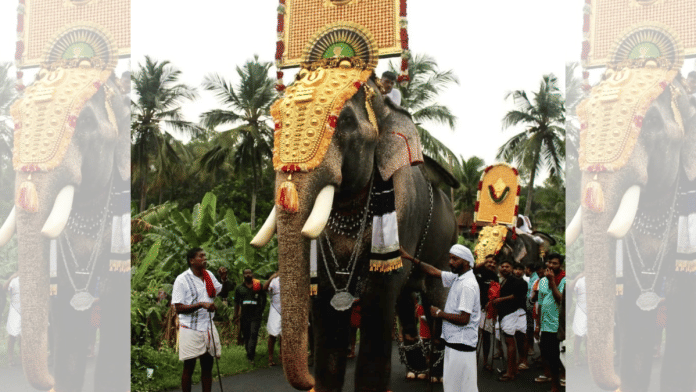


New Delhi: Last week, the Supreme Court directed the Kerala government to temporarily take over the custody of Raman, the state’s tallest captive elephant which is at the centre of two competing ownership claims, to prioritise his “health and overall well-being”.
A bench of justices Dipankar Datta and Satish Chandra Sharma held the elephant’s disputed caretaker Krishnankutty guilty of contempt and fined him Rs 2,000 for violating an undertaking recorded before the court on 6 August 2025 that the elephant would not be made to participate in any commercial or temple activities.
This contempt petition was the latest chapter in a decade-long ownership dispute involving Thechikottukavu Ramachandran, commonly known as Raman, that has travelled all the way from a police station in Kerala to the Supreme Court, via the magistrate’s court, and the Kerala High Court.
At the centre of the dispute are two competing claims over Raman’s custody and ownership—one by Mata Amritanandamayi Mutt, represented by authorised representative Jayakrishna Menon, and the other by Krishnankutty, who says he has cared for the elephant for the past 10 to 12 years.
The court made it clear that the interim custody order was temporary and subject to final orders in the pending criminal appeals.
But the contempt ruling reframed the dispute from one of ownership and custody to one about the welfare of a “voiceless” animal. This ruling comes at a time when India’s animal rights debate is focused on the inadequacy of animal cruelty laws, and Raman’s case sits squarely within that larger argument.
Also Read: Male elephants are dying more than female in human-animal conflicts. Loners & bachelors
The underlying dispute
Menon’s case is that Raman belongs to the Mutt and was only temporarily entrusted to Krishnankutty for upkeep and care. According to him, Krishnankutty later retained custody unlawfully and relied on fabricated or invalid gift deeds to assert ownership.
The Mutt’s position has been that, even if such transfer documents were genuine, any transfer would be void without approval under the Wildlife (Protection) Act, 1972.
Krishnankutty, for his part, has maintained that Raman was lawfully transferred to him under the 2017 gift deeds and that he has continuously taken care of the elephant thereafter.
That contest over title and lawful possession remains unresolved, because the Supreme Court’s contempt order did not finally determine ownership; it only crafted a temporary welfare-based custodial solution while the underlying appeals continue.
Paperwork is central to this dispute. The impugned gift deeds from 2017, which the Mutt alleges are “forged” and “fabricated”, purport to transfer Raman to Krishnankutty.
Setting authenticity aside, any such deeds are subject to the provision of the Wildlife (Protection) Act whereby any transfer of an Asian elephant (a Schedule 1 protected species) requires prior written approval of the Chief Wildlife Warden of the state as elephant ownership/transfer is heavily regulated.
The Mutt contends that no such approval was obtained in this case.
While deciding an interim appeal, the Kerala High Court has noted that Forest Department records—a certificate of ownership, a microchip implantation certificate, and entries in the captive-elephant data book—support the Mata Amritanandamayi Mutt’s prima facie claim over Raman.
What began as a custody dispute around 2018, devolved into a criminal case with Krishnankutty charged under Section 406 (criminal breach of trust) and Section 420 (cheating) of the Indian Penal Code (IPC). The criminal case was registered in 2023 on the basis of a complaint filed by Jayakrishna Menon.
Concurrently with the criminal case, the Mutt filed an application before the Judicial First Class Magistrate’s Court in Karunagappally under Section 451 of the Code of Criminal Procedure (CrPC)—a procedural provision that empowers courts to make orders for the custody and disposal of property during the pendency of proceedings.
The animal, weighing roughly 6,000 kgs and standing 11 feet tall, is at the centre of this ‘property’ dispute.
From there, through a series of appeals, the case has travelled from the trial court to the Kerala High Court and is now pending before the Supreme Court. The trial court had granted interim custody of Raman to the Mutt in 2023, through Menon, but the order was challenged before the High Court.
Eventually, the Supreme Court, in 2024, directed status quo to be maintained with respect to Raman’s custody while the legal questions were settled, and ordered a report on the elephant’s health and wellbeing. The status quo meant allowing Krishnankutty the custody of Raman.
In reports to both the High Court and the Supreme Court, Raman has been reported to be in ‘musth’ for months at a time. Musth refers to a periodic condition in adult male elephants associated with heightened aggression and hormonal change.
In separate civil proceedings, Raman’s custody remains the focal point.
The Kerala High Court set aside in 2025 a temporary injunction obtained by Krishnankutty in 2024 from a trial court against the Mutt taking forcible possession of Raman.
Advocate Philip T. Varghese, who appeared for Krishnankutty in the civil proceedings before the Kerala High Court, says “The elephant Raman is a rogue elephant and he has to be handled with great care and caution. Mata Amritanandamayi Mutt was not able to control him and that is why they gave him away. Only because Krishnankutty and his team have the understanding and ability to take care and control of Raman that they have managed to keep him with them, that too and without causing any major trouble anywhere.”
The contempt case
With the Supreme Court status quo order effectively allowing Raman to remain with Krishnankutty, the Mutt moved a fresh application in 2025 citing concerns about Raman’s physical condition and alleging his use in temple festivals and commercial events.
The court ordered a report on Raman’s health by Kerala’s Chief Wildlife Warden. Krishnankutty’s undertaking that “the elephant would not be used for any commercial or temple activities in the meanwhile” was recorded in the court’s order dated 6 August 2025.
While the report on Raman’s health was delayed due to musth, when it was finally submitted in February 2026 it recorded that an inspection attempt by a three-member team had found Raman participating in a festival ceremony at a temple.
In written submissions before the Court, Krishnankutty admitted to one instance of temple attendance and argued that veterinary doctors had advised for the elephant to be taken on walks for his physical recovery when emerging from musth. Further, he cited a “religious emergency” whereby another elephant had fallen ill for the temple ritual and hence Raman was forced to step in.
The court was not persuaded, arriving at the conclusion that Krishnankutty has “wilfully disobeyed” undertaking made before the court.
“It is truly unfortunate that the elephant in question i.e., Raman, who also happens to be the tallest elephant in the State of Kerala has been subjected to commercial exploitation despite an order restraining such exploitation, that too on the strength of an undertaking made before this Court. We would be failing in our duty towards the voiceless, if we turn a blind eye towards such defiance. We cannot be a mute spectator, more so in matters pertaining to voiceless animals, whose wellbeing is also of paramount importance”, the court said.
Varghese found this order “totally unjustified”.
“As the records show, Raman is in musth for major part of the year, the person keeping him in custody would incur huge expenses for his upkeep, instead of making monetary gain. As releasing a captive elephant like Raman to the wild is impossible, the only solution is to allow the person who is able to take care and control of Raman to keep the elephant in his custody,” he said.
“Elephants are sensitive animals and their custody matters are to be dealt with in the same manner as child custody matters. Will a Court of law take a child away from his/her parents and put him/ her in State custody for the reason that the parents have committed a one time disobedience of the Court’s order? That too when the parents have a plausible explanation for what they did?” he adds.
Temple elephants and welfare concerns
Scientists have long established that elephants are highly intelligent, deeply social, and emotionally complex sentient beings who feel stress, grief, fear, and attachment.
In this context, Raman’s case is inseparable from the larger institution of temple elephants in India, especially in Kerala, where captive elephants remain central to ‘poorams’ or temple festivals. This tradition is increasingly being met with a welfare counter-narrative, and one visible sign of change has been the introduction of mechanical elephants.
In 2023, the Irinjadappilly Sree Krishna Temple in Thrissur became the first temple in the country to introduce a life-size mechanical elephant, Irinjadappilly Raman, for rituals. The initiative was later followed by another mechanical elephant, Pallipuram Unnikrishnan, gifted to a temple with public support from actor Sonakshi Sinha and People for Ethical Treatment of Animals (PETA).
This pivot towards mechanical substitutes is rooted in the long documented suffering of captive temple elephants. Animal welfare groups and news reports have shown evidence of cruelty and abuse including chaining, physical punishment, suppression of musth, transport in adverse conditions,
deprivation of food and water, foot disease, untreated wounds and severe psychological stress.
The concern is that elephants are routinely pushed into festivals, tourism and processions even when they are old, blind, injured, or in musth – conditions that are dangerous for the animals and the public alike.
Recent Kerala festival incidents involving agitated elephants include three deaths and more than 30 injuries at a temple festival in Koyilandy in February 2025, and around 20 injuries at a Malappuram festival in January 2025.
The Supreme Court has previously directed registration of temples in Kerala keeping elephants and warned of criminal consequences if captive elephants are found abused or harassed. More recently, the Kerala High Court has issued and revisited guidelines on parading elephants during festivals, while stressing that the use of captive elephants is not an essential religious practice.
Raman has long been a ‘celebrity’ elephant in Kerala and a ‘star presence’ at major poorams, including Thrissur Pooram, where caparisoned elephants are central to the ritual aesthetic.
His journey from a revered pooram tusker to the subject of lengthy legal proceedings is symbolic of the collision between tradition, ‘ownership’ and the rights of a sentient being.
(Edited by Ajeet Tiwari)
Also Read: Tracking India’s elephants: Unreleased census, shrinking herd & DNA profiling of dung