



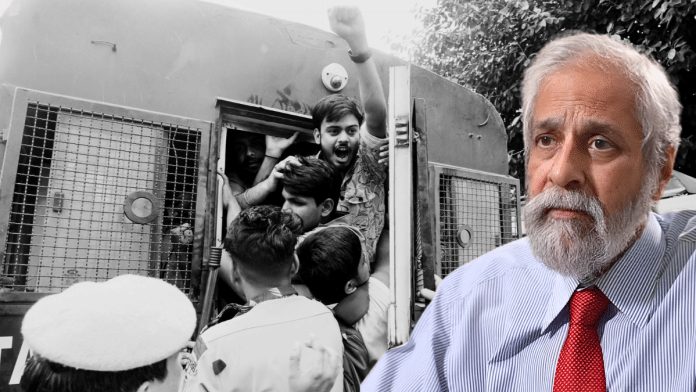
New Delhi: Constitutional courts are falling short of their duty as police overreach paralyzes Delhi, former Supreme Court judge Madan Lokur has warned. In an interview with ThePrint, Justice (retd.) Lokur expressed deep concern over judicial inertia amid the ongoing crackdown where citizens, lawyers, and journalists have faced arbitrary detentions.
Lokur served as a judge in the Supreme Court from 2012 to 2018. He now serves on the non-resident panel of the Supreme Court of Fiji and is also the chairperson of the UN Internal Justice Council.
Despite the Supreme Court’s history of initiating suo motu proceedings for issues like stray dogs or bulldozer justice, Justice (retd.) Lokur noted that courts remain passive while fundamental rights to protest are dismantled.
“Why it doesn’t exercise it in a situation like this, which involves personal liberty… is really difficult to answer,” he said, asserting that both the Supreme Court and Delhi High Court have a fit case to exercise their suo motu cognisance powers and fulfill their constitutional roles.
The former judge’s critique follows unprecedented police deployment across Delhi, with 20,000 to 30,000 armed personnel taking over the city. Justice (retd.) Lokur emphasised that law enforcement agencies are engaging in widespread, illegal preventive detentions that openly defy legal standards. Detentions have expanded far beyond protest sites, targeting bystanders, media workers, and political figures in their homes or during transit.
Pointing to instances where Cockroach Janta Party leaders Abhijeet Dipke, Saurav Das and Ashutosh Ranka were picked up from inside a passenger aircraft and commentator Dhruv Rathee detained at his Gurugram home, Justice (Retd) Lokur said, “Obviously all this is illegal”. On senior advocates, including Shadan Farasat, being physically dragged on the streets, he said it marked a complete collapse of basic rights.
Beyond detentions, Justice (retd.) Lokur condemned severe infrastructure restrictions that have disrupted daily life. Authorities have closed up to 57 metro stations, canceled nearly 200 trains, put up pervasive barricades, and shut off Internet services across commercial hubs like Connaught Place.
He contrasted this with the Supreme Court’s past rulings during the Shaheen Bagh protests, where commuter convenience was prioritised to restrict assemblies. “On the one hand they say that the protesters in Shaheen Bagh are creating a problem… But here the same problem is being created by the police,” he noted. “The standards are very different… I’m at a loss to find out any reason for this discrimination.”
Lokur warned that requiring police permits for public gatherings shifts India to a “licence raj” or a restrictive “permission raj”.
Addressing why courts fail to act effectively, the retired judge cited normalised police defiance and judicial passivity. Although citizens occasionally obtain court rulings reaffirming fundamental rights, police routinely disregard these directives.
He argued that relying on isolated contempt petitions is ineffective, as hauling up one or two officers cannot halt continuous illegal detentions. “Why are the courts allowing this to happen?”
Justice (retd.) Lokur highlighted that Internet services were choked across a wide 3- to 4-km radius, including central commercial hubs like Connaught Place, stressing that Internet and Wi-Fi access have become “second nature” for citizens, particularly office workers, making these blackouts severely disruptive to everyday life and work.
He further called on constitutional courts to prioritise cases involving fundamental liberties.
Criticising delays in critical matters like electoral bonds, anti-defection laws, and voting rights petitions, he warned that judicial procrastination erodes public faith. To rebuild confidence, Lokur insisted that the Supreme Court and Delhi High Court must take up liberty cases out of turn, hear matters patiently, and deliver timely judgments rather than allowing executive overreach to become normalised.
(Edited by Nardeep Singh Dahiya)
Also Read: Delhi protests, mass detentions put SC’s suo motu powers in focus: When does top court step in