



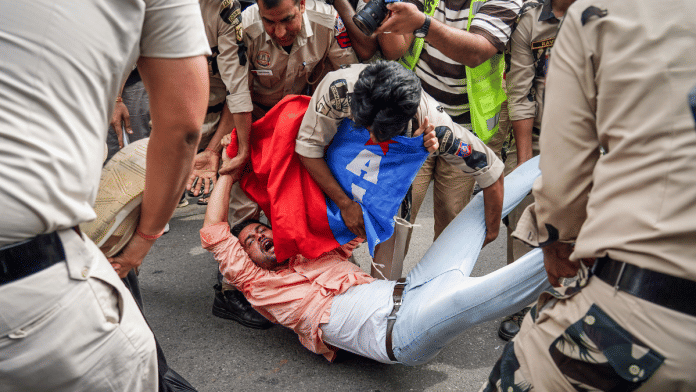
New Delhi: The Ramlila Maidan incident of June 2011, the 2013 case of Punjab Police assaulting a woman in public, the 2023 video showing women being paraded naked in Manipur, the 2026 controversy over a new NCERT social science textbook, and recent rape cases in Delhi. These all illustrate instances in which the Supreme Court initiated proceedings on its own, without any aggrieved person filing a writ petition or a public interest litigation.
The top court has utilised its suo motu (on its own motion) powers under Article 32 of the Constitution to intervene and act in cases of police excesses, human right violations and grave threat to the institution.
However, as Delhi witnessed protests and detentions on 10 October, the SC did not take suo motu cognisance, putting focus on an important constitutional question: when allegations of police excesses and violations of the right to peaceful protest emerge, what determines whether the court intervenes on its own?
In July as well, when Delhi witnessed violence and protests durign the CJP protest seeking the resignation of then Union education minister Dharmendra Pradhan, questions over the court’s suo motu intervention were raised.
Swapnil Tripathi, a constitutional expert, explained to ThePrint that the key systemic concern with the SC’s suo motu jurisdiction is that its exercise is highly discretionary.
Unlike proceedings initiated through ordinary petitions, including PILs, there are no clearly articulated criteria or benchmarks governing when the court should take suo motu cognisance or the scope of such proceedings, he said.
Consequently, he said, if and when the court intervenes remains largely a matter of judicial discretion.
Tripathi, who leads the constitutional law team Charkha at Vidhi Centre for Legal Policy, elaborated on differences that do exist, particularly in how individual judges exercise their suo motu powers.
His DPhil research at the University of Oxford, which examined the Supreme Court’s exercise of suo motu jurisdiction, found “no consistent pattern or clearly identifiable criteria governing” when the court chooses to intervene.
“This shows that the jurisdiction is highly discretionary and inconsistent. Consequently, much depends on the priorities and preferences of the individual judge or Bench hearing the matter,” he said.
Senior advocate Colin Gonsalves, who has extensively litigated human rights matters, argued that the Supreme Court’s suo motu powers could be used not only to address alleged police excesses on 10 October but also to correct what he described as “grave errors” in its own earlier orders concerning the Special Intensive Revision (SIR) of electoral rolls.
Acknowledging that this is a very powerful power of the court, he explained how the court can reverse the track completely if it concludes that a mistake has been made and injustice has been caused. And the only thing is, he said, “they must have reasons, that is to say, they must acknowledge that a huge mistake has been made, and they are correcting it.”
Gonsalves argued that the court could use the same jurisdiction to revisit its earlier orders on the SIR, as “exclusion of large numbers of voters amounted to a grave error”.
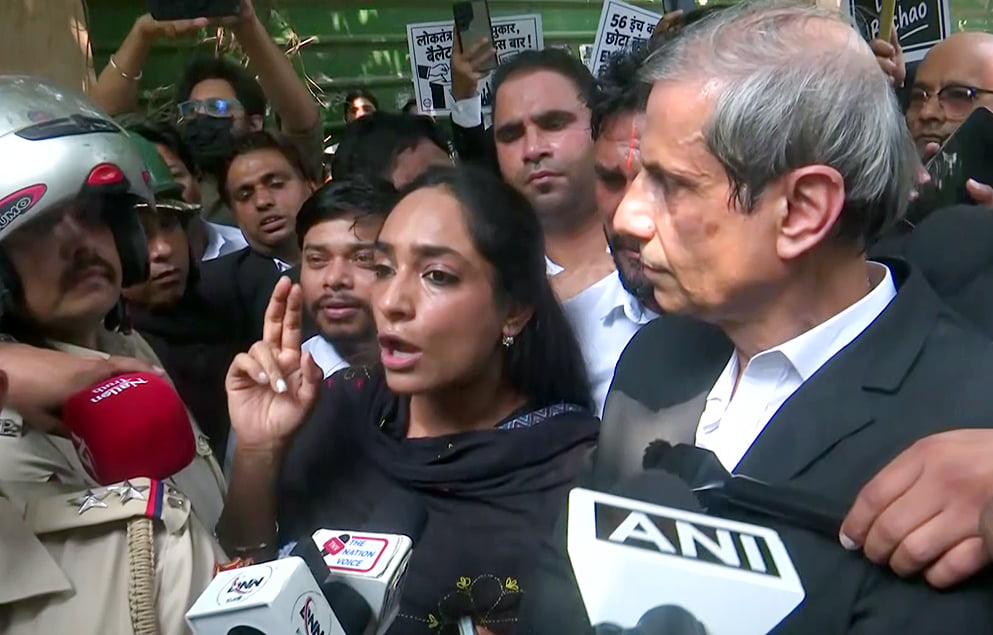
Comparing the situation to the Supreme Court’s decision during the Emergency, when Justice HR Khanna stood apart in defending constitutional liberties, Gonsalves said that here “it is even clearer than the Emergency, that if you can knock off 15-18 lakh persons across the country (in SIR), then you know you’ve made something even more grievous than a blunder”.
“And therefore, if you use your suo motu power, which can only be exercised if you admit as a judge of the Supreme Court that I made a blunder”, he added.
Turning to the protests and police detentions in Delhi, Gonsalves cautioned against treating police excesses as the principal issue, arguing that the focus should remain on the underlying decisions that, in his view, had led to the unrest.
“Police excesses and charges are hardly anything as compared to the huge wrongdoing of excluding lakhs of people”, he said.
Also read: Detained CJP legal head alleges wrongful confinement, moves court amid protests against CEC
How the suo motu jurisdiction originated
The foundation of the top court’s suo motu jurisprudence is the Sunil Batra’s case of 1990 where the SC itself ruled that strict procedural requirements of locus standi (the right to bring an action to court) can be relaxed when human rights are violated. It also established that the Court can act on its own volition or via informal communications to protect fundamental rights under Article 32.
This case was taken up after a letter written by a prisoner detailing the torture of a co-prisoner. Since then, different judges of the top court have at different times taken cases suo motu. And many environmental and social issues have led to the SC passing directions on its own.
The most recent examples are those of Justice JB Pardiwala-led bench taking suo motu cognisance of the recent rape incidents in Delhi. The court issued several practical directions to enhance women’s safety across Delhi-NCR, particularly at night, while making the officers-in-charge personally accountable for their implementation.
Earlier this year, CJI Surya Kant took suo motu cognisance of a controversial section on “corruption in the judiciary” in the NCERT social science textbook for Class 8. Acting on an Indian Express report, the court ordered the withdrawal of physical and digital copies nationwide before closing the proceedings on 1 September 2026, after NCERT clarified the content lacked proper committee approval.
The Supreme Court took suo motu cognisance of attacks on judicial officers in West Bengal during the Special Intensive Revision (SIR) process in April this year, ordering the deployment of central forces and an independent probe.
Past cases of police excesses
A landmark case involving alleged police excesses is the Ramlila Maidan incident of June 2011, when the Delhi Police launched a midnight crackdown to evict Baba Ramdev and thousands of his sleeping supporters from the site of a mass hunger strike against corruption, using tear gas and force.
Taking suo motu cognisance, the Supreme Court severely criticised the police for their “arbitrary and brutal” use of force on a resting assembly without giving them adequate warning or an opportunity to leave peacefully—directing both criminal and disciplinary prosecution against the erring police personnel and officials who exceeded their authority during the operation.
Tripathi also drew a comparison between the SC’s response to the July 2026 protests and the 2011 Ramlila Maidan protests.
Two days after the July 20th violence, he recalled how when the matter was initially mentioned before the Supreme Court, probably to seek suo motu intervention, the chief justice declined, and observed that no petition had been filed. The court subsequently entertained the matter, nearly a week after the incident, once a formal petition was filed, he said.
Contrasting this with the top court’s response to the 2011 case where the court took suo motu cognisance within a day and sought explanations from the authorities concerned, Tripathi said that the contrast “highlights the absence of a consistent approach even in similar cases”.
In July 2023, the Supreme Court took suo motu cognisance after a video showing two women being paraded naked and subjected to sexual violence in Manipur surfaced. The SC described the incident as a serious violation of constitutional and human rights.
In March 2013, the Supreme Court took suo motu cognisance of newspaper reports about Punjab police personnel beating a woman in public and a police lathi-charge on protesting contractual teachers in Patna.
Back to the current case
Drawing a similarity between the suo motu jurisdiction and public interest litigation, Tripathi said he believed that “allegations of police brutality make for a fitting case and failure to intervene risks defeating the very purpose of suo motu jurisdiction”.
It is an important tool in the Indian Supreme Court’s arsenal for protecting fundamental rights and it is important that the jurisdiction continues to serve this purpose, Tripathi concluded.
Gonsalves said the court could exercise its suo motu powers to address allegations of police violence, suggesting that video evidence from journalists, activists and other participants in peaceful protests could be examined by an independent committee of judges.
“On the other injury(the police excesses), the simple thing to do is to direct all journalists and everybody else who participated in all the peaceful agitations to submit their video clips to a committee of judges; and if the video clips show that a particular police officer was using excessive force, terrible harm to people who are non-violent – let their services be terminated under Article 311” – which deals with the dismissal, removal or reduction in rank of persons employed in civil services.
He added that any such inquiry into police conduct should not divert attention from what he considers the more fundamental issue.
To correct this “blunder, the judges must have deep courage to say that they made a blunder – via a suo motu order, say that we made a terrible mistake in allowing this SIR to go on. And we hereby withdraw all orders made and restore the electoral list to what it was prior to SIR,” he said.
“But the question is, do the judges have the conviction? And it requires a lot of conviction, a lot of strength, all of the strength for a judge to say this. And so the question is, will the judge, does the judge have that? And if he does, will he do it?” he told ThePrint.
(Edited by Ajeet Tiwari)
Also read: SC orders restoration of metro, train, internet and movement rights in Sunday special bench hearing